Your big toe is more than a tool for finding bedposts and chair legs in the dark.
The big toe is the only toe significant enough to get its own medical name. It’s dignified with the appellation “hallux”. The other four little piggies have to be satisfied with mere numbers.
When you are upright, your big toe bears half your body weight at key moments. Your big toe also plays an important role in maintaining your balance.
Traumatic injuries or other painful big-toe conditions can destabilize your daily life.

What is the phalanx and MTP joint?
The joint where your big toe meets your foot is called the metatarsophalangeal (MTP) joint. The MTP joint connects the first long bone in your foot (the metatarsal) to the first bone in your big toe (the phalanx).
A lump, big toe bump, pain, or swelling in your MTP joint can signal several conditions that can lead to debilitating problems.
Five conditions that can cause bumps on the big toe (besides furniture)
1. Hallux limitus, also known as big toe arthritis
Hallux limitis is the medical term for the initial stages of arthritis in the MTP joint. Early symptoms of MTP arthritis include limited flexibility in the affected joint, along with swelling, pain, and redness. As arthritis worsens, it progressively breaks down the cartilage that normally cushions the joint.
As the MTP joint becomes increasingly stiff, the appropriate diagnosis is hallux rigidus. At this stage, arthritic bone spurs can cause a sort of Rice Krispies (snap, crackle, and pop) effect.
What is the treatment for big toe arthritis?
Treat big toe arthritis promptly because surgical replacement of the degraded cartilage isn’t yet possible. First-line treatment for big toe arthritis is usually custom orthotic insoles that relieve pressure on the big toe. A cleanup surgery, known as a cheilectomy, removes scar tissue and bone spurs from the joint.
Untreated big toe arthritis can lead to near-total destruction of the MTP joint and may require fusion or replacement.
2. What are bunions?

A bunion (hallux valgus) results from distortion of the MTP joint. Instead of the normal straight-line connection between the metatarsal and the phalanx, the two bones meet at an angle. This causes a protrusion at the base of the big toe.
As the phalanx bends, the big toe itself will move over (or under) the neighboring toe. Friction between the bunion and the inside of the patient’s shoe can cause pain.
Bunions are not as destructive to the MTP as is big toe arthritis. In its initial stages, a bunion is generally considered to be a cosmetic problem. But once discomfort or pain is present, consult a podiatrist to avoid permanent injury. An X-ray is an easy way to see its severity.
Several factors can cause bunions, including genetics, tight shoes, high heels, or a toe box that is too small. They occur in women more than twice as often as in men.
Common symptoms of a bunion
Beyond the visible bump at the base of the big toe, bunions often show up with a cluster of telltale signs. You may notice persistent soreness or a burning sensation along the inner edge of your foot, especially after a long day on your feet. The skin over the bump can become red, swollen, or calloused from constant shoe friction. As the deformity progresses, the big toe may drift noticeably toward the second toe, and you might find it increasingly difficult to bend the joint comfortably. Some patients also experience numbness or stiffness first thing in the morning.
How are bunions diagnosed?
Diagnosis is straightforward. Dr. Bob will examine your foot, assess your range of motion, and ask about your symptoms and footwear history. A weight-bearing X-ray confirms the angle of the joint deviation and helps determine how far the deformity has progressed – information that shapes your tailored treatment plan from the very first visit.
How to treat bunions?
As with big toe arthritis, initial treatment is usually custom orthotics (also known as “shoe inserts”), which prevent the bunion from rubbing against the inside of the patient’s shoe.
The only way to completely and permanently correct a bunion is surgery. However, many nonsurgical treatment options can slow or even halt bunion growth.
Non-surgical options Dr. Bob may recommend include:
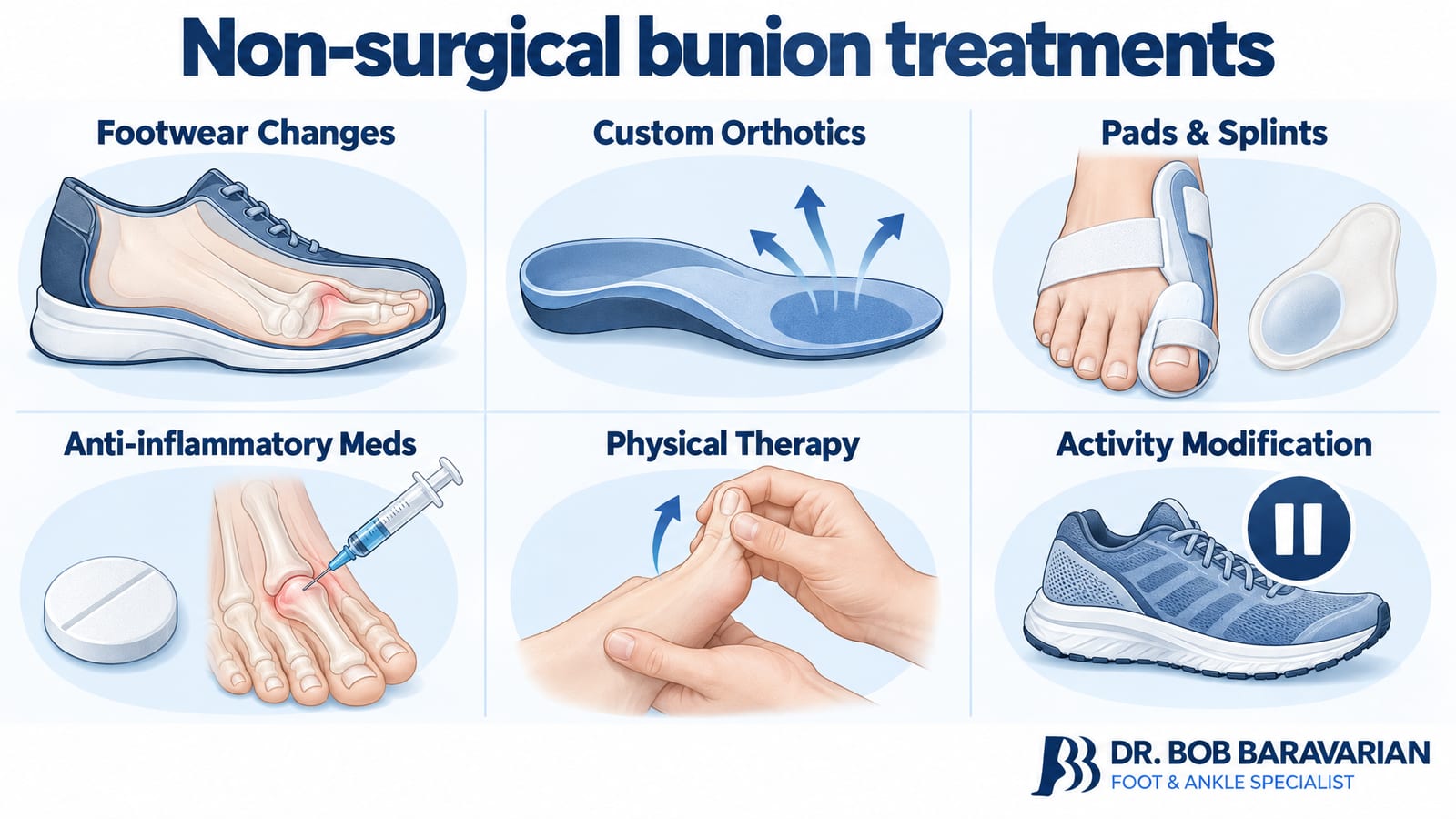
Footwear modifications – switching to wider, lower-heeled shoes with a roomy toe box immediately takes pressure off the joint.
Custom orthotics – personalized shoe inserts redistribute weight away from the bunion and can slow its progression.
Bunion pads and splints – protective padding reduces friction, while night splints gently encourage better toe alignment over time.
Anti-inflammatory medication – oral NSAIDs or a cortisone injection can calm acute flare-ups and reduce swelling.
Physical therapy – targeted stretching and strengthening exercises improve joint mobility and ease surrounding muscle tension.
Activity modification – temporarily avoiding high-impact activities gives inflamed tissue a chance to settle down.
When conservative care is no longer enough, Dr. Bob offers pioneering metal-free bunion surgery – including Lapiplasty 3D Bunion Repair – using bio-integrated hardware that becomes bone over time, so there is no metal to ever remove. Patients consistently report faster healing and less pain than with traditional approaches, and most are walking within days of the procedure.
3. Corns and calluses
Corns and calluses often form on the skin over the MTP joint on the big toe.
Big toe bumps are often a common foot problem called calluses, areas of skin made thick and rough by repetitive friction with a surface like the inside of a badly fitting shoe. They usually form on areas of your foot that bear your weight when you’re walking or running. Calluses are generally painless and relatively easy to eliminate.
Corns are a type of callus, also made of roughened, toughened skin. However, corns often form on top of and between the toes, and they can penetrate under the skin. Corns can be painful and can also lead to infections or skin ulcerations.
How to treat corns and calluses?
Treating corns and calluses involves removing dead skin and addressing the cause of the friction. Badly fitting footwear is often the culprit. Using protective pads can help prevent recurrence. In more severe cases, your podiatrist can provide relief.
Your podiatrist can pare down calluses and remove corns during an office visit.
Your podiatrist can also teach you how to use patches containing salicylic acid.
Orthotics can help alleviate difficult corns and calluses.
Be aware that removing corns and calluses is not a DIY project. Using sharp instruments, like scissors, a nail clipper, or an X-Acto blade, on corns or calluses is far too likely to cause an infection.
4. What is bursitis?

Bursas (or bursae) are small fluid-filled sacs that act as shock absorbers around and between your bones, muscles, tendons, and ligaments. The painful condition, bursitis, generally occurs after trauma or repetitive stress, causing inflammation of the bursa, and it can appear as a big toe bump. When bursitis occurs in your feet, it usually appears in or around your big toe.
How bursitis feels different from other toe bumps
Unlike a bunion – which is a bony structural shift – or a corn, which sits right at the skin’s surface, bursitis tends to feel soft and squishy to the touch. The bump may be warm, slightly red, and noticeably tender even when you’re not putting weight on it. You might also notice the swelling fluctuates: worse after a long day on your feet, a little better after rest. That on-and-off puffiness is a telltale sign that fluid, not bone, is the culprit.
Common symptoms to watch for
A soft, fluid-filled bump near the big toe joint or ball of the foot
Localized warmth and redness around the affected bursa
Pain that worsens with activity and eases with rest
Stiffness or limited range of motion in the toe joint
Discomfort when wearing shoes that press on the area
Treatment
The first step in treating bursitis is, logically enough, avoiding whatever caused the trauma or repetitive stress in the first place. The reliable acronym RICE (rest, ice, elevation, and compression) will help, as will anti-inflammatory agents like ibuprofen.
Switching to wider, lower-heeled shoes that don’t crowd the toe box can also take meaningful pressure off an inflamed bursa. Cushioned insoles or custom orthotics help redistribute load away from the irritated area, giving it the breathing room it needs to calm down.
If the condition persists, see your podiatrist, who may administer corticosteroids, provide physical therapy, or, in extreme cases, perform surgery.
5. What is gout?
Swelling, redness, and pain in and around an MTP joint can also indicate gout. Gout is a type of arthritis caused by a buildup of uric acid in the bloodstream.
Uric acid is a natural product of normal food digestion, and the kidneys generally dispose of any excess. When the kidneys can’t keep up, gout can ensue.
What causes gout?
Overabundant uric acid precipitates into needle-sharp crystals, which usually collect in the MTP joint. Why there? Well, uric acid solidifies at lower temperatures. The coolest temperatures in your body are usually in your feet because they’re farthest from your warm heart.
Gout can be exceedingly painful. The MTP joint swells, turns red, and feels hot. Even the slightest touch can be agonizing.
Gout was once called the disease of kings. It was associated with menus only royalty could afford, like marbled red meat, shellfish, organ meats, fine wines, and lots of liquor. Now practically anyone can afford a gout-producing lifestyle.
What is the treatment for gout?
Gout treatment starts with lifestyle changes. A healthy diet and increased exercise are powerful long-term remedies.
In the short term, medications that address acute gout attacks and also prevent future attacks include:
Nonsteroidal anti-inflammatory drugs (NSAIDs), such as ibuprofen and naproxen sodium.
Colchicine, a pain reliever that is more specific to gout. However, colchicine is often accompanied by significant side effects, such as nausea, vomiting, and diarrhea.
Corticosteroids, like prednisone. But corticosteroids have their own set of unpleasant side effects.
Your doctor may also prescribe medications that reduce your uric acid production or help your kidneys clear excess uric acid.
Other causes of bumps on the toes
Gout, bunions, and bursitis get a lot of attention – and for good reason – but they’re far from the only things that can create a bump on your toe. Here are a few more culprits worth knowing about:
Hammertoes. When the middle joint of a toe bends downward and gets stuck in that position, it creates a raised knuckle that can rub painfully against your shoe. That friction often leads to a corn or callus forming right on top of the bump, which makes the whole situation even more uncomfortable. Hammertoes can worsen over time if left untreated, so it’s best to get them checked out early.
Ganglion cysts. These are fluid-filled sacs that can pop up along a joint or tendon. They’re usually soft and squishy and can appear seemingly out of nowhere. While they’re almost always benign, they can cause pressure and discomfort depending on where they sit on your foot or toe.
Plantar warts. Caused by the human papillomavirus (HPV), plantar warts can develop on the toes and the bottom of the foot. They often look like a small, rough bump with tiny dark dots in the center. A word of caution here: please don’t try to cut or shave them off at home – that’s a fast track to infection and rarely solves the problem.
Ingrown toenails. When a toenail grows into the surrounding skin, the resulting swelling and inflammation can create a tender, red bump along the side of the toe. If you notice signs of infection – warmth, pus, or spreading redness – it’s time to see a specialist. You can learn more about common causes of foot pain that often go hand in hand with these conditions.
When should you see a doctor about a bump in your toe?
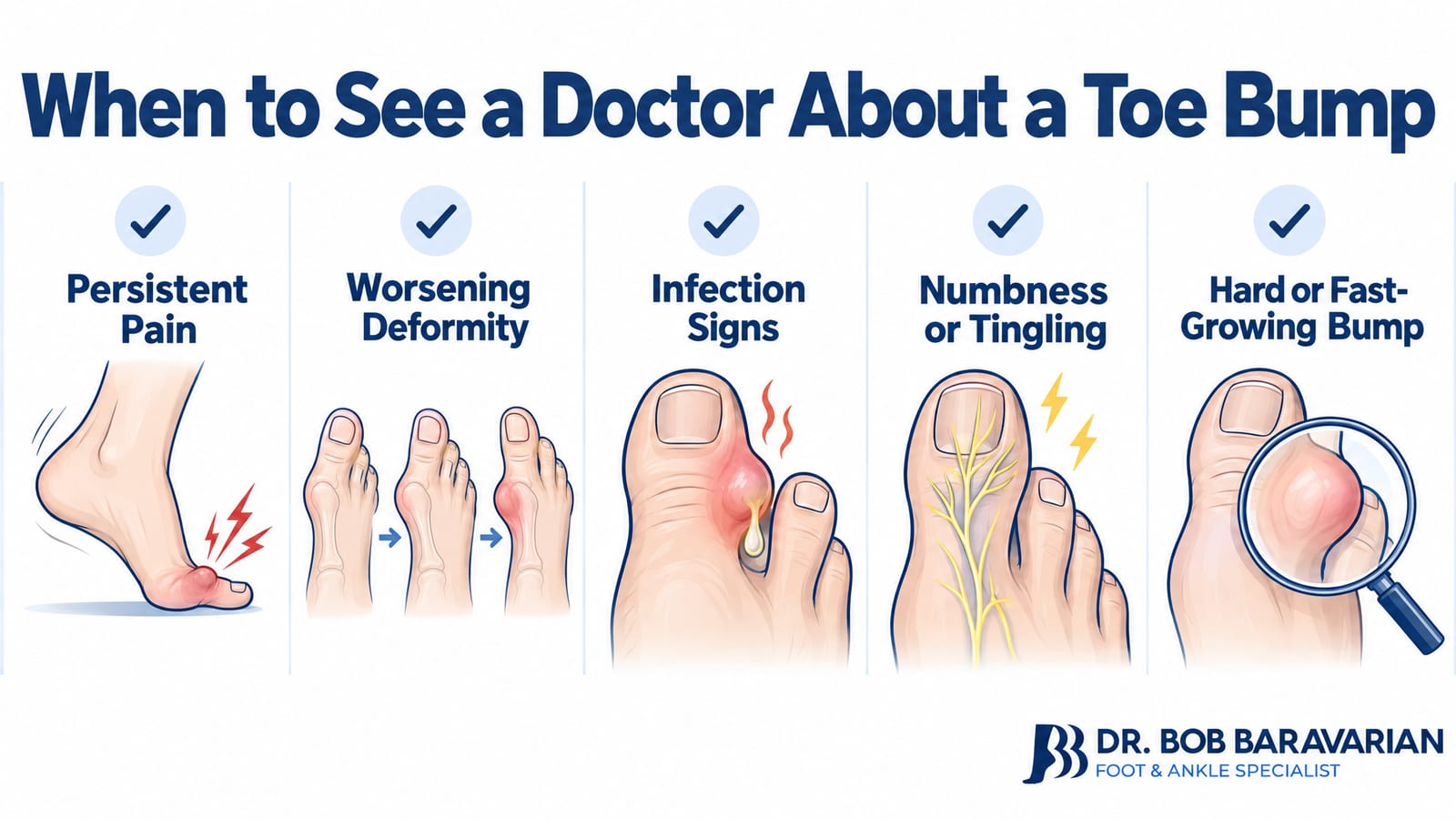
Most bumps on the toe start out as a minor annoyance – something you notice when you pull on your shoes but quickly forget about. The tricky part is knowing when that bump deserves more than a shrug. Here are some clear signals that it’s time to stop waiting and book an appointment.
Pain that won’t quit. If the bump in your toe is consistently painful – especially during everyday activities like walking, standing, or climbing stairs – that’s your body asking for help. Discomfort that lingers for more than a couple of weeks rarely resolves on its own.
A deformity that’s getting worse. Conditions like bunions and hallux limitus tend to progress over time. If you notice your toe drifting, stiffening, or the bump visibly growing, earlier intervention almost always means simpler treatment.
Signs of infection. Redness, warmth, swelling, or any discharge around the bump are red flags that need prompt attention. This is especially true if you have diabetes, since even a small foot issue can escalate quickly – check out our guide on urgent foot care for more detail.
Numbness or tingling. Nerve involvement changes the picture entirely and warrants a professional evaluation sooner rather than later.
The bump is hard, fast-growing, or unusual-looking. While most toe bumps are benign, any growth that feels firm, changes rapidly, or looks different from a typical corn or bunion should be assessed to rule out anything more serious.
When in doubt, a personalized evaluation from a specialist gives you real answers – and a tailored treatment plan built around your specific situation.
How to prevent bumps on your toes
While not every bump on your toe is preventable – gout has a strong genetic component, and some people are simply born with foot structures that make bunions more likely – there’s quite a lot you can do to lower your risk and slow the progression of many common toe conditions.
Start with your shoes. Footwear is probably the biggest factor you can control. Shoes that are too narrow, too short, or have a steep heel push your toes into unnatural positions day after day. Look for a wide toe box that lets your toes spread naturally, and keep heel height reasonable – ideally under two inches for everyday wear. If you’re a runner, check out our guide on how to break in running shoes to avoid unnecessary friction and pressure that can lead to corns and calluses.
Beyond footwear, these habits make a real difference:
Moisturize regularly. Dry, cracked skin is more prone to callus buildup. A simple daily moisturizer keeps skin supple and reduces friction.
Maintain a healthy weight. Extra body weight increases pressure on the forefoot with every step, accelerating joint wear and inflammation.
Stretch and strengthen. Toe stretches, calf raises, and foot mobility exercises help keep joints flexible and tendons happy.
Watch your diet. If you’re prone to gout, limiting purine-rich foods and staying well hydrated can significantly reduce flare-up frequency.
Get your feet checked early. Small deformities caught early are far easier to manage – and far less likely to need surgery down the road.
Think of prevention as an investment. A little attention now can save you a lot of pain – and a lot of treatment – later.
Why choose Dr. Bob Baravarian for your foot and ankle care?
If you’re experiencing foot problems, including any type of big toe bumps, Dr. Bob is here to help. As a nationally recognized foot and ankle specialist, he provides advanced podiatric care with some of the nation’s highest success rates and leads research and treatment for all foot and ankle conditions.
To schedule a consultation, please call (855) 557-5400 or make an appointment now.
Dr. Bob Baravarian is conveniently located in Los Angeles, near Cedars-Sinai Medical Center, providing expert foot and ankle care for patients throughout Southern California.