So you have a bunion, and you are considering surgery. That’s great, but how do you know which surgeon is the best for you?
Of course, there is no perfect answer. However, after 20 years of caring for patients with foot and ankle ailments and refining my skills, I have developed what I believe is the ideal bunion surgeon. This doesn’t mean one doctor is perfect for everyone, just as a Rolls-Royce isn’t the perfect car for everyone.
Some critical things your surgeon should be well-versed in are non-negotiable; others are personal preferences. I’ll explain this further. My idea for writing this paper is not to entice you to come to me. I am in Los Angeles, and many of you will be in other areas of the country and may not have access to me. The goal is to help each patient find the bunion surgeon who is perfect for them, hopefully in their local region.
What’s critical for your surgeon, and what must you consider?
First and foremost, does your surgeon have any medical board issues or medical-legal cases against them? Although some can be minor, I would steer clear of any significant issues. You can check this on your local medical board’s website.

Most surgeons have multiple hospital privileges, and hospitals ask good surgeons to join for their expertise.
Second, does your surgeon have hospital privileges or only surgery center or office privileges? If a surgeon does not have hospital privileges, it’s a problem on many fronts, even if your operation is outpatient in a surgery center. One concern is that they cannot admit you if there is a problem, and you may lose continuity of care if you have to go to a hospital.
A surgeon without hospital privileges is just strange. Most surgeons have privileges at multiple hospitals, and hospitals ask good surgeons to join for their expertise.
Finally, be careful with office bunion surgery. An office bunionectomy is just not good. The equipment, cleanliness, level of care, and patient protection must match a surgery center or hospital, so be warned.
Other things to think about
Board-qualified or board certification is a great thing. The best board and most prestigious is the American College of Foot and Ankle Surgeons (ACFAS). It is hard to get accepted; you have to do a fair amount of surgery, and there is rigorous testing. If your surgeon is part of ACFAS, that’s good, but it’s not always a standalone seal of approval. Be warned that there are a lot of little boards, so don’t be fooled.
ACFAS is the most solid recommendation for surgeons. What about board-qualified? That means a surgeon has finished residency and possibly a fellowship, but has not been fully accepted into ACFAS. They still must submit cases for full status.
Board-qualified surgeons are still great, but they are just young. Not always bad, but still something to consider.
Now that you have a board-certified ACFAS surgeon, let’s talk bunion surgery details
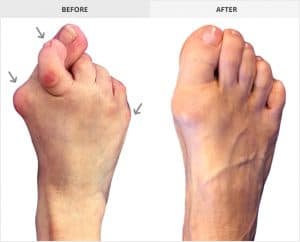
First, ask to see their before-and-after surgery pictures.
There are over 50 ways to correct a bunion, so how do you know what is right for you? Good surgeons usually want people to know they are good. They have before-and-after pictures of their surgeries, including X-rays and healed foot images.
It’s like any other specialist in any other field. Who wants to hide their work? No one. Ask to see images, or go to the surgeon’s website to see their work. See if they are on social media and have posted any images. This is the artistic side of medicine and important to review.
One procedure is not right for every patient. A good surgeon can determine the type of bunion you have and develop a precise, detailed procedure for your needs.
It is not just a bunion; it is far more complicated
It includes your entire foot position, how loose your bunion is, if you have arthritis, if you have cartilage rotation, and if you have an abnormal rotation of the toe. Each of these issues must be addressed, and I suggest you ask your surgeon about each one and see how they respond. If they really get it, answering these questions is easy, and the surgery you need should never be cookie-cutter.
Is the surgeon’s experience more important than their age?
Experience matters, a lot. It is the most important thing to consider when picking a surgeon. But a surgeon’s age alone isn’t a huge issue in my opinion.
In my prior practice, I hired a surgeon who had recently completed his fellowship, and he was an absolute rock star. He had great surgical hands, a great bedside manner, and was very talented in selecting the right procedures for each patient. What I loved was that he was humble enough to ask the older guys in the group for their thoughts. It reassured us and was great for the patient.
So if you see a younger doctor who is board-qualified, has done an extensive surgical residency and maybe a fellowship or additional training, and has a great bedside manner, don’t assume they’re not good. That being said, the ideal age for a surgeon is about 10-20 years out from residency. The first 10 years are learning years. You may have great hands and a great bedside manner, but you haven’t seen the complications and problems, so you may not know how to deal with them.
From year 10 to year 20 of being a surgeon, you’re really in your element. You’ve seen the good, the bad, and the ugly, and dealt with it. You’ve turned away patients who will not do well with surgery and have done enough surgery to really know what works for each patient. From 20 years out, you’re at your peak.
After age 65, which is about 35-40 years out from residency, you may have a great doctor with a great bedside manner who really knows his stuff. But if he doesn’t keep up with the latest techniques and the state-of-the-art technologies, there could be a problem. They can still be good doctors, but they may no longer be great surgeons.
Face time with a surgeon is important, but it’s not the end-all be-all in getting great results

A surgeon needs to be considerate, kind, courteous, and make sure to answer your questions.
A good surgeon can listen to and examine a patient for a few minutes and realize what is necessary. It becomes second nature over 10-20 years. That being said, a surgeon needs to be considerate, kind, courteous, and make sure to answer your questions.
A great surgeon who disappears after surgery is a no-no. I suggest you ask about the post-operative care regimen and make sure you are okay with it. Some surgeons will pass you off to an assistant, and you may never see them again. This is not something I like or am okay with.
Remember, you need your surgeon the most when things are NOT going well. They must be there for you. As long as a surgeon answers your questions, makes you feel secure, knows what he is talking about, and isn’t dismissive, you have a good start. If they’ll be there for you if an issue comes up, you have a great start. If they offer you their email or cell phone after surgery, you are in great shape.
Make sure you are in a clean office that feels comfortable
This will be your home for a while. If the surgeon’s office offers physical therapy, it’s even better. Then you have great care in a single location, with the surgeon aware of the post-operative care from start to finish.
Either like the doctor or find another. I don’t get along with every character that comes into my office. I am fairly laid back and not very formal. Patients call me Dr. Bob. Some patients find this rude and don’t want to see me. I accept that personalities will blend or not blend.
Find a surgeon who fits your style and personality. Do your homework and educate yourself. You don’t get on a plane and go on a trip without doing some homework on the airline, hotel, restaurants, and places to visit, but you will blindly have surgery. Do your homework.
I’m Dr. Bob Baravarian, here to keep you moving pain-free
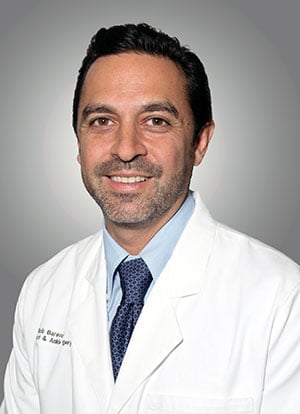
I’m Dr. Bob Baravarian, a foot and ankle specialist dedicated to providing personalized care for each of my patients. I perform a variety of bunion surgeries, tailoring each procedure to meet the specific needs of the person I’m treating. From your first consultation to surgery scheduling, billing, and physical therapy, I coordinate all aspects of care in-house to make the process as smooth and convenient as possible.
With extensive training, including specialized fellowships, I bring deep expertise to every procedure. Beyond my surgical skills, I strive to be approachable, attentive, and committed to helping my patients achieve the best possible outcomes for their foot and ankle health.
To schedule a consultation, please call (855) 557-5400 or make an appointment now.
Dr. Bob Baravarian is conveniently located in Los Angeles, near Cedars-Sinai Medical Center, providing expert foot and ankle care for patients throughout Southern California.