I have been operating on feet and ankles for more than 25 years. Often, I can guess a patient’s age from their X-ray before I even open their chart.
That’s because our overall foot health changes as we get older. And this is particularly true for patients managing systemic conditions like diabetes that lead to poor blood circulation and slow-healing sores.
That is not a scare tactic; it is just anatomy. The cushioning thins, the alignment drifts, and the tendons holding your arch up eventually get tired.
Here’s the part nobody tells you at 60: experienced feet doctors like myself can help you with almost all of your foot problems—from common issues like calluses, warts, fungal infections, ingrown toenails, foot ulcers, and recurring blisters (check out more information in my blog) to more serious issues such as plantar fasciitis, bunions, and hammer toes.
This article is going to focus on the more serious issues. So, if your feet could use some TLC, read on.

As you age, your feet lose their built-in cushioning
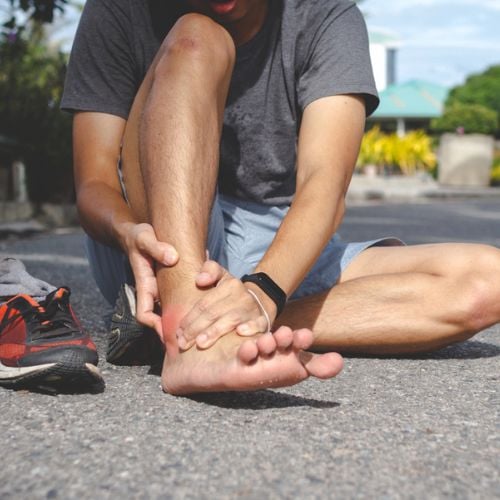
When you walk, does it feel like you have a bruise that never heals or a pebble in your shoe that you can never find? Is it worse barefoot and better in a cushioned sneaker?
This is most likely due to age-related changes in the plantar fat pads under your heels and balls of your feet. As we age, these pads thin out and slide forward. So, when you’re in the shoes that carried you comfortably through your 40s, you suddenly feel like you’re standing on hardwood.
My first moves here are unglamorous, but they work:
- a properly built custom orthotic.
- supportive shoes with real cushioning and wide toe boxes.
- applying daily moisturizer to treat dry skin and prevent cracked heels.
- getting you out of the habit of walking barefoot on hard floors at home.
The American Academy of Orthopedic Surgeons (AAOS) has sensible guidance on arch support, shoe fit, and foot problems, and I agree with nearly all of it.
And when your foot’s padding is genuinely gone, we can rebuild it. Leneva, an injectable allograft adipose matrix, restores volume under the ball of your foot to relieve foot pain, so you are not walking on bare bone. It is an in-office injection, and for the right patient, it changes daily activities.
Bunions and hammertoes finally catch up with you
Bunions are not caused by aging, but they are progressive, and 30 or 40 years is plenty of time for a small drift to become a real deformity. The big toe angles toward the second toe, the metatarsophalangeal joint enlarges as bone spurs develop, and the lesser toes buckle to make room for it.
Then patients reach their 60s and get told to just live with it, usually because someone decided surgery is too much for an older foot.
That advice is outdated.
It is based on how foot and ankle surgery, including bunion surgery, used to be done. Today, even older feet can have corrective surgery with my Metal-Free Ghost Surgery System.
Why did I stop using metal screws and plates in almost all my foot and ankle surgeries?
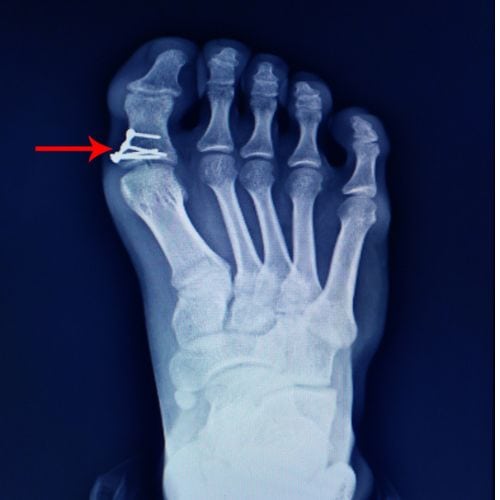
Traditional bunion and hammertoe correction surgery relies on metal hardware—screws, plates, and pins to hold your bone while it heals.
The good news is that metal was the great advance of 50 years ago, and it does work.
The bad news is that it also stays in you forever. It can loosen, back out, cause aches for some patients in cold weather, and complicate imaging. And because of these negative side effects, a significant percentage of patients need a second operation to take their metal hardware out.
That is a poor trade-off at any age. It is a worse trade-off at 65, because you may be far more likely to need an MRI of that foot or that leg along the way. And a second surgery to remove metal hardware is simply more difficult the older you get.
What was my solution?
I developed the Metal-Free Ghost Surgery System. Instead of metal, we fix bone with bio-integrative fiber implants, primarily OSSIOfiber. It’s as strong as metal. However, it doesn’t hang around like metal does.
Over roughly two years, this fiber material integrates with your own bone and becomes indistinguishable from it. That disappearing act is where the “Ghost” part of the name comes from. When your healing is finished, there is nothing left in your foot but bone.
What does metal-free bunion correction look like?
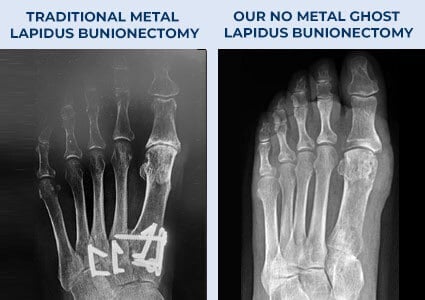
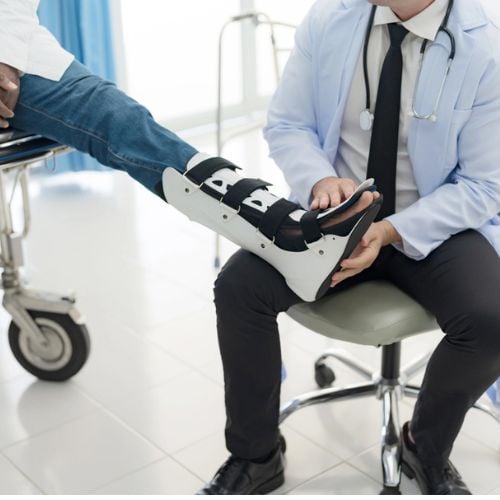
We realign your bone at the level of the deformity, hold the correction with fiber hardware, and you walk out the same day in a surgical boot. Most of my patients are back in well-fitting shoes in four to six weeks rather than the two to three months traditional metal hardware often demands.
There is no hardware to remove later: no screws, no plates you can feel through thin skin on top of the foot, and nothing to set off a metal detector or cloud a future scan.
If you want to see the results for yourself, click here to see our before-and-after bunion surgery photos from actual patients.
Hammertoe surgery is better without having a pin sticking out of your toe
Many patients decide to correct their hammertoe when the severe friction causes painful corns and calluses. Traditionally, this meant driving a metal pin through the tip of the toe, leaving it protruding (sticking out) and taped down for weeks until we pull it out in the office.
Patients hate that, and they are right to.
Our metal-free hammertoe correction uses a small, bio-integrative implant inside the toe instead. Nothing protrudes, nothing gets yanked out at a follow-up visit, and nothing permanent stays behind in bone that is already small and delicate.
If you want the background on the deformity itself, the AAOS overview of hammer toe covers the mechanics well.
Your arch can collapse in your 60s even if it never did before

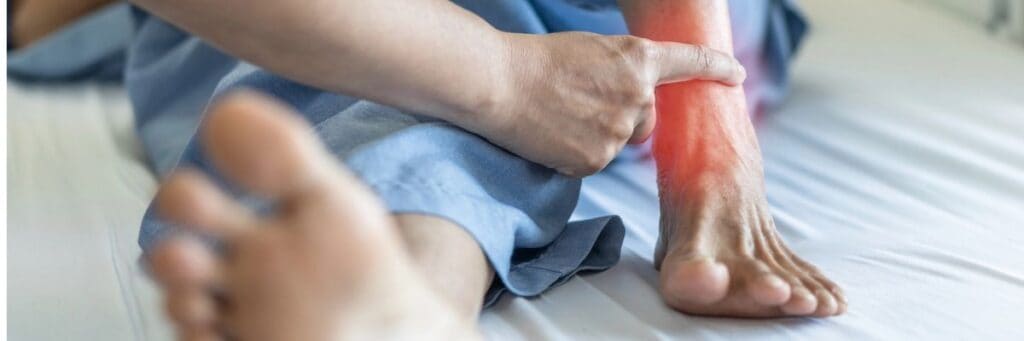
Your posterior tibial tendon connects the muscle in your lower leg to your foot. This tendon runs behind the bone on the inside of your ankle. Its job is to hold your arch up. It is a workhorse, and it commonly wears out in our 50’s or 60’s.
The result is called posterior tibial tendon dysfunction. It begins as a vague ache along the inside of the ankle. If ignored, it ends as a flat, stiff, painful foot that no shoe makes comfortable.
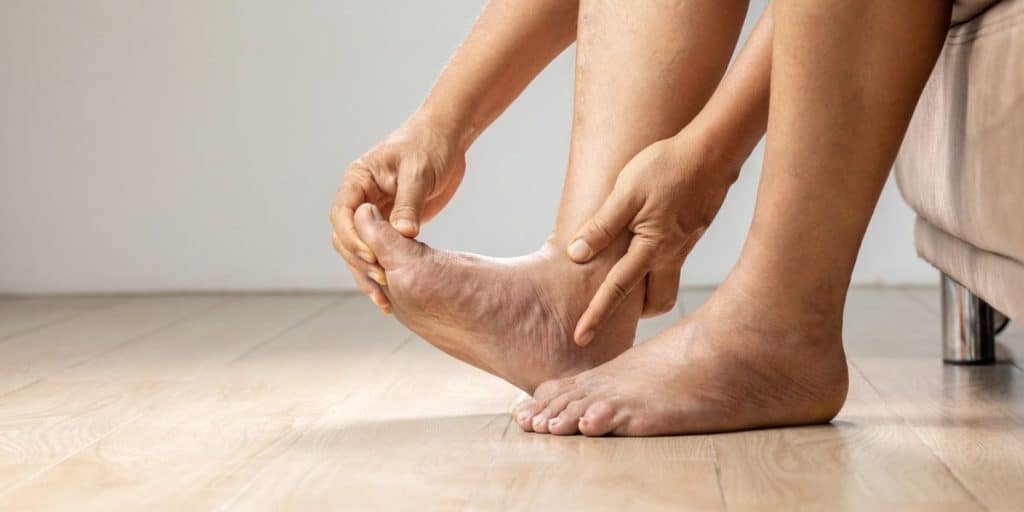
Big toe arthritis and progressive nerve damage (like peripheral neuropathy causing numbness) follow a similar arc. The joint stiffens, push-off hurts, and you quietly start walking on the outside of your foot to avoid it.
When either problem needs correction, we can usually rebuild the arch or resurface the joint using the same non-metal, bio-integrated plates and screws. In this way, you are not trading one long-term problem for another.
Our hallux rigidus and flat foot reconstruction options are often available metal-free as well.
When should you see a foot doctor?
As a result of my professional expertise and experience, I push people not to wait, whether that means starting targeted physical therapy or exploring surgical corrections. How your foot feels determines how you walk, and how you walk determines how steady you are. More than one in four adults aged 65 and older falls each year, making mobility a primary concern for older adults. A painful foot that shortens your stride is a fall risk you can genuinely do something about.
Do not let your feet decide what you say “yes” to in your later years!
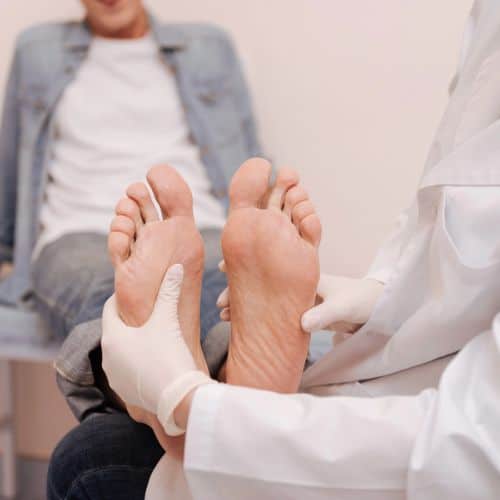
If you are choosing shoes, routes, and invitations around your aching feet, scheduling a comprehensive foot exam is worth an appointment rather than a shrug. I treat patients who fly in from across the country for metal-free foot and ankle correction, and my team helps coordinate travel. Call (855) 557-5400 or request your appointment online at docsfootankle.com.
Dr. Bob Baravarian, the best choice for foot and ankle care in Los Angeles

When you choose Dr. Bob Baravarian, you will quickly discover that you have chosen a compassionate healthcare expert with decades of experience. He uses state-of-the-art equipment, works directly with medical manufacturers to develop new technologies, and is one of the few foot and ankle practices in the nation that offer the latest treatment options.
To schedule a consultation, please call (855) 557-5400 or make an appointment now.
Dr. Bob Baravarian is conveniently located in Los Angeles, near Cedars-Sinai Medical Center, providing expert foot and ankle care for patients throughout Southern California.
FAQs
Can you fix bunions and hammertoes at the same time?

Yes. I frequently correct a bunion and hammertoes in the same surgery because they often show up as one problem across several toes.