Dr. Bob discusses ankle instability and the InternalBrace treatment.
Why choose Dr. Bob Baravarian for chronic ankle instability treatment?
Ankle ligament injuries and instability are complex orthopedic problems because multiple ligaments can play a role. At Docs Foot Ankle, you benefit from the unparalleled expertise of Los Angeles foot and ankle surgeon Dr. Bob Baravarian. Nationally recognized for perfecting ankle instability care, Dr. Baravarian has successfully treated over 20,000 patients and performed thousands of successful surgeries.
His approach prioritizes advanced regenerative therapies, such as stem cell injections, to strengthen ligaments and help patients avoid surgery whenever possible. For those requiring surgical intervention, his extensive experience ensures the most effective and lasting results, restoring stability and confidence.
What is ankle instability?
Briefly, ankle stability means the amount your ankle can stay in place during movement. Ankle instability is when your ankle joint repeatedly “gives way”. This is due to ligament laxity. In other words, weakened ligaments that no longer support your normal range of motion. The results are persistent ankle pain and reduced function.
Often, ligament laxity results from multiple ankle injuries. These injuries allow the talus bone to shift abnormally beneath the tibia and fibula. This affects your balance and increases your injury risk.
Up to 70 percent of individuals who suffer an acute ankle sprain develop chronic instability when ligaments fail to heal fully.
What are chronic ankle instability symptoms?
Patients with unstable ankles commonly experience:
- Pain along the outer ankle during weight-bearing activities.
- Swelling or tenderness at the ligament attachment sites.
- A sensation of looseness or “rolling” with lateral movements (lateral ankle instability).
- Stiffness and reduced range of motion after periods of inactivity.
- Repeated ankle sprains, even with minor impacts.
These signs indicate compromised structural support and should be checked out via clinical evaluation.
How is ankle instability diagnosed?
Your foot care specialist will combine a focused physical examination, imaging studies, and functional stress tests. Together, these results will confirm (or deny) whether your ligaments are weakened (or not). Tools such as the following will help your specialist to make their diagnosis:
Patient history review
Patient history documents the frequency and context of recurrent ankle sprains to guide treatment.
Manual tests
Tests such as the anterior drawer test and talar tilt assess ligament laxity.
Radiographs
X-rays rule out fractures or malalignment.
MRI (Magnetic Resonance Imaging)
An MRI visualizes ligament tears, cartilage damage, and soft-tissue changes.
Ultrasound study
An ultrasound evaluates real-time ligament integrity and dynamic stability.
It is essential to carry out a comprehensive assessment to pinpoint the exact issue and create the optimal management plan.
Dr. Bob Baravarian knows how to do this. Nationally recognized for perfecting ankle instability care, Dr. Baravarian has successfully treated well over 20,000 patients and performed thousands of successful surgeries.
What non-surgical treatments are effective for ankle instability?
Before considering surgery, many patients find relief through conservative care. Dr. Baravarian often recommends one or more of the following approaches:
Physical therapy
A customized physical therapy program helps strengthen the ankle muscles and retrain balance (proprioception). Proprioceptive training not only improves stability but also reduces the risk of future sprains.
Ankle bracing and orthotics
Supportive devices, such as ankle braces or custom orthotics, provide external stability while properly aligning the foot. These tools help reduce ligament strain and prevent the ankle from “rolling.”
RICE protocol and anti-inflammatory medication
The combination of rest, ice, compression, and elevation (RICE) along with non-steroidal anti-inflammatory drugs (NSAIDs) helps control inflammation and pain. This approach supports early healing and enables patients to return to their activities more comfortably.
Regenerative therapies
In addition to standard therapies, Dr. Bob specializes in using advanced regenerative treatments such as stem cell injections to strengthen ligaments. These innovative options can often restore stability and reduce pain, helping many patients avoid surgery altogether.
When should you consider surgery for chronic ankle instability?
Surgical referral is appropriate when all the following criteria are met:
- Persistent instability after at least 6 months of targeted physical therapy.
- Recurrent sprains can interfere with daily activities or participation in competitive sports.
- Documented ligament tears or significant laxity on imaging.
- Failed bracing or orthotic support to control instability.
Meeting these conditions indicates that surgical repair may be the most reliable option for achieving permanent joint stability.
What are the chronic ankle instability surgical procedures?
The Brostrom procedure
The Brostrom procedure repairs and tightens the lateral ankle ligaments by reattaching torn fibers and reinforcing the ligament complex. Watch a video about this procedure here. This anatomical repair:
- Restores tension in the anterior talofibular and calcaneofibular ligaments.
- Reestablishes normal joint kinematics and neurosensory feedback.
- Reduces excessive inversion by tightening the lateral joint capsule.
By reinforcing the ankle’s natural stabilizers, the Brostrom repair significantly decreases recurrent sprains without major alteration of anatomy.
InternalBrace procedure for ankle instability
The InternalBrace procedure is an advanced surgical technique designed to augment (increase) and reinforce primary ligament repairs, particularly in cases of chronic ankle instability.
Unlike traditional ankle ligament reconstruction, InternalBrace doesn’t replace your natural ligaments. Instead, it uses a strong, biocompatible FiberTape® to act as an internal “seatbelt.” This taping supports and protects the repaired ligaments while they heal.
Key benefits of the InternalBrace procedure include:
- Enhanced Stability: Provides immediate and robust reinforcement to the repaired ligaments.
- Reduced Re-injury Risk: Offers superior protection against future sprained ankles.
- Faster Recovery: Often allows for an earlier return to activity compared to conventional methods.
- Minimally Invasive: Performed with a less invasive approach, reducing tissue disruption.
Surgeons typically combine this technique with a modified Brostrom procedure. First, they repair the damaged ligaments. Then, they apply the InternalBrace to provide additional strength and support, ensuring a more durable and stable ankle joint.
What should patients expect during recovery?
Recovery timelines for ankle instability surgery can vary depending on the patient. While a return to normal activities for Dr. Bob’s patients typically occurs around 10-12 weeks, and high-impact activities can be resumed around 16 weeks.
You can expect a structured plan as follows:
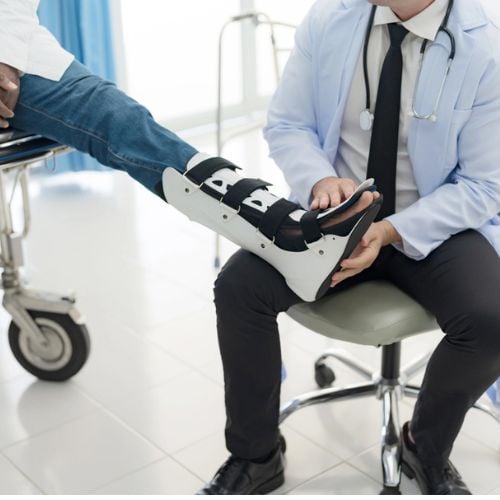
- Four to six weeks of Immobilization: A cast or boot is used to protect the repair.
- Three weeks of Early Rehabilitation: Once your cast or boot is removed, your physical therapist will guide you in gentle range-of-motion exercises.
- Eight weeks of Functional Therapy: Now that your range of motion is back on track, your physical therapist will help you improve your strength and balance/proprioception.
How does Docs Foot Ankle provide specialized care for ankle instability?
At Docs Foot Ankle, Dr. Bob Baravarian integrates advanced diagnostic tools, evidence-based therapies, and personalized surgical techniques to deliver superior outcomes. With extensive experience in treating complex ankle conditions, the practice offers:
- State-of-the-art imaging for precise ligament assessment.
- Customized rehabilitation plans that incorporate the latest proprioceptive (kinesthetic) training methods.
- Minimally invasive surgical options to reduce recovery time.
- Compassionate patient education and ongoing support to empower informed care decisions.
Dr. Baravarian’s patient-centered model maximizes stability restoration and long-term joint health.
Dr. Bob Baravarian is conveniently located in Los Angeles, near Cedars-Sinai Medical Center, providing expert foot and ankle care for patients throughout Southern California.
Chronic ankle instability FAQs
What does ankle instability feel like?

Ankle instability typically feels like a sudden “giving way” or rolling sensation. It is often accompanied by sharp pain on the outer ankle and rapid swelling. This occurs when ligaments fail to stabilize the joint during uneven footing or lateral movements.
Can ankle instability heal without surgery?
Mild to moderate instability can improve with dedicated physical therapy, bracing, and orthotic support, restoring strength and proprioception over several months. However, chronic cases with significant ligament tears often require surgical intervention for lasting stability.
What are the long-term effects of untreated ankle instability?
When left unaddressed, ongoing instability can lead to:
- Accelerated cartilage wear which increases the risk of osteoarthritis in the ankle joint.
- Tendon dysfunction from compensatory movement patterns, causing peroneal tendon irritation.
- Chronic pain that limits mobility and diminishes quality of life.
- Progressive balance deficits affect overall musculoskeletal health and increase fall risk.
Timely management preserves joint integrity and prevents these debilitating outcomes.
What is the best exercise for ankle instability?
Single-leg balance exercises on an unstable surface—such as a wobble board—are among the most effective for addressing ankle instability. These exercises enhance proprioceptive feedback, recruit stabilizing muscles, and reduce the risk of future sprains by improving neuromuscular coordination.
Is ankle instability a serious condition?
Yes, untreated ankle instability poses a serious risk of chronic pain, accelerated joint degeneration, tendon injuries, and impaired balance that can limit athletic participation and daily activities. Early diagnosis and appropriate management are essential to prevent long-term complications.
Recovery and prevention strategies build enduring stability, enabling you to return to the activities you enjoy with confidence and support long-term ankle health.
How common is ankle instability?
Ankle instability affects approximately 25 percent of people who have sprained an ankle, with prevalence rising to over 50 percent among high-impact athletes in sports like basketball and soccer.