Hi, I’m Dr. Bob Baravarian. I’m a board-certified podiatrist and foot and ankle surgeon in Los Angeles, and over the past 25 years I’ve performed more than 20,000 bunion surgeries. Patients fly in to see me from Texas, New York, Florida, and just about everywhere in between, and nearly every one of them asks me the same question before we schedule anything.
“How long until I feel completely normal again?”
This guide is my answer. I’ll walk you through recovery one week at a time, providing a detailed bunion surgery recovery timeline, and I’ll show you two timelines side by side: the metal-free surgical hardware approach I use in about 90% of my surgeries, and the traditional metal hardware approach most surgeons still use. The difference is bigger than most people expect.
Why the hardware inside your foot changes everything
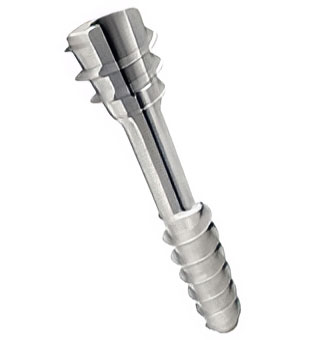
Screws
When a surgeon corrects a bunion, they move a bone into a better position and then hold it there while it heals. Something has to do the holding. For decades, that something was metal: steel or titanium screws, pins, and plates.
Metal works. But it stays in your foot for the rest of your life, and your body never fully stops noticing it. Some patients feel it ache in cold weather. Some feel it press against the inside of a shoe. And a meaningful number eventually need a second operation just to remove the hardware.
I do it differently. My Metal-Free Ghost Surgery System uses OSSIOfiber bio-integrative implants, which are built from natural mineral fibers woven into a matrix and combined with a medical-grade polymer. They’re as strong as metal. Then something remarkable happens: your bone grows into the non-metal hardware and slowly replaces it with your own bone. Within about two years, the non-metal surgical screws, nails and/or staples integrate, so what’s left behind is your own bone.
What non-metal foot and ankle surgery actually means for you
Let’s start with less inflammation, because there’s no permanent foreign object for your immune system to argue with. Less swelling and less pain during the weeks when it matters most. No beeping at airport security, no complications with an MRI, and no second surgery to remove hardware down the road. Non-metal screws also have a “sticky factor” to them, which means they adhere to the bone better, which means more rapid healing and less movement of the bone, which can often cause pain.
It also means you heal faster. My metal-free patients are typically back in normal shoes in 4 weeks or less. With traditional metal fixation, that same milestone usually lands at 8-12 weeks.
Metal-free bunion surgery vs. traditional bunion surgery recovery, two timelines, side by side
Here’s how these two different approaches to bunion surgery. Your own timeline depends on several factors, including:
- The size of your bunion
- Which surgical procedure you need to properly correct your bunion (minimally invasive bunion surgery, osteotomy, or Lapidus)
- And how closely you follow my post-op instructions and post-surgical plan, but this is what I see in my practice:
| Milestone | Metal-free Ghost surgery | Traditional metal hardware |
|---|---|---|
| Walking after surgery | Same day, in a boot or surgical sandal | Often two to six weeks with little to no weight on the foot |
| Stitches removed | About one week | About one week |
| Back to a desk job | A few days to one week | Two to three weeks |
| Driving again | Usually in two weeks | Three to four weeks |
| Back in sneakers | Usually in four weeks | Eight to twelve weeks |
| Returning to full recreation | About two months | Three to six months |
| Swelling resolved | Usually in 10-12 weeks | 12-16 weeks |
| Metal hardware still in your foot at one year | None | Yes, permanently |
Week 1: the quiet week
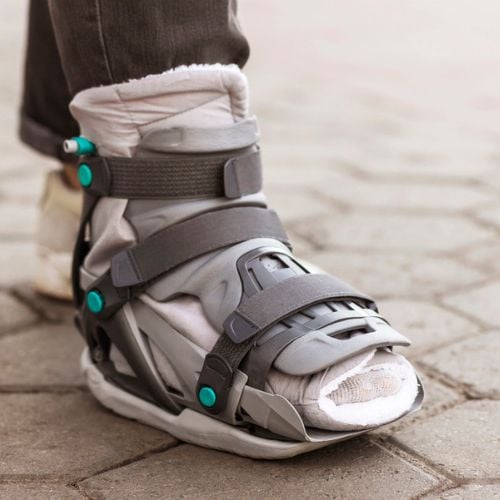
- Most patients walk out of my surgery center about an hour after your outpatient procedure once the anesthesia has worn off. Not on crutches, in most cases, just in a protective surgical boot, a surgical shoe, or a small surgical sandal. If you need my Ghost Lapidus procedure for a severe or unstable bunion, you may use spring-loaded crutches for the first two weeks, but even then, you’re up and moving.
- Your only real job this week is to keep the foot up. I want your toes above your heart as much as humanly possible.
- Elevation and ice control swelling better than anything I can prescribe, and swelling is what causes most of the discomfort patients feel.
- Most of my patients are shocked by how little it hurts. Advil or other NSAIDs, or Tylenol (acetaminophen), almost always manages the pain, and we will discuss a full pain management plan during your pre-op visit. I can prescribe something stronger, and I will if you need it, but the vast majority of my metal-free patients never fill that prescription.
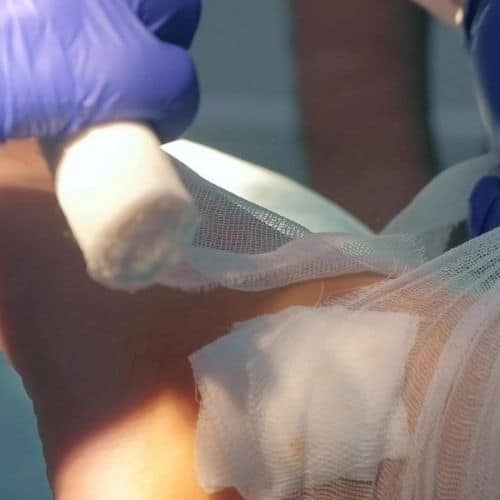
- Keep your dressings clean and dry and keep your surgical foot out of the shower.
- Set up your recovery area before surgery: a comfortable chair, a stack of pillows, and ice within arm’s reach, so you’re not hopping around your kitchen or needing a knee scooter on day two.
With traditional metal surgery, week one often looks very different. Many patients spend it in a cast under strict non-weight-bearing orders, sometimes for as long as six weeks.
Week 2: stitches out and a first look
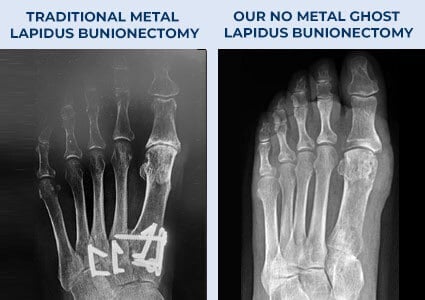
- I’ll see you around the one-week mark. We take out the stitches, check how the incision is closing, and take an X-ray to confirm your bone is sitting exactly where I put it.
- This is also when the non-metal hardware starts earning their keep. Your natural bone has already begun attaching itself to the OSSIOfiber hardware, which is a big part of why the area where you had surgical correction feels so solid so early.
- Swelling is usually at its worst right now, and that’s completely normal but far less with the non-metal option. Your foot may look wider than the other one and feel snug in the boot. Keep your foot elevated, and don’t panic. If you have any concerns, you have my phone number and email address, and you are always welcome to reach out.
- If you have a desk job, you’re probably already back at it, especially if you work from home. I’ve had patients answering email the day after surgery. If your job keeps you on your feet all day, plan on more time.
- Start gentle toe range-of-motion exercises to prevent scar tissue and stiffness.
- You are cleared to drive with a surgical shoe.
Weeks 3 and 4: finding your rhythm
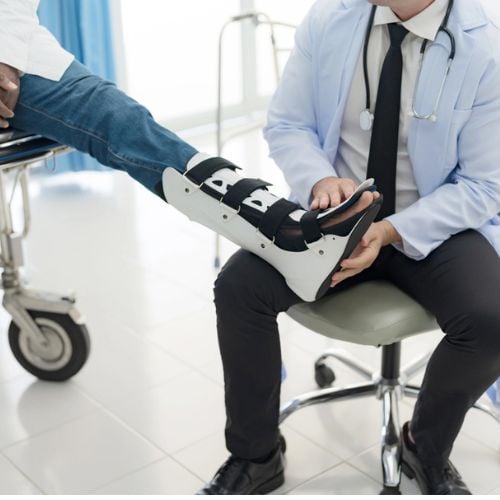
- By now you’re walking more comfortably in the boot and moving around the house without thinking much about it.
- Now is the time when I start you on more aggressive range-of-motion exercises for your big toe joint. Whatever you do, don’t skip these exercises! A big toe that won’t bend much is the most common complaint after any bunion surgery. You just need a few minutes of gentle daily motion to prevent that. Don’t worry, I’ll show you exactly what to do. We will also put in a special injection to help avoid scar formation in the joint, and that is part of our efforts to make your surgery exceptional.
- Short walks are good for you. All-day shopping trips are not, at least not yet.
- In certain cases, if you are feeling fast, you may be able to wear a tennis shoe.
Weeks 5 and 6: back into a real shoe
This is the milestone everybody waits for.

- At around week five or six, most of my metal-free Ghost bunionectomy patients move out of the boot and into a roomy, supportive sneaker.
- Your bone is healed in the way that counts, which is that it can carry you. Your foot may still puff up some by the end of the day, but that is normal. And you may need a half size larger shoe than usual for a while. That’s also normal, and before too long, it won’t be necessary.
- You can start light exercise now: a stationary bike, an elliptical, upper body work, and swimming once the incision is completely sealed. Hold off on running, jumping, and other high-impact activities until I clear you for that. Don’t worry, it will be soon!
For comparison, traditional bunion surgery often has patients coming out of a cast at 6 weeks and putting weight on their foot for the first time.
Weeks 7 through 12: getting your life back
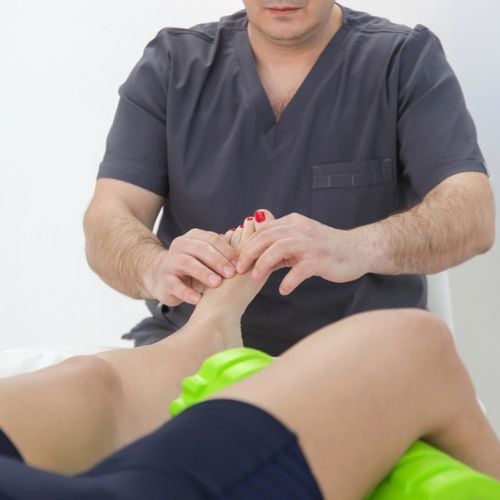
These weeks are about rebuilding. Your foot has been protected for a month and a half, and the muscles around it need to be woken up again.
- Physical therapy helps enormously here, and I prescribe it for most patients. If I do, treat it as a requirement, not a suggestion. The patients with the best outcomes at one year are almost always the ones who did their therapy.
- At around eight weeks, most of my patients are in regular athletic shoes full time and back to normal daily life. By two months, most are cleared for full recreational activities, and yes, that includes wearing heels, if you want to. I’d rather you save those shoes just for special evenings out at first.
- If you’re a nurse, a teacher, a server, or anyone else who stands all day, this is usually the stretch where work stops being uncomfortable.
Months 3 through 6: the fine-tuning
Somewhere in here you’ll simply stop thinking about your foot. That’s the goal, and it’s a better measure of success than any date on a calendar.
- Swelling is always the last thing to go away permanently. Most of my metal-free patients are close to normal by three or four months. After traditional metal surgery, swelling can last six to nine months. Some end-of-day puffiness is not a complication; it’s just how your foot heals.
- Runners and athletes usually get full clearance between three and six months, depending on which procedure you had and how the bone looks on X-ray. Scars keep fading for a full year, and I’ll give you a scar-care routine to speed that up. At a year, you often cannot even see you had surgery thanks to my plastic surgical approach to sutures.
The 2-year mark: your surgical screws are now bone
This is the part I love explaining to patients. Over roughly two years, your non-metal fiber screws or other hardware hand their job over to your body. The mineral fibers act as a scaffold; your bone grows through and around them, and living bone and tissue gradually replace the implant. It is truly amazing.
At the end of that process, there is no hardware in your foot. Nothing to loosen, nothing to back out, nothing to remove, and nothing to explain at the airport. You just have a wonderfully straight toe and zero bunion pain, of course.
A patient with metal is at the same point in their story with a permanent screw still sitting in their bone, and a chance that it is bothersome from time to time, or worse, in need of surgery someday to take it out.
What tends to slow your recovery and what to avoid
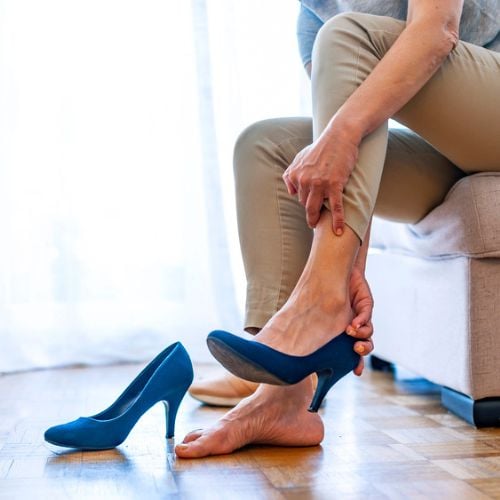
Once you leave my operating room, most of your recovery is in your hands. Yes, I see you numerous times to make sure all is well and to make sure all your concerns, if you even have any, are addressed.
The setbacks I see are predictable, and virtually all of them are avoidable, such as:
- Walking too much or too soon. The foot feels good, you overdo it, and then it swells for three days. Don’t do that.
- Letting the foot hang down. Gravity is not your friend during weeks one and two, so keep it elevated.
- Smoking. Nicotine narrows blood vessels and measurably slows bone healing. If at all possible, please refrain.
- Skipping range-of-motion work. Stiffness is far easier to prevent than to fix. Do your simple exercises.
- Squeezing into a narrow shoe too early. Give your foot room while it’s still swollen; your foot will thank you for it.
When should you contact my office? Right away if you have any questions
I started DOCS Foot and Ankle to get away from only being allowed to spend 15 minutes, tops, with a patient. If you are a patient of mine, you are here to be taken care of, and if you need me, I am there for you.
With that said, the truth is the overwhelming majority of recoveries are completely uneventful, which is a beautiful thing. Even so, please pick up the phone and call me if you notice any of the following:
- A fever above 101 degrees Fahrenheit
- Redness spreading away from the incision, or drainage that looks cloudy or smells bad, as these can be signs of infection
- Sudden, severe pain that elevation and your usual medication don’t touch
- Calf pain, warmth, or swelling, which can be a sign of a blood clot
- Numbness, or a foot that looks pale and feels cold
Don’t wait to see if it sorts itself out. A five-minute phone call almost always prevents a much bigger problem.
Why do patients fly to Los Angeles for my metal-free surgeries?
I treat patients from all over the country, and I’ve built the practice around making that practical. We start with a virtual consultation, so you know your procedure, your plan, and your timeline before you ever book a flight.
Most out-of-town patients arrive a day or two before surgery, stay locally for the first week, and then head home for the rest of recovery. Because you’re walking from day one, flying home is far easier than it would be after traditional surgery. We coordinate your follow-up with a doctor near you, and I stay involved by video for as long as you need me.
Only a small handful of surgeons in the country perform metal-free bunion removal and correction at real volume. I helped develop the technology and the surgical techniques, and I’ve refined it across thousands of cases. You can see the results for yourself in our bunion surgery before and after photos. That’s why people fly in.
Ready to see what your timeline looks like?
Every foot is different, and the honest answer to “how long will this take?” starts with looking at your foot and your X-rays. When you’re ready, we can do that together.
Schedule a consultation with me at DOCS Foot and Ankle in Los Angeles, in person or by video from anywhere in the country or the world. We’ll review your bunion, also known as hallux valgus or a tailor’s bunion, talk through which Ghost procedure fits you best, and map out your recovery week by week before you commit to anything.
Bunion Surgery Recovery FAQs
When can I walk normally after bunion surgery?

With our minimally invasive and Ghost no-metal techniques, most patients walk in a boot immediately post-surgery. Natural walking without a limp typically resumes between weeks 8 and 12, after swelling decreases and your transition back to regular footwear is complete.
How painful are Dr. Baravarian's post-surgical recoveries?
Patients consistently report less pain than they ever expected. Dr. Baravarian uses long-acting local anesthesia and metal-free fixation that reduces inflammation. The vast majority of patients manage recovery with over-the-counter anti-inflammatories, not prescription narcotics.
What are the warning signs of complications after bunion surgery?
Most recoveries are uncomplicated, but early action is always best. Call Dr. Baravarian immediately for:
- Fever above 101°F,
- Increasing redness or pus from the wound
- Calf pain with shortness of breath (ER immediately for possible DVT),
- Severe worsening pain after day 3
- Any new numbness or tingling.
What is the difference in recovery between a Lapidus bunionectomy and an osteotomy?
A traditional Lapidus requires 6–8 weeks of non-weight-bearing. Dr. Baravarian’s Ghost Lapidus reduces this by several weeks. In some cases, that time is spent entirely in a boot. A standard osteotomy with metal allows weight-bearing in 2–4 weeks; Dr. Bob’s Ghost osteotomy generally allows for immediate weight-bearing in a boot.