Dr. Bob Baravarian explains how OssioFiber® is redefining bunion surgery
What is a Bunion?
A bunion appears as a bony bump on the inside of the foot where the first metatarsal meets the base of the big toe. The bunion forms when the bone shifts outward, causing the joint to protrude (stick out). A similar bump at the base of the little toe is called a tailor’s bunion.
While a bunion cannot be fixed without surgery, its development can sometimes be slowed with non-surgical treatments like custom orthotics and supportive shoes.
What sets Dr. Bob Baravarian apart from other bunion surgeons?
Los Angeles foot and ankle surgeon Dr. Bob Baravarian is board-certified and nationally recognized as one of the top bunion surgeons in the country.
Named one of the Best Foot Surgeons in California and recognized as a Top Doctor in Los Angeles by Los Angeles Magazine, he has performed over 20,000 successful bunion surgeries in his more than 25 years of practice. This extensive experience has helped him refine and perfect his surgical techniques, consistently achieving excellent results with faster recoveries and minimal bunion pain or scarring.
About Dr. Baravarian’s Non-Metal Ghost Bunionectomy™ Surgeries
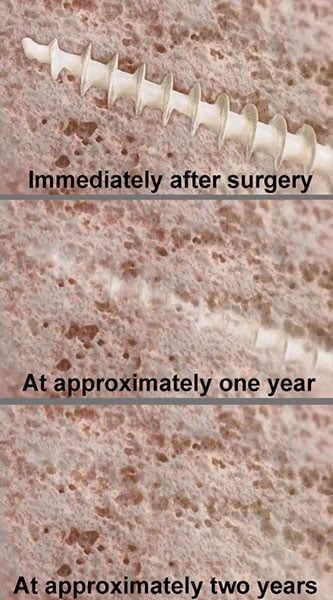
Dr. Baravarian has perfected a completely non-metal surgical solution for most of his surgeries, including bunion surgery.
He has completely eliminated the need for metal screws or plates in surgery! Instead, he uses surgical hardware made from a proprietary fiber-reinforced composite material called Ossio-Fiber, which he helped develop over the past eight years.
Ossio-Fiber is as strong as metal. It is essentially integrated into your body’s own bone over the next two years. Hence the name “Ghost Bunionectomy,” because the surgical hardware simply disappears as it integrates into your own bone.
The Ossio-Fiber non-metal fixation controls stress abnormalities through the bone because the material is sticky. This stickiness holds the foot’s bones in place even better than metal surgical hardware while the bones heal.
And because Ossio-Fiber doesn’t contain metal, there are never any surgical screws, plates, or nails to remove. There are never any metal allergy issues or discomfort from cold weather, unlike with metal hardware. Also, the fiber doesn’t interfere with post-operative imaging like MRI or CT scans, making it easier for your doctor to monitor healing.
What types of Ghost non-metal bunion surgeries does Dr. Baravarian perform?
Dr. Baravarian performs three distinct state-of-the-art bunion treatment options. He always chooses the approach best suited to each patient’s unique anatomy and goals. They are:
Ghost Non-Metal Bunion Minimally Invasive Surgery
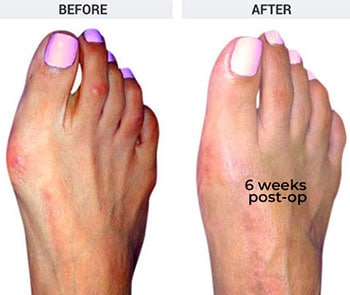
This treatment option combines the best parts of open bunionectomy (which stabilizes the bone with hardware) with the best aspects of a traditional minimally invasive bunionectomy, needing just one tiny 1 cm (less than ½ inch) incision.
Traditional minimally invasive procedures use a thin, fragile metal pin to keep the cut bone fixed in place. Dr. Baravarian’s surgical approach uses his own custom-designed Ossio non-metal fixation system. It provides a stronger, more stable fixation that can be placed through a very small incision.
There are several important results. One is that you will be able to bear weight on your foot immediately after surgery. Another is the improved environment for excellent healing. A vital third is that this procedure greatly limits the likelihood of “non-union risk”. In other words, a broken bone will fail to heal properly. This risk is associated with traditional minimally invasive metal bunion surgeries.
By marrying the best of both approaches with his non-metal surgical hardware technology, Dr. Bavarian finds that this surgery is an exceptional option for achieving optimal outcomes.
Ghost Non-Metal Osteotomy Bunionectomy
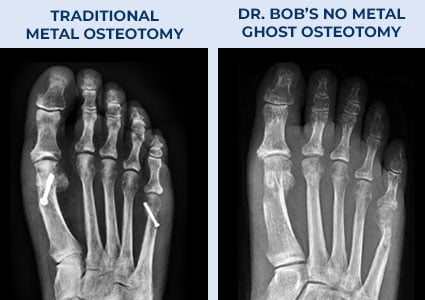
This procedure is used for moderate to severe bunions without joint instability. It is commonly used on active patients younger than age 50. It is one of the most performed bunion surgeries today.
An osteotomy, or bone cut, is performed at the tip of the first metatarsal. This “V” shaped cut allows the first metatarsal to shift, so that it becomes parallel to the second metatarsal. The metatarsal bones are then secured in their new position with two non-metal surgical screws.
Dr. Bob is proud to offer his revolutionary Ghost no-metal fixation option for his osteotomy bunion surgeries. Since Ossio-Fiber is used, this osteotomy bunionectomy is a strong and predictable procedure with immediate weight-bearing.
Ghost Lapidus Non-Metal Bunionectomy
Dr. Baravarian’s metal-free Ghost Lapidus Bunionectomy is the best choice for moderate to severe bunions and those with joint laxity. This type of bunion correction is considered the Gold Standard for bunion surgery.
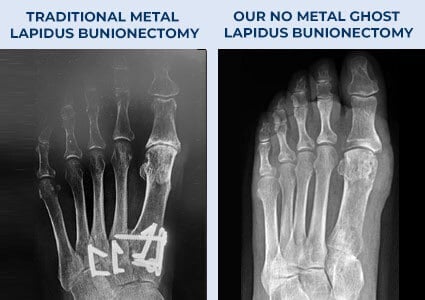
For the right patient, this unique Lapidus procedure has the highest success rates, with essentially a 0% chance of the bunion returning. This is because the procedure fixes the source of the bunion deformity: a lax/hypermobile joint between the first metatarsal and the cuneiform bone located at the base of the big toe joint.
Dr. Baravarian’s non-metal surgery moves the deviated bone back to its original position without cutting it. This naturally realigns your foot, straightening your big toe, alleviating the bump, and eliminating any accompanying foot pain.
This method avoids the complications that often occur with metal hardware. In addition, your foot can be weight-bearing in just two weeks (versus 6-8 weeks with the traditional approach).
Bunion Revision Surgery
Many of Dr. Baravarian’s patients consult with him after unsuccessful bunion surgeries at other facilities. Revisions account for almost one-third of his bunion surgeries. It pains him that so many people need to go through bunion surgery a second time.
Failed bunion surgeries are discovered when new complications appear, including recurrence of the bunion, an excessively shortened big toe, stiffness in the toe joint, and/or arthritis. Other common causes of failure include under-correction of the deformity, improper implant placement, and poor bone healing around traditional metal hardware – all of which can leave patients in as much pain as before their original procedure, or worse.
Revision cases require a fundamentally different surgical mindset. Dr. Baravarian begins each revision consultation by thoroughly reviewing prior imaging and surgical records to understand exactly where the first procedure fell short. Because many failed surgeries involved traditional metal implants, he frequently transitions revision patients to his pioneering metal-free approach using Ossiofiber bio-integrated hardware – non-metal hardware that becomes bone over time, eliminating the reactive bone loss that can undermine a standard repair. This means no metal to ever remove and a more stable, lasting correction.
Bunion revision surgery requires the necessary experience and skills to understand and address the shortcomings of the original surgery.
Patients like Carmela and Nina came to Dr. Baravarian after years of recurring pain and disappointment following surgeries elsewhere. With a tailored treatment plan, minimally invasive technique, and regenerative support, both were able to walk comfortably again – outcomes that speak to the unmatched skill and compassionate care Dr. Baravarian brings to even the most complex reconstructive cases.
Dr. Baravarian can also integrate PRP, amniotic fluid allograft, and amniotic Wharton’s Jelly to enhance healing and improve outcomes for any of our procedures. In revision cases especially, these regenerative therapies play a critical role – PRP delivers a concentrated dose of the patient’s own growth factors directly to the repair site, while amniotic Wharton’s Jelly provides powerful anti-inflammatory and tissue-regenerating properties that support faster healing and less pain during recovery. Together, they give revision patients the best possible foundation for a durable, long-term result.
Does Dr. Baravarian perform other types of bunion surgical procedures?
Yes, when appropriate for his patients, Dr. Baravarian also performs these additional bunion surgical options:
Bunionplasty
The Bunionplasty® 360 Bunion Repair™ procedure is a minimally invasive bunion surgery (MIBS) that enables many patients to walk immediately after their procedure. It utilizes patented technology and patent-pending surgical techniques to provide superior correction and a quick return to daily activities.
Lapiplasty
The Lapiplasty® 3D Bunion Correction™ procedure is an advanced surgical solution that corrects mild, moderate, and severe bunions by restoring the entire bone to its natural alignment. Unlike traditional bunion surgery that simply removes the bump, Lapiplasty® addresses the root cause—an unstable joint—through precise, tri-plane correction and patented fixation technology.
Dr. Baravarian’s bunion surgeries are virtually painless and scar-free
Many patients avoid bunion removal because they fear pain and scarring. It’s one of the most common concerns Dr. Baravarian hears – and one of the easiest to put to rest. Thanks to pioneering minimally invasive and metal-free techniques, recovery is remarkably comfortable, incisions are almost invisible, and most patients say the same thing afterward: they wish they hadn’t waited so long.
The fear of post-surgical pain is completely understandable, but modern bunion correction has come a long way. Dr. Baravarian uses metal-free Ossiofiber hardware that bio-integrates directly with your bone – meaning there is no metal to ever remove, no hardware reactions, and significantly less inflammation during healing. Patients are typically weight-bearing within two weeks, compared to the six-to-eight-week recovery standard associated with traditional bunion surgery. That’s a difference that matters enormously to anyone with an active lifestyle, a demanding job, or simply a life they don’t want to put on hold.
Patients describe the experience in their own words. SJ reported zero pain after surgery – something that once seemed impossible for a procedure many had dreaded for years. Rachael H. was back to her active lifestyle far sooner than she expected, crediting Dr. Baravarian’s personalized care and tailored treatment plan for making the process feel manageable from the very first consultation. These aren’t outliers – they reflect what compassionate care and unmatched surgical skill consistently deliver.
Recovery typically follows a reassuring arc: most patients are walking in a protective boot within days, transitioning to regular footwear within weeks, and back to full activity within a few months depending on the complexity of their correction. Dr. Baravarian takes the time to walk every patient through exactly what to expect at each stage, so there are no surprises – just steady, faster healing and less pain every step of the way.
When should you consider bunion surgery?
Most people with bunions don’t need surgery right away – and honestly, surgery shouldn’t be the first step. Conservative treatments like orthotics, wider footwear, and padding can manage mild to moderate bunion discomfort for years. But there comes a point for many patients when those options simply stop working, and that’s when surgery becomes worth a serious conversation.
Here are the clearest signs it may be time to consider bunion surgery:
Persistent pain that limits daily life. If your bunion hurts during normal activities – walking, standing, even resting – and that pain has lasted for months despite conservative care, surgery is likely the most effective long-term solution.
Failed non-surgical treatment. When orthotics, anti-inflammatory medications, physical therapy, and shoe modifications haven’t provided meaningful relief after a reasonable trial period, it’s time to explore surgical options.
Progressive deformity. Bunions are structural problems that tend to worsen over time. If your toe is drifting further out of alignment, overlapping neighboring toes, or causing hammertoe development, earlier surgical correction can prevent more complex reconstructive surgery down the road.
Difficulty finding footwear. When even wide or specially fitted shoes cause pain or can’t accommodate your foot comfortably, the deformity has likely progressed to a point where surgery offers the best quality-of-life improvement.
It’s also worth knowing that not all bunion surgeries are the same. Dr. Baravarian’s pioneering metal-free techniques – including options with a 0% recurrence rate for the right patient – mean faster healing, less pain, and no metal to ever remove. The right tailored treatment plan makes all the difference.
Experience Dr. Baravarian’s exceptional personalized care
From Dr. Baravarian: “After twenty-five years and over 20,000 bunion surgeries, I feel like I’ve really perfected bunion surgery.”
“I see a limited number of patients, and my goal is to create a family-friendly environment where you have access to me and my staff whenever you need us. We get you in right away, address your issues promptly, and help you improve your quality of life with state-of-the-art care.
“I am proud to be among the first and most experienced surgeons to make holistic, non-metal foot and ankle surgery a reality for my patients today.”
In addition to bunion correction surgery, Dr. Bob Baravarian is available for both minor and major foot problems. We perform all kinds of surgeries, including hammer toe surgery, Achilles tendon ruptures, flat feet, and Morton’s neuroma, among others

Dr. Bob Baravarian, the best bunion surgeon in Los Angeles
Dr. Bob Baravarian is a pioneer in advanced bunion correction and foot and ankle surgery. He developed leading surgical protocols including Bunionplasty®, Lapiplasty®, and the innovative Ghost™ no-metal bunionectomy, known for minimal scarring and faster recovery. With more than two decades of experience and thousands of successful surgeries, he continues to refine his techniques to achieve exceptional, natural-looking results.
A leader in regenerative medicine, Dr. Baravarian integrates amniotic stem cells, PRP, amniotic fluid allograft, and SoftWave® therapy to enhance healing and improve outcomes. He’s also been instrumental in clinical research on OSSIOfiber®, a metal-free fixation technology. Each procedure is fully tailored to the patient’s anatomy and lifestyle, reflecting his precision, artistry, and commitment to providing the most advanced surgical care available.
Dr. Bob Baravarian is conveniently located in Los Angeles, blocks from Cedars-Sinai Medical Center and Beverly Hills, providing expert foot and ankle care for patients throughout Southern California.
For more information or to schedule a consultation, please call (855) 557-5400 or contact Dr. Bob now.
Bunion FAQs
Why do Dr. Baravarian’s patients recover faster and with less pain?

Dr. Baravarian uses advanced techniques to make recovery as easy and comfortable as possible.
He’s gentle with soft tissue, uses special fixation methods to reduce swelling, and applies long-lasting local anesthesia to control pain. Regenerative medicine speeds healing, and a custom boot helps protect the foot. Most patients need little to no prescription pain medicine after surgery, often just over-the-counter options.
Can I still run if I have a bunion?
In most cases, yes, especially when the bunion is mild to moderate. Running doesn’t cause bunions, but every push-off puts repeated pressure on the big toe joint, which can speed up an existing deformity. Shoes with a wide toe box, custom orthotics, and taping can help many runners keep training comfortably.
Watch for signs that the bunion is progressing: pain that starts earlier in your runs, pain at rest, numbness in the toe, or your second toe beginning to drift. If you notice any of these, it’s time for an evaluation rather than more miles.
For a deeper look at shoes, training decisions, and surgical options for active patients, read our surgeon’s guide to running with bunions.
What causes bunions and who is at risk?
Bunions don’t just appear overnight – they develop gradually, and understanding why can help you take steps to slow their progression. The honest answer is that bunions are usually caused by a combination of factors rather than one single culprit.
Genetics play the biggest role. If your mother or grandmother had bunions, there’s a good chance you’ve inherited the foot structure that makes them more likely. What you’re really inheriting is the shape of your foot – things like a hypermobile joint at the base of the big toe, flat arches, or a naturally wide forefoot. These structural traits put uneven pressure on the metatarsophalangeal joint over time, gradually pushing the big toe out of alignment.
Footwear is a major contributing factor, especially for women. Narrow, pointed-toe shoes and high heels force the toes into an unnatural position for hours at a time. They don’t cause bunions on their own, but they absolutely accelerate the process in feet that are already predisposed. You can read more about choosing the right fit in our expert shoe fitting tips guide.
Inflammatory conditions like rheumatoid arthritis can also trigger bunion formation by weakening the joint and surrounding soft tissue, making the toe drift inward more easily.
You’re at higher risk if you:
- Have a family history of bunions or flat feet
- Regularly wear tight, narrow, or high-heeled shoes
- Have hypermobile joints or loose ligaments
- Live with rheumatoid arthritis or another inflammatory joint condition
- Are a woman – bunions are significantly more common in women than men
The good news? Knowing your risk factors early gives you the best chance to manage the condition before it worsens.
Do bunion correctors work?
No. While widely available and marketed as a solution for bunions, bunion correctors have very limited effectiveness. It’s essential to understand that bunions are a structural issue, and while these devices may provide some temporary relief, they won’t correct the root cause of the deformity.
Are bunions hereditary?
Yes, genetics plays a significant role in the development of bunions. If your parents or grandparents had bunions, you may have an increased risk of developing them as well. However, it’s important to note that other factors like footwear, foot mechanics, and lifestyle can also contribute to their development.
Can you stop a bunion from getting worse?
Here’s the honest truth about bunions: if you have a genetic predisposition, you can’t completely prevent one from forming. But you absolutely can slow its progression – and that matters a lot. Catching a bunion early and making a few smart lifestyle changes can mean the difference between managing it comfortably for years and needing surgery down the road.
The single most impactful thing you can do is wear shoes that actually fit. That means a wide toe box that lets your toes spread naturally, adequate arch support, and a low heel. High heels and narrow, pointed shoes force your big toe inward and put enormous pressure on the joint – exactly the conditions that accelerate bunion growth. If you’re not sure how to find the right fit, our expert shoe fitting tips are a great place to start.
Beyond footwear, these habits can genuinely help:
Custom orthotics: A tailored insole redistributes pressure away from the bunion joint, reducing pain and limiting further drift of the toe.
Toe spacers and bunion pads: These cushion the bump and gently encourage better toe alignment during daily activity.
Toe-strengthening exercises: Towel scrunches, toe spreads, and resistance band stretches keep the muscles around the joint strong and balanced.
Maintaining a healthy weight: Less body weight means less force traveling through the forefoot with every step.
If your bunion is already causing pain or visibly worsening, don’t wait. A personalized care plan from Dr. Baravarian can help you stay ahead of it – and if surgery ever becomes necessary, his pioneering minimally invasive techniques mean faster healing and less pain than you might expect.
Can bunions be corrected without surgery?
Bunions can often be managed and improved without surgery, especially if they are detected early. However, the effectiveness of these approaches varies depending on the severity of the bunion and individual factors.
Here are some non-surgical methods to consider:
- Footwear
- Orthotics
- Padding and taping
- Physical therapy and exercises
- Medications
Is bunion surgery covered by insurance?
In many cases, bunion surgery is covered by insurance when it is deemed medically necessary. Medical necessity is typically based on the severity of the bunion, the impact it has on your daily life, and the failure of conservative treatments to provide relief.
Keep in mind that cosmetic bunion surgery, which is performed solely for aesthetic reasons, is typically not covered by insurance.
How long is recovery from bunion surgery?
The recovery time for bunion surgery may take from six months to a year or longer to achieve full recovery depending on the extent of the surgery, individual healing factors, overall health, and how well post-operative care instructions are followed.
Is bunion surgery painful?
Despite pre-surgical fear of pain and recovery, virtually all our patients report they essentially no pain and wish that they had surgical correction sooner and hadn’t put it off as long as they did.
Dr. Bob’s advances in surgical techniques drastically reduce recovery time, often allowing you to bear weight immediately.
Can you get a bunion on your pinky toe?
Bunions on the pinky toe are less common but not impossible. When a bony bump or prominence forms on the outer side of the foot near the base of the pinky toe, it is referred to as a tailor’s bunion or bunionette.
What are Bunion symptoms to look out for
Bunions don’t always announce themselves with dramatic pain right away. In fact, many people first notice a subtle bump forming at the base of their big toe and wonder if it’s something to worry about. Here’s what to watch for as a bunion develops.
The most obvious sign is a visible, bony bump on the outside edge of your foot at the base of the big toe. Over time, that toe may start to drift toward your second toe, sometimes overlapping it entirely. You might also notice:
- Pain or soreness around the big toe joint, especially after walking or standing for long periods
- Swelling, redness, or inflammation around the joint that flares up after activity
- Stiffness and restricted movement in the big toe, making it harder to bend or push off when walking
- Corns or calluses where the first and second toes rub together
- Numbness or a burning sensation in the toe – if you’re experiencing this, it’s worth understanding what’s behind it
Symptoms tend to worsen in tight, narrow, or ill-fitting shoes, which is why proper shoe fitting matters so much. Some people live with mild discomfort for years, while others find the pain becomes debilitating surprisingly quickly. Either way, catching a bunion early gives you far more treatment options – including non-surgical ones – before the deformity progresses.
If any of these symptoms sound familiar, it’s a good idea to get a professional evaluation sooner rather than later.
Can bunions cause leg pain?
Bunions themselves are primarily localized to the foot and affect the joint at the base of the big toe. However, in some cases, bunions can indirectly contribute to leg pain or discomfort due to altered gait and joint stress.
What are the best shoes for bunions?
What are the best shoes for bunions?
Choosing the right shoes for bunions is crucial to minimize discomfort and prevent further irritation. Here are some features to look for when selecting the best shoes for bunions:
- Wide Toe Box
- Low Heel or No Heel
- Flexible and Cushioned Soles
- Arch Support
- Adjustable Straps or Laces
- Soft and Breathable Materials
- Removable Insoles
- Orthopedic or Bunion-Specific Shoes
What are the benefits of bunion surgery for seniors?
Bunion surgery for seniors can offer significant foot pain relief and improve quality of life by correcting the foot’s alignment, reducing pain, and restoring mobility. Our surgeons are well-versed in bunion procedures for patients of all ages and can adjust surgery to make it a lower risk with shorter and easier recovery for seniors.
What happens if I do nothing about my bunion?
Early-stage bunion deformities will almost always get worse over time. Complications from an untreated bunion include:
- Increased discomfort and pain. Bunion progression cannot be stopped. Your bunion will cause increased swelling and pain, and the bump will appear more pronounced.
- Osteoarthritis or bursitis. As the joint shifts more and more, your joints are impacted and will eventually become very damaged. The cartilage will continue to deteriorate, and a minimally invasive surgical procedure may no longer be an option for you.
- Crossover Toe. As more time passes, many patients see that their second toe begins to cross over the first toe literally. This causes pain, calluses, and even ulcers in your second toe. More invasive surgical procedures are now your only option.
How can I tell how severe my bunion is?
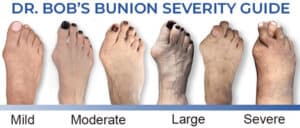
A bunion can range from mild (a small bump at the base of your big toe) to severe (where the big toe angles sharply toward the others). The image below shows how bunions progress as the joint becomes more misaligned.
Are there non-surgical bunion treatment options?
Not every bunion needs surgery – and Dr. Baravarian is the first to tell you that. If your bunion is caught early and the pain is manageable, a tailored treatment plan focused on conservative care can slow progression and keep you comfortable for years. Here’s what that typically looks like:
Footwear changes. This is usually the first and most impactful step. Switching to wider, roomier shoes with a low heel and a soft upper takes pressure off the bunion joint immediately. Avoiding pointed or narrow toe boxes can make a surprising difference in day-to-day comfort. For more guidance, check out these expert shoe-fitting tips from our podiatrists.
Orthotics and padding. Custom orthotics help redistribute pressure across the foot and correct the biomechanical imbalances that allow bunions to worsen over time. Gel pads or bunion cushions placed over the bony bump can also reduce friction and soreness throughout the day.
Anti-inflammatory measures. Icing the joint for 10-15 minutes after activity, along with over-the-counter NSAIDs like ibuprofen, can calm inflammation and reduce swelling during flare-ups.
Regenerative therapies. For patients dealing with persistent joint irritation, Dr. Baravarian may recommend minimally invasive regenerative options like Platelet Rich Plasma (PRP) to support tissue healing and reduce inflammation without surgery.
It’s important to understand that while these approaches relieve pain and slow progression, they cannot reverse a bunion deformity. If conservative care stops working and your quality of life is affected, that’s when a conversation about surgical options makes sense.