Running doesn’t cause bunions – but if you already have one, every mile you log may be quietly making it worse. That’s not a reason to hang up your shoes. It’s a reason to understand exactly what’s happening inside your foot so you can make smarter decisions about training, treatment, and your long-term running career.
If you’re a runner watching your bunion get bigger and more painful with every race, you’re not alone. At DOCS Foot and Ankle, we see dedicated runners who have managed bunion pain for years — trying every shoe and pad on the market — until the pain stops being manageable and starts threatening their ability to train.

This guide covers everything you need to know about bunions and running: exactly how the running gait loads and worsens a bunion over time, which conservative strategies genuinely help versus which ones just delay the inevitable, and when modern surgical options – including metal-free bunion surgery with faster recovery timelines – become the smartest move for your running career.
Every runner’s situation is different, and Dr. Bob Baravarian is committed to providing personalized care and a tailored treatment plan built around your specific goals — whether that’s finishing your next race or running pain-free for decades to come. If you’re already wondering whether surgery might be right for you, our bunion surgery options for runners page is a good place to start.
How Running Loads Your Bunion – and Why Every Mile Can Make It Worse
Dr. Bob Baravarian, DPM, FACFAS, is dual board-certified by the American Board of Foot and Ankle Surgery in both Foot Surgery and Reconstructive Rearfoot/Ankle Surgery — one of only a handful of surgeons in the country to hold both distinctions — and has spent decades treating competitive runners at every level. Here is how he explains the relationship between running with bunions and long-term foot health to every patient who walks through his door.
A bunion, clinically called hallux valgus, is a progressive deformity at the first metatarsophalangeal joint (MTP joint) – the joint at the base of your big toe. The metatarsal bone drifts inward while the toe angles outward, creating the characteristic bony prominence on the inside of the foot. Running is uniquely problematic because this gait places a heavy mechanical load directly on that joint.
During normal walking, the first MTP joint absorbs roughly 40-60% of your body weight at toe-off. During running, that load increases significantly, and the sport’s repetitive motion stresses your bunion hundreds of times per mile. Peer-reviewed research on hallux valgus biomechanics confirms that altered gait mechanics in runners with bunions shift load away from the first ray, increasing stress on adjacent metatarsals and raising the risk of metatarsal stress fractures.
The plantar fascia is also directly involved. As the first MTP joint loses its ability to extend properly during push-off, the plantar fascia’s windlass mechanism is compromised. Runners often develop secondary plantar fascia irritation alongside their bunion pain – a combination that makes every training run feel like a negotiation with your own foot.
The deformity itself is progressive. Running doesn’t initiate the bunion, but the repetitive loading, combined with the lateral forces of road running and the compression of a running shoe’s toe box, accelerates the drift of the metatarsal. Runners who ignore early-stage bunion pain often find themselves dealing with a moderate-to-severe deformity within a few years that conservative care can no longer adequately address.
Signs Your Bunion Is Progressing Beyond What Conservative Care Can Fix
There’s a meaningful difference between a bunion that’s uncomfortable and one that’s actively worsening. Knowing which category you’re in determines whether conservative management is still a viable strategy or whether you’re simply delaying a necessary conversation about surgery.
Watch for these specific signs of progression. Pain that was once confined to long runs now appears within the first mile. The bony prominence is visibly larger than it was six months ago. Your second toe is beginning to overlap or drift because the bunion is pushing it out of alignment. You’re changing your running gait – shortening your stride, landing differently, or favoring the outside of your foot – to avoid pain at the MTP joint. Any of these patterns signals that the deformity is advancing. A progressing bunion can also trigger a cascade of related foot and ankle conditions — from plantar fasciitis to metatarsalgia — that compound the impact on your training.
Stiffness at the first MTP joint that doesn’t resolve with warm-up is another red flag. When the joint loses range of motion, it’s often a sign that cartilage damage is beginning – a complication that changes the surgical options available to you and makes early intervention more important. The American Orthopedic Foot & Ankle Society notes that surgical outcomes are generally better when intervention occurs before significant joint degeneration.
What Actually Works: Shoes, Orthotics, Taping, and Pads for Running with a Bunion
What are the best running shoes for bunions?

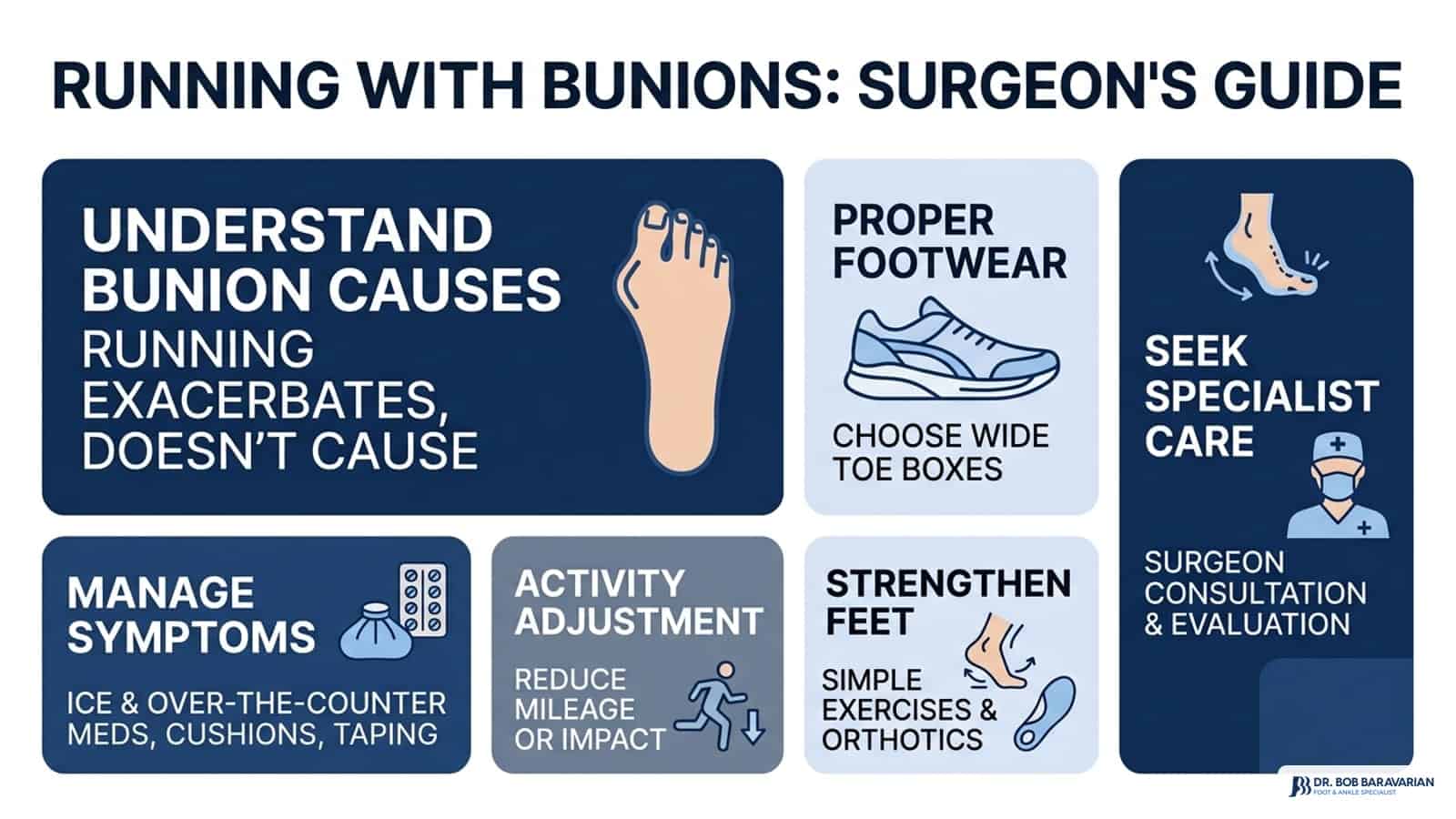
Shoe selection is the single most impactful conservative intervention for runners with bunions. You need a shoe with a wide toe box – not just a wide width, but a toe box that is anatomically shaped to allow the toes to splay naturally at push-off. Brands that offer this geometry include Altra, Topo Athletic, and New Balance’s wider-fit models. Avoid pointed or tapered toe boxes entirely, and be skeptical of “bunion-friendly” marketing claims that aren’t backed by actual toe box measurements.
Stack height matters too. A higher heel-to-toe drop increases the load on the forefoot at push-off, which means more stress on the first MTP joint. Runners with bunions often find that transitioning to a lower-drop shoe – gradually, to avoid Achilles strain – reduces forefoot pain during longer efforts.
Should I use a bunion corrector while running?
Bunion correctors – the splints and toe spacers marketed to realign the big toe – have a limited role during running. They can provide modest comfort by reducing friction between the bunion and the shoe, and toe spacers may help maintain some separation between the first and second toes. However, no clinical evidence shows that bunion correctors reverse or halt the structural progression of hallux valgus. They can help keep you comfortable day to day, but they aren’t a substitute for a proper treatment plan — and you deserve more than just getting by.
What we find genuinely helps most runners is a pair of custom orthotics, designed specifically for your foot and the way you run. A well-designed orthotic can offload the first MTP joint by controlling pronation and supporting the medial arch, reducing the forces that drive bunion progression. At DOCS Foot and Ankle, orthotics are a core part of the personalized care plans Dr. Bob builds for runners in the early-to-moderate stages of deformity — and they work best when combined with appropriate footwear, not as a standalone fix.
For runners dealing with persistent joint inflammation and pain that orthotics and footwear changes haven’t fully resolved, platelet-rich plasma (PRP) therapy is a regenerative option worth discussing with Dr. Bob. PRP uses your body’s own growth factors to reduce inflammation and support tissue healing around the first MTP joint — a particularly valuable tool for keeping active runners training while a longer-term treatment plan is developed. Georgia P., a patient at DOCS Foot and Ankle, underwent two PRP procedures and described the experience as virtually pain-free: “It’s wonderful to find a doctor that is trustworthy.”
Taping techniques – specifically low-dye taping or bunion-specific taping to hold the first ray in a more neutral position – can reduce pain during runs and are a genuinely useful short-term strategy, particularly during race season when you need to keep training. Like orthotics and correctors, taping doesn’t address the underlying deformity, but as part of a tailored treatment plan it can make a real difference to your comfort and confidence on the road.
When to Stop Running and See a Specialist: A Decision Framework for Runners

Dr. Bob approaches every runner’s situation the way he would for a member of his own family — with honesty, compassion, and a genuine commitment to protecting your long-term ability to do what you love. That means giving you a clear-eyed answer to the question every runner eventually asks: not just whether you can run with a bunion, but whether continuing to run is the right decision for your foot, right now.
Many runners manage bunions for years with appropriate care. But there’s an important distinction between running through manageable discomfort and running in a way that accelerates damage — damage that will ultimately cost you far more time off the road than stopping now would.
Stop running and seek a specialist evaluation when any of the following apply. Your pain is now present at rest, not just during activity. You’ve developed numbness or tingling in the big toe or second toe, suggesting nerve involvement. Conservative measures that previously gave you 80% relief are now giving you 20%. You’ve missed more than two consecutive weeks of training due to bunion pain in the past six months. Or you’ve noticed your second toe beginning to cross over or under the first – a sign that the deformity is affecting adjacent structures.
Take Rachael H., a patient of Dr. Bob Baravarian who had been managing bunion pain for years before finally seeking surgical consultation. “I have needed this bunion surgery for years,” she said, “and when I met Dr. Bob, I felt 100 percent confident he was the right doctor to correct my bunion. I have completed the right foot and will be doing the left foot in a couple of weeks. Thanks to Dr. Bob, I will be able to be super active and no longer have pain.” Rachael’s story is common: the runners who wait longest often have the most to gain from timely, compassionate care. You can read more stories like hers from our 5,200+ verified patient reviews.
Bunion Surgery for Runners: What Modern Minimally Invasive Options Look Like
The bunion surgery of ten years ago – large incisions, long recovery, months off running – is not the bunion surgery available to runners today. Modern minimally invasive techniques have fundamentally changed the risk-benefit calculation for active patients.
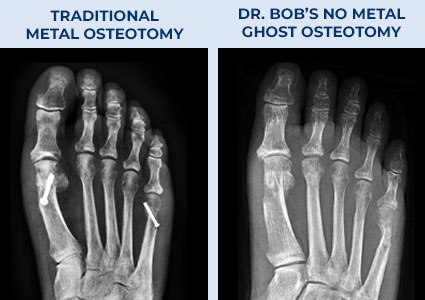
At DOCS Foot and Ankle, Dr. Bob Baravarian offers several surgical approaches tailored to the runner’s specific deformity type, activity goals, and anatomy. For mild-to-moderate bunions, minimally invasive Ghost Bunionectomy techniques using a single 1cm incision and metal-free Ossiofiber fixation can correct the deformity with significantly less soft tissue disruption than traditional open surgery. For moderate-to-severe deformities, Lapiplasty 3D bunion correction addresses the bunion in all three planes of movement – correcting not just the visible bump but the rotational component of the deformity that traditional 2D procedures miss. This matters for runners because a 3D correction is more stable under the repetitive loading of running gait.
Leslie, who underwent minimally invasive bunion surgery with Dr. Bob, described the experience as “painless” — a word that surprises most runners who have been putting off surgery based on outdated assumptions about post-operative pain. SJ, who had bunion surgery and reported “zero pain after surgery” with excellent healing, reflects what’s possible when surgical technique is precisely matched to the patient’s anatomy and recovery goals. And Chris H., after his procedure, summed it up simply: “This is a first-class experience with a world-leading research surgeon. If ‘good enough’ isn’t good enough for you, this is where you want to go.”
Metal-Free Bunion Surgery: Why No Hardware Means a Faster Return to Running
Traditional bunion surgery uses metal screws, plates, or pins to hold the corrected bone position while it heals. For runners, this creates two problems. First, metal hardware can cause ongoing irritation and inflammation in an active foot – the kind of foot that generates significant repetitive stress. Second, metal hardware sometimes requires a second surgery for removal, adding months to the total recovery timeline.
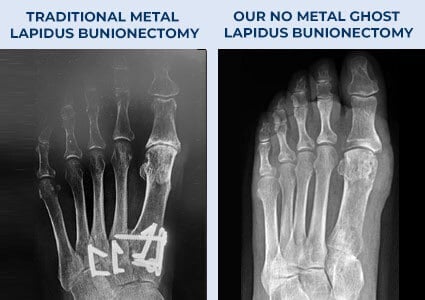
Dr. Bob Baravarian was the first surgeon in the United States to develop metal-free surgical techniques for bunion correction, using Ossiofiber metal-free surgical hardware – a bio-integrated material that gradually integrates with and becomes part of the bone itself. There is no metal to ever remove. The hardware doesn’t create the cold-weather aching or hardware-related irritation that some runners experience with traditional implants. And because the fixation is biologically integrated rather than mechanically anchored, the bone heals in a more natural, stable configuration.
For runners, this means the post-operative foot isn’t carrying a permanent foreign body that may become symptomatic under training loads. The full details are on our metal-free Ghost Surgery System page, but the practical implication is clear: no hardware removal surgery, less post-operative inflammation, and a recovery pathway that gets runners back on the road faster than traditional approaches.
Chris H., a patient at DOCS Foot and Ankle, described the experience as “a first-class experience with a world-leading research surgeon. If ‘good enough’ isn’t good enough for you, this is where you want to go.” For runners who depend on their feet professionally or competitively, “good enough” is never the standard.
Realistic Return-to-Running Timelines After Bunion Surgery
How long after bunion surgery can I run again?
This is the first question every runner asks, and the honest answer depends on the procedure, the severity of the deformity, and how well you follow the rehabilitation protocol—but modern minimally invasive techniques deliver faster healing and less pain than most runners expect. With metal-free, bio-integrated fixation, most runners are walking in a protective boot within days of surgery. Low-impact cross-training – swimming, cycling on a stationary bike – typically begins around weeks 4 to 6. Return to running usually starts between months 3 and 4, beginning with walk-run intervals on flat surfaces before progressing to full training volume.
Traditional bunion surgery with metal hardware typically adds 4 to 8 weeks to these timelines, partly because of greater soft tissue disruption and partly because of the more conservative rehabilitation protocols required to protect metal fixation. And because there is no metal to ever remove, runners treated with Dr. Bob’s bio-integrated approach avoid the additional 6 to 12 weeks of recovery that hardware removal surgery would otherwise require — making the total path back to training significantly shorter.
The key variable is bone healing, not pain. Runners are often tempted to return to training as soon as pain subsides, but the bone needs time to consolidate around the corrected position regardless of how you feel. Returning too early risks hardware failure or recurrence of the deformity – outcomes that set you back far further than the original recovery would have. A personalized rehabilitation plan from Dr. Bob ensures your quicker recovery stays on track without cutting corners on the healing that protects your long-term running career.
What Runners with Prior Failed Bunion Surgery Need to Know About Revision Care

Bunion recurrence after surgery is more common than most patients are told. Published studies on hallux valgus recurrence suggest rates of 10 to 25% depending on the procedure used and whether the underlying biomechanical cause of the deformity was adequately addressed. For runners, repetitive training loads add stress to the surgical correction, making the quality of the initial procedure especially important.
If you’ve had bunion surgery that didn’t hold — if the deformity has returned, if you have persistent pain at the surgical site, or if you developed a new deformity adjacent to the original correction — revision surgery is a specialized undertaking that requires a surgeon with specific experience in reconstructive foot and ankle care. At DOCS Foot and Ankle, revision bunion surgery is one of Dr. Bob Baravarian’s core areas of expertise, and physicians worldwide refer their most complex cases to him for exactly this reason.
Patients like Carmela and Nina came to Dr. Bob after prior bunion surgeries failed to hold—both achieved successful revision outcomes and described results that had eluded them elsewhere. Their stories reflect what’s possible when a specialist with reconstructive expertise performs revision surgery to address not just recurrence, but the root cause. Revision surgery is more technically demanding than primary surgery, but under Dr. Bob’s pioneering care, runners who have had prior failed procedures can achieve full correction and return to training with confidence — even when others have told them it isn’t possible.
If you’re not sure where to turn after a disappointing result, Dr. Bob is here to help. A personal consultation is the best first step—he’ll take the time to understand your history, review what went wrong, and walk you through every option to get you back on the road.
Frequently Asked Questions about running with a bunion
Can I keep running with a bunion?

Yes, many runners continue training with a bunion, particularly in the early-to-moderate stages of deformity. The key is monitoring for signs of progression: pain that appears earlier in runs, visible growth of the bony prominence, or gait changes that indicate you’re compensating. Running through a bunion without any management strategy accelerates deformity and increases the risk of secondary injuries like metatarsal stress fractures and plantar fascia irritation. Conservative measures – wide toe box shoes, custom orthotics, and appropriate taping – can extend your training window significantly, but they don’t stop the underlying progression.
Does running make bunions worse?
Running doesn’t cause bunions; genetics and foot structure primarily drive them. However, the repetitive loading of the first metatarsophalangeal joint during the push-off phase of running does accelerate the progression of an existing deformity. The lateral forces of road running and the compression of a narrow running shoe toe box compound this effect. Runners with bunions typically see faster deformity progression than non-runners with the same initial severity, which is why early intervention and appropriate footwear matter more for this population than for sedentary patients.
When should a runner consider bunion surgery?
A runner should seriously consider surgical consultation when conservative measures are no longer providing adequate pain relief, when the deformity is visibly progressing despite management, or when bunion pain is causing gait changes that are creating secondary injuries elsewhere in the kinetic chain. Pain at rest, toe numbness, and second-toe drift are signs that the deformity has advanced beyond what conservative care can address. The American Orthopedic Foot & Ankle Society recommends surgical evaluation when quality of life and activity level are significantly impaired by bunion symptoms.
Can bunion surgery be done without metal hardware?
Yes. Dr. Bob Baravarian was the first surgeon in the United States to develop and pioneer metal-free bunion surgery using Ossiofiber bio-integrated hardware. This material integrates with the bone over time and becomes part of the skeletal structure, eliminating the need for hardware removal surgery. For runners, this matters because it removes the risk of hardware-related irritation under training loads and simplifies the overall recovery pathway. Not all surgeons offer metal-free techniques, so ask specifically about this option during any surgical consultation.
What is the fastest recovery bunion surgery for runners?
Minimally invasive bunion surgery using metal-free bio-integrated hardware currently offers the fastest recovery pathway for runners. Smaller incisions mean less soft tissue disruption, reduced post-operative swelling, and earlier mobilization. Combined with metal-free fixation that eliminates the need for a second hardware-removal procedure, this approach gets runners back to walk-run training in about 3 to 4 months in most cases. Traditional open surgery with metal hardware typically extends this timeline by 4 to 8 weeks, and hardware removal surgery adds further recovery time on top of that.
Should I use a bunion corrector while running?
Bunion correctors and toe spacers can reduce friction and provide modest comfort during running, but they do not correct or halt the structural progression of hallux valgus. Clinical evidence does not support using them to treat bunion deformity. They are best understood as a comfort aid rather than a therapeutic intervention. If you’re using a bunion corrector and finding it helpful for pain management during runs, that’s fine – just don’t mistake symptom relief for deformity management. Custom orthotics, prescribed by a specialist, offer a more meaningful mechanical intervention for runners.