Satisfactory treatment has long been available for early-stage ankle arthritis. And effective procedures, including ankle fusion and total ankle replacement, are available for end-stage ankle arthritis.
However, one of the last significant barriers in treating ankle arthritis has been addressing moderate cases.
Until recently, some of the most significant podiatric challenges were moderate cases of ankle arthritis. They demand more than the usual methods for early-stage ankle arthritis but need less drastic measures than fusion or replacement.
Dr. Bob Baravarian has now met that challenge.

The basic underlying problem of ankle arthritis
In a healthy ankle, the parts that consistently rub against each other are covered by a quarter-inch layer of cartilage (a fibrous material made of collagen). When arthritis eradicates this protective shield, the result can be agonizing pain, major disruption of ordinary activities, and a steep decline in the quality of life.
What’s the first step in treating ankle arthritis?
To determine the best possible treatment for any stage of ankle arthritis, a detailed analysis is required.
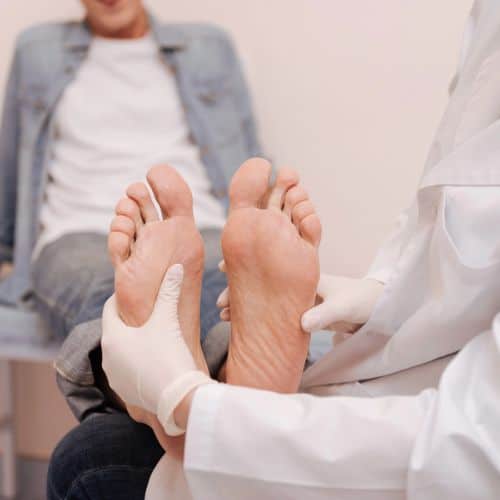
The analysis begins with taking a complete history, followed by a thorough examination of the ailing joint. The condition of the ankle’s soft tissues, and its range of motion are closely observed.
X-rays of the foot and ankle provide an overall impression of the ankle and adjacent joints. Sometimes a second level of testing is necessary. This may include an MRI or CT. These images will display the joint, its cartilage, and the surrounding soft tissue in greater detail.
Sometimes a tiny camera is inserted within the joint. This enables the surgeon to plan the surgery while directly observing the damage that needs repair.
Conservative treatment for early-stage ankle arthritis
With ankle arthritis in its early stages, it’s best to consider available conservative options. These measures will avoid, or at least delay, the need for surgery.
Bone spurs, loose fragments of bone, or joint hinge problems often coexist with early-stage arthritis. A simple surgery, beginning with two small one-centimeter incisions, enables an arthroscopic cleanup of the loose bone fragments, spurs, and hinge catches.
Stem cells and platelet-rich plasma for ankle arthritis
The cleanup surgery can be performed in parallel with infusions of platelet-rich plasma, which help reduce inflammation and its associated pain. Injections of autologous stem cells can also help the patient’s body to repair the damaged cartilage and promote the generation of new cartilage.
The stem cells required for this process are derived from the patient’s own bone marrow or adipose tissue (a polite term for fat).
End-stage ankle arthritis: ankle fusion vs. ankle replacement
Surgical immobilization of the ankle joint, a.k.a. ankle fusion, is appropriate when the consequences of ankle arthritis are intolerable, and all other measures have failed. A mechanical structure compensates for the missing cartilage by permanently separating the ankle’s bones from each other.
The entire ankle joint can also be replaced by an artificial assemblage. Recent advancements in total ankle arthroplasty come close to replicating the function of an original equipment ankle.
However, the effective lifespan of currently available ankle replacement devices is 10-15 years. This means that a younger patient may need a second replacement later on. That makes it important to devise a way to defer that first replacement for as long as possible.
Moderate stage ankle arthritis is the toughest to treat
Moderate stages of ankle arthritis have posed the greatest difficulty to podiatric surgeons:
- Cases in which large areas of cartilage have been damaged or eroded.
- Cases that are beyond the reach of plasma injections, stem cell infusions, and cleanup surgeries, but do not yet demand major invasive surgery. These cases are common.
Our solution to treating moderate-stage ankle arthritis
Until recently, a satisfactory replacement system for large areas of damaged or eroded cartilage did not exist. But there are areas of the body where excess cartilage does exist. So we devised a process to harvest the patient’s own cartilage from parts of the ankle and knee, which have cartilage to spare.
Cartilage is not a passive, inert substance. It is alive and full of active cells. We have found that using our patients’ very own cartilage as a living graft, transferred during the surgical procedure, is a very effective way to replace absent cartilage and repair damaged cartilage.
How the cartilage replacement procedure works

Our cartilage replacement procedures are performed in an outpatient surgical center, under mild sedation and a local anesthetic block. The patients are awake, aware, and breathing spontaneously. Our patients generally report that this procedure is not an unpleasant experience.
- Through an arthroscopic technique, the required amount of redundant cartilage is harvested from the patient’s knee or ankle. This cartilage is then morselized, i.e., reduced to tiny fragments, and set aside.
- Next, the ankle joint is opened. All spurs and loose bone fragments are excised. We remove the damaged cartilage and drill small holes into the underlying bone. This process creates nooks and crannies where the implanted cartilage will establish a foundation.
- The morselized cartilage is then mixed with a concentrate of the patient’s own stem cells. We spread this cartilage/stem cell mixture on the exposed bone, like icing on an aerated cake. A material called Fibrin, analogous to a natural glue, holds the cartilage in place until it can grow and thrive within the joint.
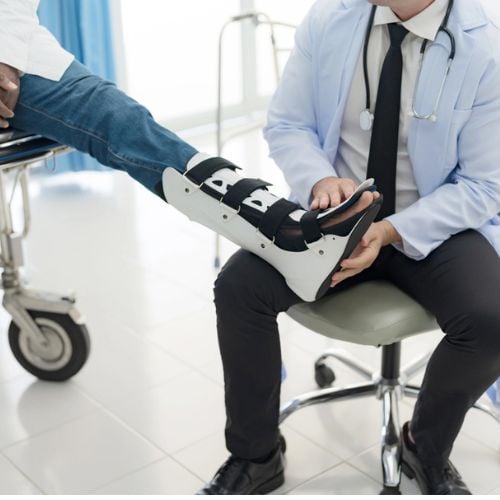
After surgery, the patient will be on crutches, with the ankle bearing no weight at all, for about eight weeks. This gives the grafted cartilage time to permanently merge with the bone it will be shielding. About a week post-surgery, range of motion exercises will begin. Normal walking is often restored within three months, and full recovery can take up to six months.
Dr. Bob provides treatment for middle-stage ankle arthritis
Severe cases of end-stage arthritis may still be best resolved by ankle fusion or total ankle replacement. However, our morselized cartilage replacement system, when combined with stem cell concentrate, enables our younger patients and those with moderate arthritis to successfully avoid or defer fusion or replacement.
Why choose Dr. Bob Baravarian for your foot and ankle care?
If you’re experiencing serious ankle issues such as ankle arthritis, or any other foot problems, Dr. Bob is here to help. As a nationally recognized foot and ankle specialist, he provides advanced podiatric care with some of the highest success rates in the nation and is a leader in the research and treatment of all foot and ankle conditions.
To schedule a consultation, please call (855) 557-5400 or make an appointment now.
Dr. Bob Baravarian is conveniently located in Los Angeles, near Cedars-Sinai Medical Center, providing expert foot and ankle care for patients throughout Southern California.