Floating toe syndrome, also called “floppy toe” or “flail toe,” is a deformity in which one or more lesser toes lift off the ground and stay suspended in the air while walking. The second toe is most commonly affected, though any smaller toe can develop this condition. Unlike bunions or heel pain, floating toe syndrome is often dismissed as a minor nuisance – but left unaddressed, it quietly disrupts your biomechanics, strains your joints, and sets the stage for more serious deformities down the line.

How Serious Is Floating Toe Syndrome?
When we walk, our toes should stay in contact with the ground for about 75% of the time. That ground contact distributes load evenly across the foot, drives the push-off phase of your stride, and stabilizes your spine and joints above. When a toe floats, that load-sharing breaks down.
Early on, you may notice nothing beyond extra joint stiffness after a long day. Over time, the body compensates – shifting weight, shortening stride, adjusting posture – and those small adaptations accumulate into real wear and tear on your knees, hips, and lower back. One of the first signs is chronic metatarsalgia, or pain in the ball of the foot, as the metatarsal head beneath the floating toe absorbs forces it was never designed to handle alone.
What Causes a Floating Toe?
Floating toes develop when the balance of forces acting on the metatarsophalangeal joint (MTP joint) is disrupted. Common mechanical triggers include:
Upward displacement of the metatarsal bones, lifting the toe off the ground.
Tight extensor tendons or dorsal ligaments that pull the toe into dorsal contracture.
Big toe misalignment that crowds or “pushes” the lesser toes out of position.
Restricted big toe motion (hallux limitus) that forces the foot to compensate through the lesser toes.
An MTP joint that is too stiff or compressed by neighboring toes.
Think of the foot as a finely balanced house of cards. Any dysfunction – a bunion, a tight tendon, a torn ligament – can topple the structure in ways that seem unrelated at first. Below are the most common clinical pathways Dr. Bob sees.
Bunions and Hammertoe
Bunions (hallux valgus) push the big toe inward, crowding the second toe and forcing its MTP joint upward. That pressure can trigger a hammertoe – a fixed bend at the middle joint of a lesser toe. Once the joint stiffens in that bent position, the toe tip can no longer reach the floor, resulting in a floating toe. The cascade rarely stops there: a floating second toe increases the risk of hammertoe on the third and fourth toes, compounding the original bunion discomfort.
Claw Toes
Claw toes occur when the proximal interphalangeal joint curves sharply upward, giving the toe a claw-like appearance. They almost always affect multiple toes simultaneously. As the proximal phalanx of the second toe arches higher, the toe tip loses ground contact entirely, creating a floating toe. A floating second toe then increases the likelihood that the third, fourth, and fifth toes will follow the same curling pattern.
Floating Toe After Surgery
Sometimes the treatment becomes a contributing cause. Several common foot procedures can cause a floating toe when soft tissue or bone length isn’t perfectly balanced during the original operation.
Weil osteotomy: Even a few millimeters of over-shortening can leave the toe too short to contact the ground. Complications from Weil osteotomies do occur, and the floating toe is among the most frustrating for patients who expected a straightforward recovery.
Joint resection (arthroplasty): Removing too much bone from the metatarsophalangeal joint can destabilize the toe, leaving it without the structural support needed to stay grounded during walking.
Arthrodesis (joint fusion): Fusing a toe joint at a slightly incorrect angle – or fusing it while adjacent structures remain lax – can shift the mechanical load in a way that causes the toe to lift off the ground over time.
Flexor tendon lengthening: Procedures that release or lengthen the flexor tendon to correct hammertoe or claw toe can inadvertently remove the downward pull that keeps the toe planted, resulting in a floppy, non-weight-bearing digit.
Post-surgical floating toe is particularly challenging because scar tissue forms around the joint and tendons after the first operation. This fibrous tissue changes the anatomy, making revision surgery more technically demanding than the original procedure. Patients often visit multiple providers before finding a surgeon with the reconstructive experience to address it properly.
Patients who have had prior foot surgery and are now experiencing a floating toe are excellent candidates for a second-opinion consultation with Dr. Bob, who specializes in revision and reconstructive procedures. Using pioneering bio-integrated, non-metal hardware that becomes bone over time, Dr. Bob is able to restore proper toe alignment without leaving any metal behind – meaning no hardware removal surgery down the road and a faster, more comfortable recovery. His tailored treatment plans are built around each patient’s unique anatomy and surgical history, giving even the most complex revision cases the personalized care they deserve.
Plantar Plate Injury
The plantar plate is a dense fibrocartilage structure on the sole of the foot that anchors the toes to the metatarsal heads and resists upward displacement. Think of it as a strong, flexible strap running underneath the base of each toe – when it’s intact, it keeps your toe pressed firmly to the ground with every step you take. When this plate tears – from repetitive overload, a sudden sprain, or nerve damage affecting the surrounding tissue – it loses its ability to hold the toe down. The flexor tendon loses its anchor point, the extensor tendon wins the tug-of-war, and the toe rises.
Plantar plate tears are more common than most people realize, and they’re frequently misdiagnosed as a simple sprain or Morton’s neuroma. The tell-tale signs include pain and swelling at the ball of the foot, a sensation that something has “shifted” under the toe, and gradual upward drifting of the affected digit. Left untreated, the deformity becomes progressively more rigid and far harder to correct.
Dr. Bob diagnoses plantar plate tears with a careful physical examination – including the drawer test, which checks for abnormal upward movement of the toe – followed by weight-bearing X-rays to assess joint alignment and ultrasound or MRI to visualize the soft tissue damage directly. MRI is particularly valuable for grading tear severity and guiding the treatment plan.
Treatment begins conservatively, with offloading insoles, toe splinting, and buddy taping to reduce stress on the injured plate. For patients whose tears are caught early, Dr. Bob’s regenerative approach – including platelet-rich plasma (PRP) injections drawn from your own blood – can stimulate the body’s natural healing response and help restore tissue integrity without surgery. When conservative care isn’t enough, Dr. Bob offers metal-free plantar plate repair surgery to correct toe alignment and restore function with non-metal hardware that integrates with bone, so there’s no metal to remove, and recovery is faster.
Symptoms of Floating Toe Syndrome
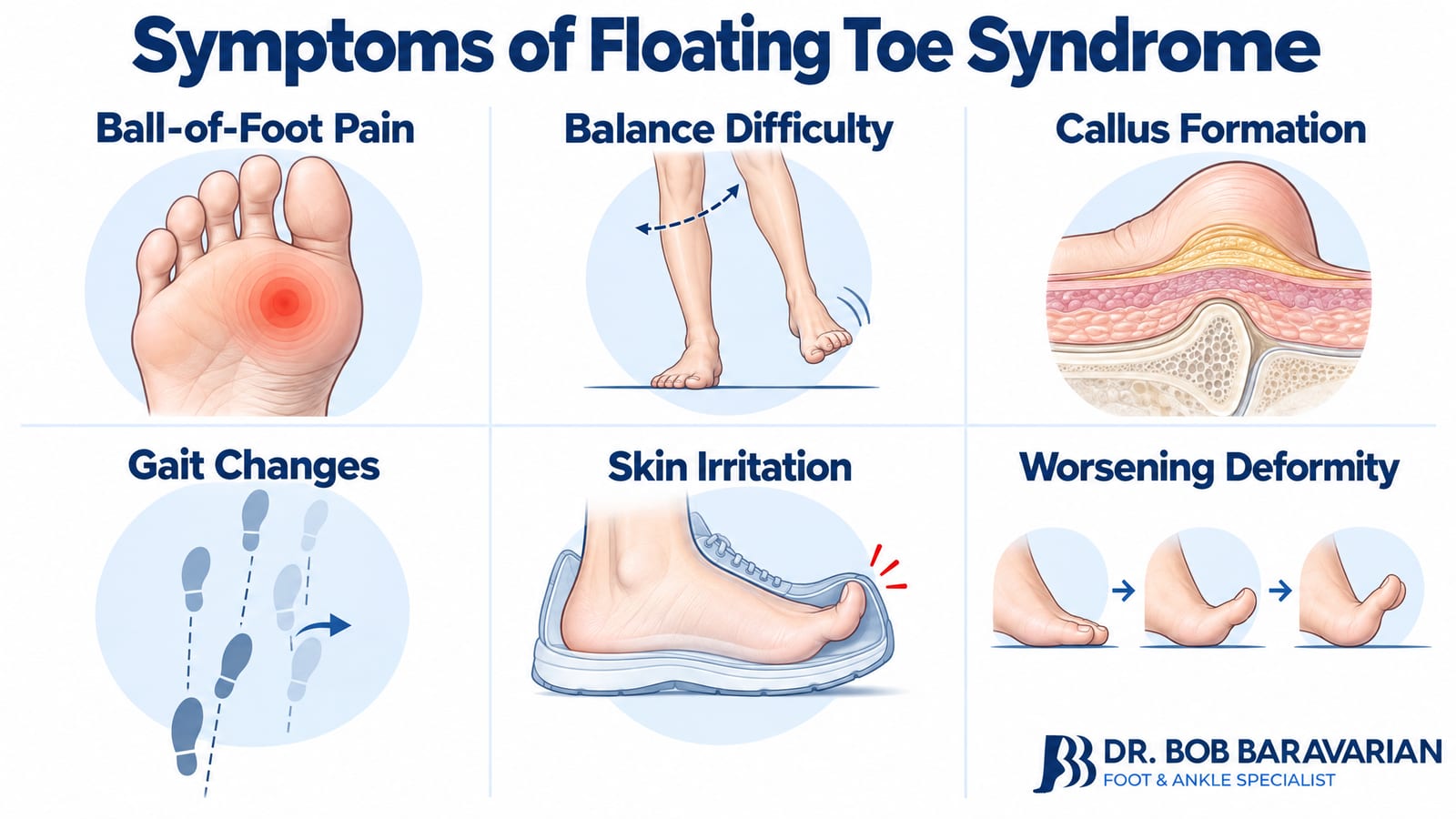
Floating toe syndrome can be subtle at first. Watch for these signs:
Pain in the ball of the foot (metatarsalgia): The metatarsal head beneath the floating toe bears extra load, causing aching or burning under the forefoot.
Difficulty balancing: With one or more toes not gripping the ground, stability while standing and walking decreases.
Callus formation: Skin thickens under adjacent toes or the ball of the foot as those areas absorb the displaced pressure.
Gait changes: You may unconsciously shorten your stride, slow your pace, or shift weight to the outer edge of the foot to avoid discomfort.
Skin irritation or rubbing: The elevated toe can press against the top of a shoe, causing redness, blisters, or corns.
Worsening deformity: Without treatment, the toe drifts higher, and the surrounding toes begin to compensate, accelerating the overall misalignment.
How Is Floating Toe Diagnosed?
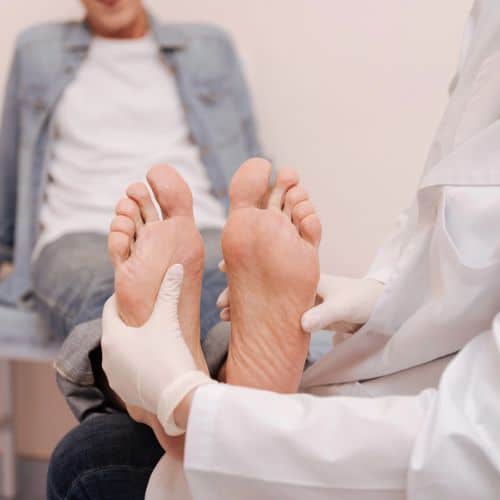
Diagnosis begins with a thorough physical examination. Dr. Bob observes the foot at rest and during weight-bearing to assess how much ground contact the affected toe maintains. He evaluates MTP joint flexibility, checks for dorsal contracture, and tests plantar plate integrity with a gentle drawer test.
Weight-bearing X-rays reveal the position of the metatarsal heads and any bony changes contributing to the deformity. Ultrasound is the preferred imaging tool for assessing plantar plate tears in real time, while MRI provides additional soft-tissue detail when the diagnosis is uncertain. Gait analysis – watching how you walk – rounds out the picture by identifying compensatory patterns that may be stressing other joints.
Can a Floating Toe Be Corrected?
Yes – with the right approach matched to the severity of your condition. Treatment falls into two broad categories: conservative management and surgical correction.
Conservative Floating Toe Management
For most patients, conservative treatment is the first and often most effective step. Dr. Bob takes the time to assess each patient’s unique presentation before recommending a tailored treatment plan – because the right non-surgical approach can make a meaningful difference in slowing deformity progression and relieving daily discomfort. Options include:
Toe splinting and taping: A toe splint holds the affected toe in a downward position, gradually retraining the soft tissue and relieving pressure on the metatarsal head. Buddy taping to an adjacent toe can also help stabilize the digit during walking and reduce the sensation of the toe lifting off the ground.
Custom orthotics: A prescription orthotic redistributes load away from the painful metatarsal head and supports the plantar plate, slowing deformity progression. Unlike over-the-counter insoles, a custom device is molded to your specific foot mechanics – an important distinction when the underlying cause involves plantar plate instability or uneven forefoot loading.
Physical therapy: Targeted exercises strengthen the intrinsic foot muscles and improve the balance between flexor and extensor tendons. Towel scrunches, toe-spread exercises, and single-leg balance work are commonly prescribed to rebuild the muscular control that keeps the toe grounded during push-off.
Footwear adjustments: Shoes with a wide toe box and adequate depth reduce compression on the floating toe and neighboring digits. High heels shift weight forward onto the metatarsal heads and should be avoided. A stiff-soled shoe or rocker-bottom design can further offload the forefoot, giving irritated soft tissue the rest it needs to recover.
PRP and regenerative therapy: For floating toes driven by plantar plate injury, Dr. Bob’s regenerative approach – including PRP injections – can stimulate healing in the damaged tissue without surgery, consistent with his pioneering use of minimally invasive and regenerative techniques. Platelet-Rich Plasma harnesses your body’s own growth factors to accelerate tissue repair at the site of injury, offering a compelling non-surgical option for patients who are not yet candidates for – or who wish to avoid – an operation. In select cases, Amniotic Fluid Allograft Therapy or Softwave Therapy may also be considered as part of a personalized, regenerative care plan.
Conservative strategies offer predictable, lower-risk outcomes and are the preferred starting point for most patients. When these measures are started early and followed consistently, many patients experience meaningful improvement – and in some cases avoid surgery altogether. If conservative care has not delivered relief after a reasonable trial period, Dr. Bob will walk you through the surgical options with the same compassionate care and unmatched skill that has made him the surgeon other doctors trust for their toughest cases.
Surgical Correction for Floating Toes
Surgery is considered when conservative care fails, or the deformity is too advanced to respond to non-invasive measures. Correcting a floating toe surgically means adding length – even a few millimeters – to restore ground contact. The standard technique is a flexor-to-extensor tendon transfer, which reroutes the flexor tendon to counteract the extensor’s upward pull. In more severe cases, bone grafting can lengthen the metatarsal and relieve the dorsal contracture.
This procedure is more technically demanding than simple metatarsal shortening or joint fusion. If prior surgery has already been performed on the toe, existing scar tissue raises the complexity further – the more the soft tissue has been disturbed, the less predictable the final position. When multiple toes are involved, the procedure becomes significantly more intricate. Dr. Bob is the surgeon other doctors trust for exactly these kinds of challenging reconstructive cases.
Can Floating Toe Be Prevented?
Not every case is preventable, but many are. The most effective steps are:
Wear shoes with a wide toe box: Narrow, pointed footwear compresses the lesser toes and accelerates MTP joint stress. Choose shoes that allow the toes to lie flat and spread naturally.
Limit high-heel use: Heels shift body weight onto the forefoot, overloading the metatarsal heads and straining the plantar plate over time.
Treat related deformities early: Bunions, hammertoes, and claw toes that are addressed before they become rigid are far less likely to progress to a floating toe.
Address foot pain promptly: Pain in the ball of the foot is often the first warning sign of plantar plate stress. Early evaluation and conservative care can prevent a partial tear from becoming a full rupture.
Maintain foot strength: Simple intrinsic muscle exercises – toe curls, towel scrunches, single-leg balance work – help preserve the dynamic stability that keeps toes grounded.
When Should You See a Podiatrist for a Floating Toe?
It can be tempting to brush off a floating toe as a minor annoyance – especially if it doesn’t hurt much at first. But waiting too long can allow the underlying problem to progress, making treatment more complex down the road. So how do you know when it’s time to stop self-managing and book an appointment?
Here are some clear signals that it’s time to see a specialist:
Your toe has visibly lifted off the ground and doesn’t return to a normal resting position, even when you’re barefoot and relaxed.
You’re experiencing persistent pain in the ball of your foot, especially during walking or standing for extended periods.
Calluses or corns are forming under neighboring toes, which often means your gait has shifted to compensate for the floating toe.
You feel unsteady on your feet or notice changes in the way you walk – both are signs the condition is affecting your overall balance and biomechanics.
Conservative measures aren’t helping. If taping, orthotics, or wider shoes haven’t made a noticeable difference after a few weeks, it’s time for a professional evaluation.
The condition appeared after a previous foot surgery. Post-surgical floating toe can involve scar tissue and structural changes that require a highly experienced hand to address properly.
The earlier you seek care, the more treatment options are available to you – including minimally invasive and regenerative approaches. If you’re in the Los Angeles area, Dr. Bob and his team offer personalized, compassionate care with a tailored treatment plan built around your specific needs. Don’t wait until a manageable problem becomes surgical.
Need Floating Toe Correction Near L.A.? Dr. Bob Is Your Best Bet
Dr. Bob is one of SoCal’s leading centers for the holistic treatment, management, and prevention of foot and ankle issues. He specializes exclusively in foot care and understands how a floating toe, a plantar plate tear, or a subtle metatarsal problem can ripple through your entire body. Dr. Bob takes the time to get to know every patient personally, tailoring each treatment plan as if he were caring for his family.
To schedule a consultation, please call (855) 557-5400 or make an appointment now. Dr. Bob Baravarian is conveniently located in Los Angeles, near Cedars-Sinai Medical Center, serving patients throughout Southern California.