If you’ve been told you need foot or ankle surgery, one of the first questions you might have is: what happens to the hardware once the bone heals? For decades, the answer was that it stays in there unless it causes enough trouble to warrant another procedure to remove it.
But that equation is changing. Dr. Bob Baravarian recently joined Jennifer Spector, DPM, on the Podiatry Today Podcast, produced by HMP Global, to discuss a newer class of surgical implants called biointegrative fixation and why he believes it could fundamentally shift how foot and ankle surgery is done.
You can listen to the full episode on the HMP Global Learning Network.
What is biointegrative fixation, exactly?
Traditional surgical fixation in foot and ankle procedures relies on metal hardware, such as cancellous screws, staples, nails, and anchors made from titanium or stainless steel. The upside is that these hold the bone in place while healing occurs. The downside is that they remain in place indefinitely, which can lead to irritation, metal sensitivity reactions, and the need for a second removal procedure.
Biointegrative implants take a completely different approach. These implants are made from a combination of silica and calcium phosphate: materials that occur naturally in our bodies. This means that these devices will gradually be replaced by your own bone over a period of six months to a couple of years.
The older absorbable or resorbable hardware broke down, leaving a void or cystic changes in the bone. Biointegrative material, on the other hand, acts more like a bone graft. The body fills it in and replaces it completely, restoring the natural cortex and leaving nothing behind.
At the time of implantation, we use biointegrative self-tapping cortical screws within a comprehensive screw system with optimized thread pitch, staples, nails, and anchors. This comprehensive system offers fixation strength and pull-out resistance comparable to those of metal hardware. And rather than loosening over time as metal hardware tends to do, biointegrative implants become stronger as the surrounding cancellous bone and cortical bone attach to them.
The problem with hardware removal, and how biointegrative fixation solves it
Dr. Baravarian is candid about why he’s moved toward biointegrative options: in his words, hardware removal surgery is “the worst surgery” to perform. This is especially true when a metal screw head becomes stripped or buried. The operation itself is technically demanding. Plus, the screws strip, break, or become difficult to extract. The only realistic outcome is that everything went as expected. There’s no upside, just risk.
For patients, a secondary removal procedure means additional anesthesia, recovery time, cost, and inconvenience. For the healthcare system, it represents a high and often avoidable cost.
Biointegrative internal fixation eliminates that scenario entirely, because once the medical device is replaced by bone, there is nothing left to remove.
The clinical benefits extend to imaging as well. Metal hardware degrades the quality of MRI and CT scans, a real problem when you need to evaluate a patient post-operatively for a new injury or a complication. Biointegrative implants don’t produce metal artifact, which means clearer images and better diagnostic information.
Dr. Baravarian’s ghost foot and ankle surgery: the clean X-ray patients actually want
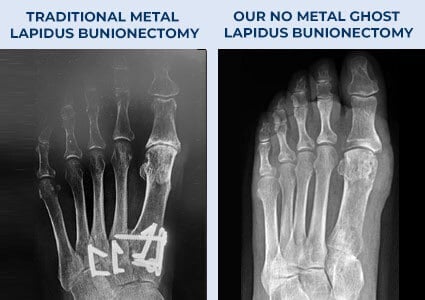
One of the more memorable points Dr. Baravarian makes on the podcast concerns what he calls “ghost surgery”. In other words, a procedure that leaves no visible hardware on an X-ray. He has long championed metal-free surgical techniques and notes that while surgeons often take pride in the look of a well-placed screw on a post-op image, patients see it very differently.
For patients, hardware is an unwelcome surprise, something foreign that’s now permanently in their foot. A clean X-ray, with the bone healing cleanly and no metal in sight, is far more reassuring.
There’s also the matter of ongoing irritation. Metal screws and staples can press against soft tissue, cause cold or nickel allergies, and create low-grade inflammation that continues long after the surgical site is otherwise healed. Biointegrative implants adhere to bone, integrate into it, and carry essentially no risk of the reactions associated with retained metal.
Who is a good candidate?
According to Dr. Baravarian, there are very few situations where biointegrative fixation is contraindicated, as the list of absolute contraindications is minimal. To put it another way, biointegrative hardware suits almost every situation.
The current limitation is a practical one: large plates for screw fixation, the kind used to stabilize fibular or femoral fractures, for example, aren’t yet available in biointegrative formats. But for the vast majority of foot and ankle fixation needs, we have the hardware, and it is usually the better option. This includes various osteotomies, arthrodesis, and:
- bunion correction
- hammertoe repair
- ankle instability procedures using anchors
- fracture fixation with screws or staples
- tendon reattachment with anchors
Biointegrative options are now available and, in Dr. Baravarian’s view, preferable to metal.
Does it change how surgery is performed?
The short answer: not at all. Surgical technique, fixation strategy, and postoperative protocols remain the same. The implants are used in exactly the same way as their metal equivalents, following the same protocols for sterilization and handling. For surgeons already familiar with standard fixation methods and the use of a traditional screw driver for screw insertion, transitioning to biointegrative hardware doesn’t require a learning curve, just a willingness to try a better material.
What’s ahead for biointegrative technology?
The field is still developing, with new screw designs, varied thread lengths, and improvements to screw tips continually emerging. Screws, including cannulated screws and compression screws of varying screw diameters placed over a guide wire, nails, staples, and anchors, are all currently available in biointegrative formats. Plates, the locking screw, and the bio-integrative fully threaded screw are in development.
Dr. Baravarian’s prediction: within the next 10 years, the need for metal fixation in foot and ankle surgery will largely disappear.
That’s a bold claim, but it’s grounded in the data. Metal reactions are more common than many patients and even physicians realize. Hardware removal procedures are costly and carry real surgical risk. And the long-term advantages of a fixation system that becomes bone, rather than simply sitting next to it, are hard to argue with.
Hear it directly from Dr. Baravarian
Whether you’re preparing for an upcoming surgery and want to understand your options or you’re simply curious about what’s new in foot and ankle care, this podcast
episode is worth a listen. Podiatry Today is an award-winning publication produced by HMP Global, one of the leading medical education platforms in the country, and its podcast series brings the same clinical rigor to audio that the journal brings to print.
Listen to Dr. Baravarian’s full conversation on biointegrative fixation here.
Ready to learn more about your surgical options?
If you’re facing foot or ankle surgery and want to understand all of your options, including metal-free approaches, the team at University Foot and Ankle Institute is here to help. Dr. Baravarian and our surgical team offer comprehensive evaluations and access to the latest orthopedic and orthopedic fixation technologies, so you can make an informed decision about your care.
Request an appointment today and take the first step toward a confident recovery.
Source: Notes on Biointegrative Fixation. Podiatry Today Podcast, HMP Global Learning Network. Published March 20, 2026. Featuring Bob Baravarian, DPM, FACFA