Dr. Baravarian explains how the Ghost Non-Metal Bunionectomy® is revolutionizing bunion surgery
The Ghost Bunionectomy: Eliminating Metal from Bunion Surgery
Recent statistics show that 81% of people experience foot pain. One common cause of this pain is a bunion, a deformity of your big toe joint. But another source of pain is often the metal screws and plates used in surgery for decades. So I decided to do something about it.
For over 25 years, I have been refining bunion surgery. And I’ve now developed three proprietary bunion surgery techniques removes all metal from bunion surgery, for most patients, no matter how severe their bunion is.
About Dr. Bob Baravarian’s Breakthrough in Metal-Free Bunion Repair
I’m Dr. Bob Bavarian, and I am not your typical podiatrist. I am a Board-Certified Podiatric Foot and Ankle Specialist (ABFAS) and a Board-Certified Foot Surgeon and Reconstructive Rearfoot/Ankle Surgeon (RRA).
I am one of the few foot and ankle surgeons to hold both foot and reconstructive rearfoot and ankle certifications as a Fellow of the American College of Foot and Ankle Surgeons. I am also fellowship-trained post my residency in reconstructive foot and ankle surgery.
After completing my three-year residency at the University of Pittsburgh, focusing on sports medicine, reconstructive surgery, foot and ankle trauma, and diabetic limb salvage, I went to Dresden, Germany, to get additional training in reconstructive foot and ankle surgery. I then joined the podiatry team at UCLA.
From there, I founded University Foot and Ankle Institute, which is now affiliated with the Balance Health brand. In 2025, I founded DOCS Foot and Ankle in Los Angeles to emphasize personalized care for each person who needs my services.
Removing metal screws and hardware from surgery has been a passion of mine for well over a decade. While fixing the most complicated foot and ankle conditions and injuries has been something I’ve loved for over 25 years. Leaving metal screws and plates inside the human body, as surgeons have done since the advent of advanced orthopedic surgery, is not optimal. So I dedicated myself to finding a solution.
I have collaborated with a medical technology company for years to develop non-metallic surgical hardware for foot and ankle surgeries. And now, I am thrilled to announce that this dream has become a trusted surgical reality.
I am proud to be among the first and most experienced surgeons to make holistic, non-metal foot and ankle surgery a reality for my patients today.
Why the name “ghost bunion”?
Typically, traditional bunion surgery requires the use of metal screws, staples, and plates. However, postoperatively, this equipment can cause problems. Therefore, when developing the ideal bunion treatment, one of my criteria was to design options that eliminate the need for metal hardware.
I closely collaborated with a company to create a biocompatible, fiber-based product that naturally integrates with your bone over a two-year period, eliminating the need for metal.
Once the material is incorporated and gone, there’s nothing left behind to irritate your body. After two years, it is as if no surgery has been performed at all. Hence the name “ghost bunion.”
This proprietary technology is as strong as metal when inserted, but actually becomes stronger over time as it attaches to and integrates with your bone. This is known as the “sticky factor.” It enhances strength and accelerates healing in bone and bunion surgery, leading to faster recovery times.
So, what replaces the traditional metal bunion surgical hardware?
Each Ghost Bunionectomy uses OSSIOfiber® bio-integrative implants, shaped into pins, screws, and staples that take the place of traditional metal hardware.
These implants hold the bone securely while it heals, then are gradually replaced by your own bone over about 18 to 24 months through a process called bio-integration. Once that process is complete, there’s no hardware left behind to irritate the area or require removal.
Why are there three “Ghost NO METAL Bunionectomies?”
In my career, I have discovered there is no one type of bunion surgery that is right for all bunion patients. This fact was not overlooked as I developed the Ghost Bunion NO METAL Bunionectomy. I designed a range of metal bunion surgeries to treat all types of bunions, from the simplest and smallest to the most complex, largest, and even bunion revision cases.
By offering three types of bunion surgery, we can customize the procedure to each patient’s specific bunion deformity and needs. Since no single procedure works perfectly for every patient, selecting the right treatment plan is crucial for correcting any deformity and alleviating bunion pain.
The three types of Ghost Bunionectomy procedures we perform are:
The Ghost Bunion No-Metal Osteotomy Procedure
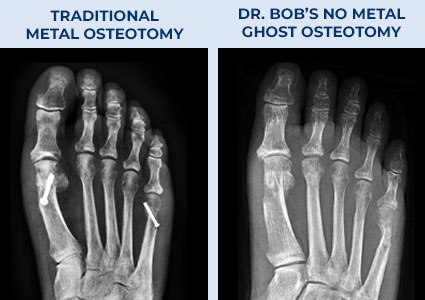
Our most common procedure is a ghost bunion osteotomy. This surgery is performed through a small incision on the side of the big toe. The incision provides access to the joint, allowing for the removal of spurs and excess bone, realignment of the bone with a cut, and stabilization with our fiber screw and pin.
Usually, this procedure involves an amniotic injection to help prevent scar tissue formation. Sometimes, we use a bone marrow aspirate if arthritis is present in the joint.
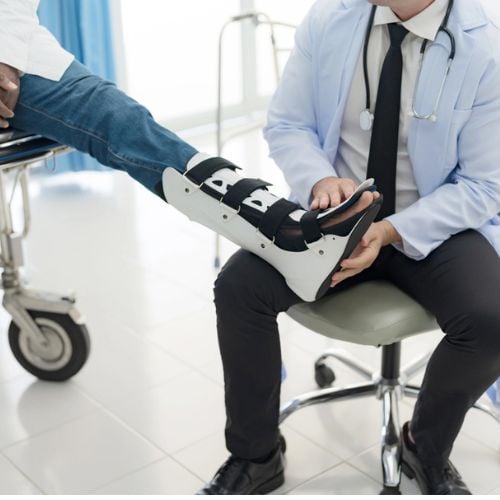
Our Ghost Bunion Osteotomy enables immediate weight-bearing in a boot and allows for a return to activity within 4-6 weeks.
The Ghost Bunion No-Metal Minimally Invasive Bunion Surgery
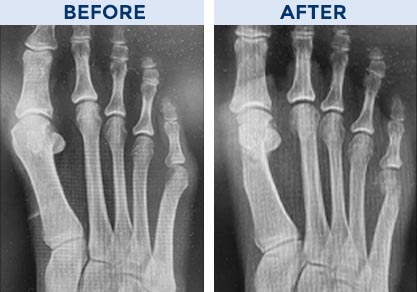
Our second option is our minimally invasive ghost bunion procedure. In this procedure, we use three small incisions to cut the bone and realign the bunion without opening the joint. We still utilize our fiber screw fixation, which becomes incorporated into the bone over a period of two years. This procedure reduces swelling and scar tissue.
Just like the ghost bunion osteotomy, the minimally invasive option allows for immediate weight bearing in a boot, and we use an amniotic injection to promote tissue healing and prevent scar formation. Patients typically return to wearing shoes at 6 weeks.
This option is not used in all bunion surgeries, especially if the joint is poorly aligned or the toe is significantly shifted.
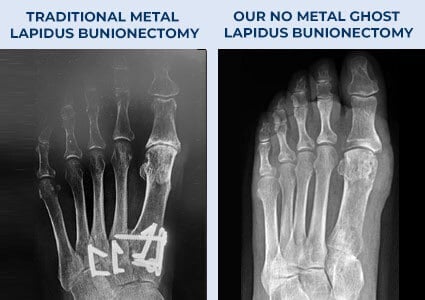
The Ghost Bunion No-Metal Lapidus Bunionectomy
Our most complex ghost bunion surgery is the Lapidus Ghost Bunionectomy. In this procedure, we realign the bone without cutting it. To do this, we stabilize the bone at its base to the midfoot (base of the big toe).
In this case, we utilize our non-metal, fiber screw and staple fixation system. We combine it with a bone marrow stem cell injection and an amniotic injection to help heal the bone and stabilize the toe in the correct position.
Our Lapidus Ghost Bunionectomy is used in cases of severe bunions or large and unstable bunions. Typically, it’s the preferred choice in revision cases where a patient’s previous bunion surgery has failed.
The recovery period is the longest for this procedure. You will use crutches, specifically a spring-loaded style, for additional comfort over the next 2 weeks. Then, you will spend 4-6 weeks in a weight-bearing boot before progressing to shoes.
Additional treatment improvements
My three ghost bunion procedures were a significant improvement in using minimally invasive bunion surgery to correct bunion deformities and give pain relief. However, it was not enough for me. I wanted to investigate what additional measures could be taken to expedite patient recovery and reduce the need for crutches, casts, and non-weight-bearing devices.
After designing the distinct procedures, I sought to identify the primary causes of bunion problems following surgery and develop strategies to address and mitigate these issues and complications. These include stiffness of the big toe joint, incision healing, swelling, time on crutches, and the need for a cast.
I have worked with individual companies to design patient-specific products. These products help me achieve the ideal outcome for my patients. For example:
- A bone marrow stem, stem cell, or plasma concentrate—useful in large and complex cases, as well as arthritis cases, which may require a boost for healing.
- An amniotic stem cell injection—used to enhance tissue healing and prevent stiffness and scar tissue around the joint, thereby improving the range of motion of the big toe; this injection also helps reduce pain and swelling.
- Our boots—designed to be the most comfortable and easy to walk in after surgery, so we rarely need to use a cast.
- When crutches are required, we can often reduce the recovery time from 6-8 weeks to just 2 weeks; in many cases, crutches are not needed at all.
For a close look at what to expect during recovery, see our week-by-week bunion surgery recovery timeline.
Why are non-metal bunion procedures so important?
The introduction of metal pins and screws was a major advancement 50 years ago. Metal fixation improved alignment, reduced pain, and allowed for faster recovery and earlier weight-bearing. Non-metal bunionectomy builds on these benefits while avoiding the drawbacks of hardware.
However, metal implants can sometimes trigger an allergic or foreign body reaction. And while screws are most secure when first inserted, they often loosen over time. This can cause pain if the screw shifts within the bone or even backs out completely. In many cases, the hardware must be removed, necessitating a second surgery and incurring additional costs.
What are the advantages of non-metal bunion surgery?
Dr. Bob Baravarian’s NO METAL Bunion surgeries combine the best advances in bunion correction with innovative, biointegrative fiber material that replaces metal. Unlike traditional hardware, the fiber naturally bonds with bone, adds stability during recovery, and is fully replaced by bone within two years—essentially doing its job and then disappearing.
Thanks to its unique “sticky factor,” the material adheres to surrounding bone, becoming stronger and more stable as you get more active, which means faster healing, less swelling, and little to no pain for many patients.
To further enhance recovery, Dr. Bob combines the fiber material with amniotic and bone marrow stem cells to promote healing and treat arthritis. Finally, he customizes the procedure to each bunion type and provides supportive post-operative shoes, boots, and crutches for a quicker and safer return to daily life.
What does “holistic no metal bunion surgery” mean to you?
The biggest improvement is this: Nothing is too big or complicated for us to handle.
We have refined these procedures over the past decade to make them the best possible options for achieving optimal results and shorter, smoother healing periods with reduced pain. We take the time to assess your personal situation, so we can give you our best medical advice.
Our goal is simple: choose the right procedure, perfect it for every patient, and get you back to your life with as little downtime, risk, and issues as possible.
Ghost No-Metal Bunionectomy FAQs
What is the newest bunion surgery?

The ghost bunion surgery is the most innovative and newest option for bunion surgery. Although many of the techniques of old bunion procedures are still used, we have adjusted and augmented the procedures using a fiber material for our screws, staples, and pins. This eliminates the need for metal hardware removal, as the fiber material incorporates and becomes integrated into the bone over a period of two years.
This is our NO METAL bunion procedure and is revolutionizing the bunion surgery world.
Are there any risks or complications associated with new bunion surgery techniques?
All surgery has risks associated with it. That being said, bunion surgery has undergone significant advancements in the past few years, reducing the risks associated with the procedure. Through proper incision placement and improved bone procedures, Dr. Bob Baravarian has almost eliminated the risks of cutting the bunion deformity. Furthermore, his NO METAL procedure removes the need for hardware removal and reduces the risk of pain from metal in the body.