If your first steps out of bed feel like stepping on a tack, you may already know plantar fasciitis all too well. It’s one of the most common causes of heel pain. For people whose pain just won’t go away, extracorporeal shockwave therapy (ESWT) has become a popular option.
Shockwave therapy is an effective non-invasive treatment for chronic plantar fasciitis, a common cause of heel pain. It works by delivering acoustic waves to the affected area, stimulating healing and reducing pain. Many patients experience significant relief, especially those who have not responded to other conservative treatments. DOCS Foot & Ankle offers shockwave therapy as part of its comprehensive care for heel and nerve pain.
A new review in The Journal of Foot and Ankle Surgery closely examined the research behind shockwave therapy. Instead of asking, “Does it work?” the researchers asked a different question: How solid are the numbers in the studies that say it does?
We asked Dr. Bob Baravarian of DOCS Foot and Ankle, who has used shockwave therapy to treat plantar fasciitis for years, what the findings mean for patients.

What is plantar fasciitis?
The plantar fascia is a thick band of tissue that runs along the bottom of your foot, connecting your heel to your toes. It works like a bowstring, supporting your arch with every step. When that tissue gets irritated, usually from overuse, the result is plantar fasciitis.
Common signs include:
- Sharp heel pain with your first steps in the morning
- Pain after standing for a long time
- Pain that flares up after exercise, not during it
Most people get better with simple care like stretching, supportive shoes, and rest. But some people are still hurting months later, even after doing everything right.
“Most heel pain improves with the basics, and that’s always where we start,” says Dr. Baravarian. “The patients I think about most are the ones who’ve stretched, changed their shoes, and been patient for six months or more, and they’re still limping in the morning. That’s often when shockwave therapy comes into the conversation.”
What is shockwave therapy?
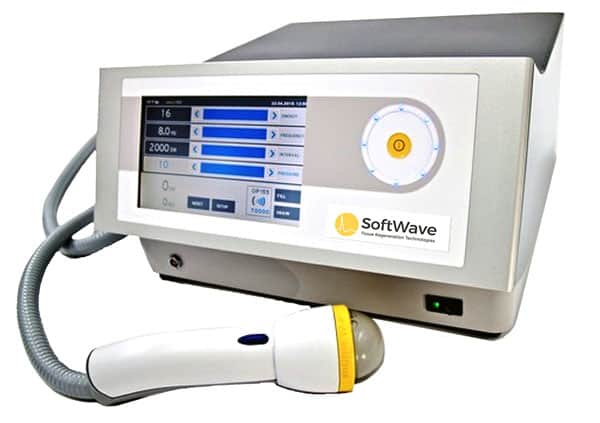
Shockwave therapy uses a handheld device to send strong sound waves through the skin and into the injured tissue. No cuts, stitches, or needles are involved, and treatment happens right in the office.
The idea is that these sound waves wake up the body’s natural healing process in tissue that has stopped healing on its own. Some well-designed studies, including a large multicenter trial of focused shockwave therapy, have reported meaningful improvement in heel pain.
“I explain it to patients like this: your plantar fascia has, in a sense, given up on healing,” says Dr. Baravarian. “Shockwave therapy gives it a nudge to get started again.”
What did the new study look at?
The researchers gathered 19 randomized controlled trials (RCTs) on shockwave therapy for plantar fasciitis. RCTs are considered the gold standard in medical research because patients are randomly placed into groups, which makes the comparison fairer.
From those 19 studies, the team pulled out 159 yes-or-no results. For example, a study might ask, “Did this patient’s pain improve by a certain amount: yes or no?” Then the researchers measured how “fragile” each result was.
What does “fragile” mean?
When a study finds a result is “statistically significant,” it means the result probably isn’t a fluke. But some results barely clear that bar.
Researchers measure this with something called the fragility index. It answers a simple question: How many patients would need a different outcome for the result to stop being significant?
Think of it like a basketball game. A team that wins by 30 points clearly played better. A team that wins by one point on a last-second shot still won, but a single bounce could have changed everything. A fragile study result is like that one-point win.
What did the researchers find?
Overall, the researchers found that many shockwave therapy results are fragile. Here’s what stood out:
- In a typical result, changing the outcome for just five patients could flip the finding.
- That’s only about 6% of the patients in a typical study.
- For the positive findings, the ones showing shockwave therapy made a difference, flipping roughly 3% of patients could change the conclusion.
- Results about physical function, like walking or doing daily activities, were the most fragile.
- Results measured with ultrasound images of the foot were the sturdiest.
- In about one in five results, more patients dropped out than were needed to flip the result.
That last point matters. It means that if the patients who dropped out had stayed in, some of these conclusions could have been different.
It’s also worth knowing that only 20 of the 159 results were statistically significant. Some of these studies compared shockwave therapy with other treatments rather than with no treatment at all. In those studies, “no clear difference” can mean shockwave therapy did about as well as another treatment, not that it failed.
The authors concluded that doctors should be careful when reading positive shockwave therapy results. They also recommended that future studies report how fragile their findings are.
Does this mean shockwave therapy doesn’t work?
No. This study didn’t test whether shockwave therapy works. It tested how solid the math is behind the studies already done.
Fragile results are actually common in medical research, especially in smaller studies. When a trial has a modest number of patients, just a handful of people can tip the scales. Researchers are still comparing shockwave therapy to other options, such as steroid injections for plantar fasciitis, to get a clearer picture.
“Honestly, I welcome a study like this,” says Dr. Baravarian. “You deserve to know how strong the evidence is behind any treatment, including the ones I offer. I’ve seen shockwave therapy help a lot of patients who felt like they were out of options, but no treatment is a sure thing, and I never want to promise that it is.”
He adds, “A fragile result isn’t a wrong result. It just means we need bigger, better studies to be sure. That’s how medicine moves forward.”
What this means for you

If you’re dealing with stubborn heel pain, this study isn’t a reason to rule out shockwave therapy. It’s a reason to go in with realistic expectations and good questions.
Here’s what Dr. Baravarian suggests keeping in mind:
- Shockwave therapy usually isn’t the first step. Most people should try stretching, supportive shoes, and other simple treatments first.
- It’s often a good fit for long-lasting pain. Many patients who consider it have had heel pain for six months or more.
- It works best as part of a plan. Stretching and the right footwear still matter during and after treatment.
- Results vary from person to person. Some people feel better quickly, while others need more time or a different approach.
It’s also smart to ask questions at your appointment. You might ask how many sessions you’ll need, how long it usually takes to feel a difference, and what the next step is if shockwave therapy doesn’t help.
“Shockwave therapy isn’t a magic wand,” says Dr. Baravarian. “It’s one tool. The goal is always to find the right combination of treatments for your foot and your life.”
Ready to take the next step for your heel pain?
If heel pain is slowing you down, our foot and ankle specialists at DOCS Foot and Ankle can help you understand your options, from simple at-home care to shockwave therapy and beyond. Contact us today to schedule a consultation.