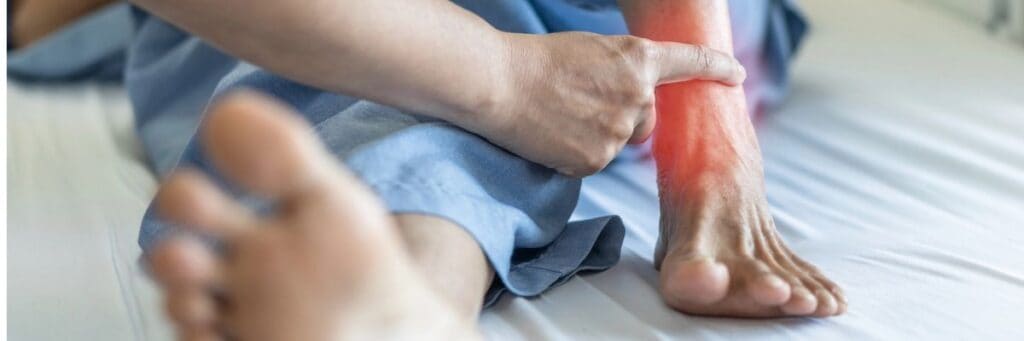
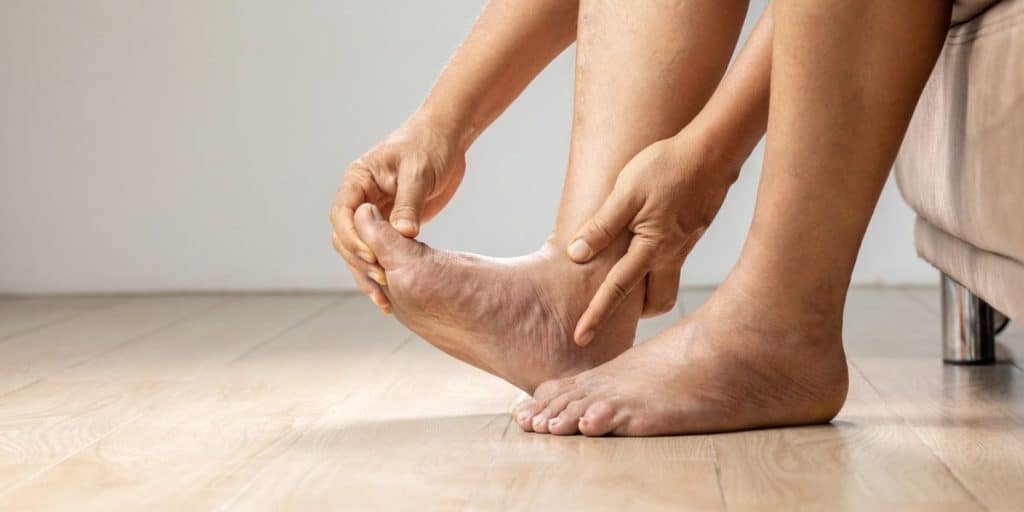
When humans walk, the propulsion that actually moves us forward occurs when the heel of our trailing foot has lifted, and we are pushing off on the toes of that foot.
At that moment, the metatarsophalangeal joint (MTP), a hinge between the toes and the ball of the foot, bends significantly. That constant bending and straightening require the internal musculature of the foot to flex and relax with each step.
It is well established that the evolutionary development of this hinge, and the concomitant ability to flex the toes in relation to the rest of the foot, is one of the key features of human evolution. It enabled our far distant ancestors to run down prey and to run away from predators. In other words, to survive.
What is toe spring?
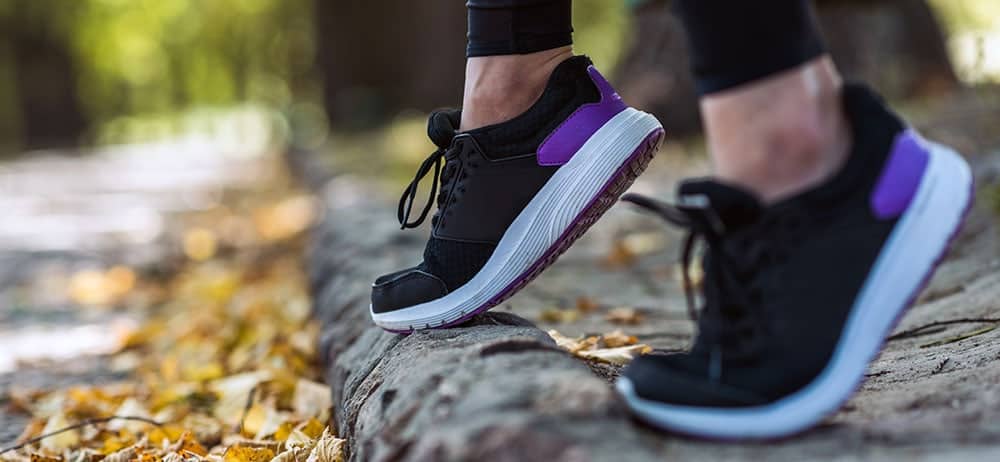
Recent trends in shoe design, especially in the making of running shoes and other athletic footwear, have resulted in that toe bend being made for you, by permanently tilting the toe box of the shoe. This mode of construction automatically elevates the forefoot. This feature of modern shoes, known as “toe spring,” has become just a bit controversial in the last decade or so.
Stylistically speaking, the controversy centers on the striking similarity between toe spring in some men’s dress shoes and the footwear of Santa’s elves. But let’s forget about style. This is a serious article about the biomechanics of foot function.
The foot biomechanics of walking: two schools of thought
Bear in mind that we are talking about normal shoes here, excluding the extremes of high heels, with their extravagantly excessive toe spring, and minimalist shoes, with no toe spring at all. The current industry standard for ordinary issues, both athletic and dress, is about 15 degrees of toe spring.
Makers of footwear with built-in toe spring contend that the effects of the toe spring are functionally beneficial. They claim that tilting the front of the shoe enables the foot to rock forward during the stance phase of walking. This “rocker” effect, they say, results in less work and a more natural and comfortable gait.
Critics demur, asserting that shoes with toe spring lock the toes into an unnaturally extended position. This may weaken the internal foot muscles and, allegedly, lead to foot problems, like hammertoes, capsulitis, and plantar fasciitis, as well as certain lower leg problems.
New research from Harvard on toe spring
A new study, recently published in Nature Magazine’s Scientific Reports, bears the impressive title: “Effect of the Upward Curvature of Toe Springs on the Foot Biomechanics of Walking.”
The study, led by Harvard University evolutionary biologist Daniel Lieberman and his colleague Freddy Sichting, suggests that, as is usually the case, the right answer is to be found between the extremes.
How did the toe spring study work?
The researchers recruited 13 participants, who:

- Ran on a custom-made treadmill. They first walked barefoot and then walked sequentially in four different pairs of specially designed sandals.
- The treadmill was equipped with an infrared camera system and force discs that measured how much power was put into each participant’s every step.
- The sandals were constructed of fiberglass plates and designed to mimic the stiffness and shape of toe springs commonly found in commercially available shoes.
- The curvature in the forefoot area of the sandals varied, simulating toe springs ranging from 10 to 40 degrees of curvature.
- The researchers visually recorded the participants’ strides with an eight-camera 3D motion capture system.
What we learned: excessive toe spring might lead to foot problems
The primary finding of the study involves the podiatric condition known as plantar fasciitis, which makes it necessary to briefly discuss what that condition is and how it is caused.
The plantar fascia is a wide, thick, and strong band of tough tissue. It runs along the bottom of your foot, from your heel to the base of your toes. It is essential to healthy foot function, because it literally puts the spring in your step and the arch in your foot
Overuse of the plantar fascia can result in severe inflammation, a condition known as plantar fasciitis. Plantar fasciitis is among the most common, and most painful, of foot problems. The pain can be excruciating, and the condition is often difficult to treat.
This illustrates the importance of the Harvard study’s findings. Excessive toe spring can lead to weakened foot muscles, and weakened foot muscles may lead to plantar fasciitis.
What happens when your toes are constantly pointed up?
It seems that, if the toe spring built into your shoes constantly elevates your toes, your internal foot muscles don’t have to do the repetitive work of lifting those toes with each step. Muscles that don’t work tend to atrophy. The result? The plantar fascia has to do the work which the muscles should have been doing.
As Dr. Lieberman, the study’s lead author, concluded: “We think that what happens is that people are relying on their plantar fascia to do what muscles normally do. When you get weak muscles and the plantar fascia has to do more work, it’s not really evolved for that and so it gets inflamed.”
More research needed on toe spring shoes
The Harvard research team emphasizes that their findings are preliminary, and those findings apply only to excessive toe spring. Much research has to be done before any firm conclusions can be reached.
What to look for in a good shoe
A moderate amount of toe spring, especially in athletic shoes with firm soles, arch support, and adequate cushioning, will continue to make walking both easier and more comfortable, without appreciably increasing the risk of plantar fasciitis.
[WPCT-CTA]
Why choose Dr. Bob Baravarian for your foot care?
If you’re experiencing problems with plantar fasciitis, pain in the ball of your foot, or any other foot issues, Dr. Bob is here to help. As a nationally recognized foot and ankle specialist, he provides advanced care with some of the highest success rates in the nation and is a leader in the research and treatment of all foot and ankle conditions.
For more information or to schedule a consultation, please call (855) 557-5400 or make an appointment now.
Dr. Bob Baravarian is conveniently located in Los Angeles, near Cedars-Sinai Medical Center, providing expert foot and ankle care for patients throughout Southern California.