What’s a Tailor’s Bunion?
A tailor’s bunion, also called a bunionette, is a bony prominence that forms on the outside of the foot at the base of the fifth toe. Specifically, it develops when the head of the fifth metatarsal – the long bone running along the outer edge of your foot – shifts outward, creating a visible bump at the little toe joint. The condition gets its name from tailors of centuries past, who sat cross-legged for hours with the outer edge of their feet pressed against the floor, creating constant friction and inflammation at that spot.

A tailor’s bunion is distinct from a traditional bunion, which forms on the inner side of the foot at the base of the big toe. Both involve a bony deviation, but a bunionette affects the forefoot’s outer border. The underlying mechanics are similar: the fifth metatarsal head gradually drifts laterally – away from the rest of the foot – while the little toe itself may angle inward to compensate, creating the characteristic bump you can see and feel through the skin.
The condition is more common than many people realize. It can affect people of all ages and both sexes, though it tends to run in families, suggesting that inherited foot structure plays a meaningful role. Narrow, pointed, or high-heeled footwear doesn’t cause a tailor’s bunion outright, but it absolutely accelerates its development by compressing the forefoot and increasing pressure directly over the fifth metatarsal head. Over time, that repeated irritation causes the overlying bursa – a small, fluid-filled sac – to become inflamed, adding redness and swelling to the bony prominence itself.
Understanding exactly what you are dealing with is the first step toward finding lasting relief. Whether your bunionette is mild and manageable or has been quietly worsening for years, there are effective options – and the right treatment plan starts with an accurate picture of what’s happening inside your foot.
What Causes a Tailor’s Bunion?
Tailor’s bunions are largely hereditary. A faulty mechanical structure of the foot – often passed down through families – causes the fifth metatarsal head to angle outward over time, producing the characteristic lateral deviation. This means that even if you wear sensible shoes your entire life, you may still develop a bunionette if the underlying foot mechanics predispose you to it.
That said, footwear choices can significantly accelerate the process. Tight, narrow, or high-heeled shoes compress the forefoot and push the fifth toe inward, increasing pressure on the outer metatarsal head. Feet also naturally widen with age, and patients who keep wearing the same shoe size without accounting for this change place ongoing stress on the area where a bunionette develops. Recognizing these contributing factors early gives you the best chance of slowing progression.
Tailor’s Bunion Symptoms
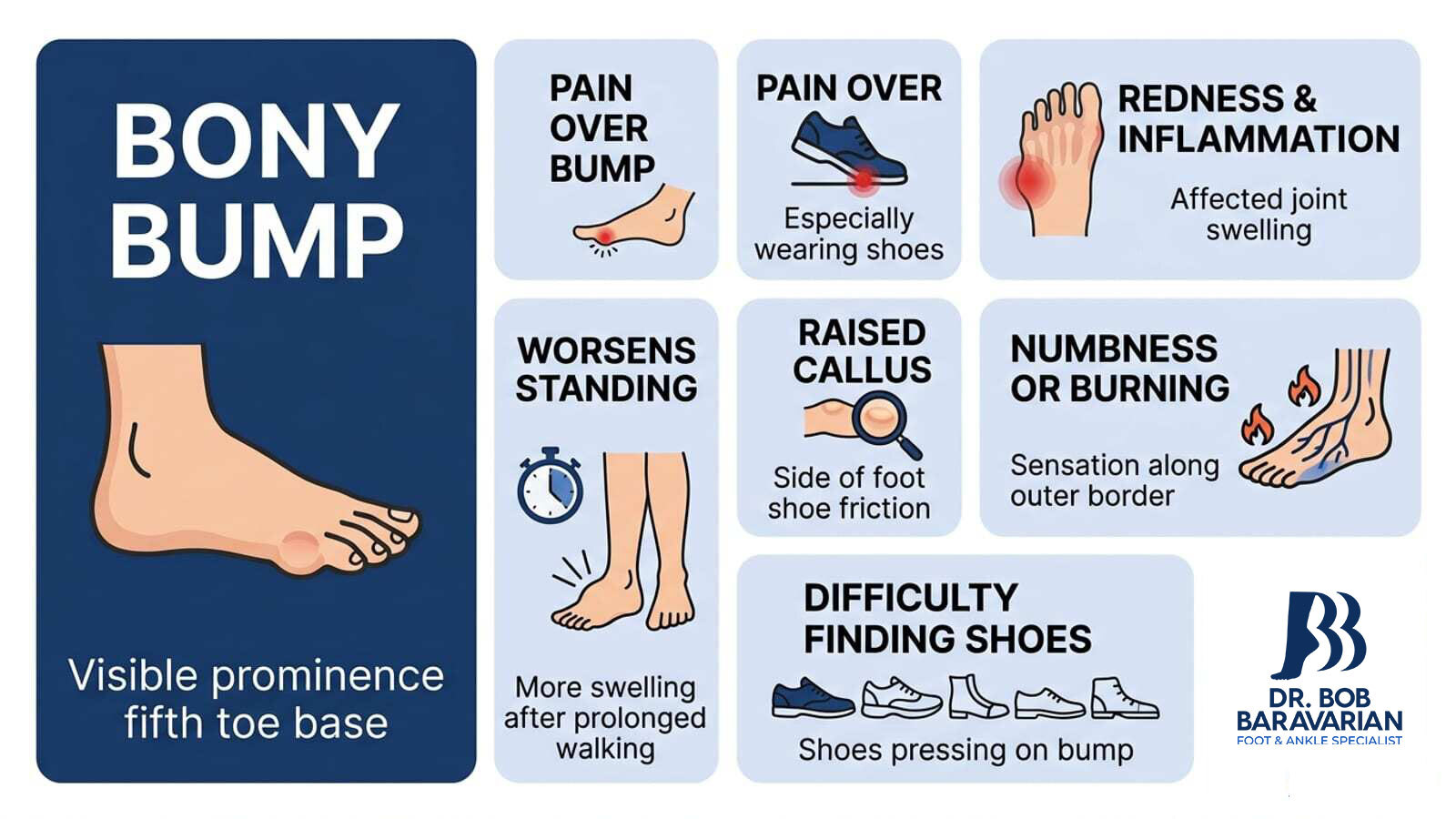
Symptoms can range from mild discomfort to significant pain that interferes with daily activity. Because the bump sits right where your shoe’s toe box presses against the foot, even a short walk in the wrong footwear can turn a minor ache into something that stops you in your tracks. Common signs of a tailor’s bunion include:
A visible bony bump on the outer edge of the foot at the base of the fifth toe
Pain and tenderness directly over the fifth metatarsal head, especially when wearing shoes
Redness and inflammation around the affected joint
Swelling that worsens after prolonged standing or walking
A painful raised callus on the side of the foot, formed where soft tissue rubs repeatedly against footwear
Numbness or a burning sensation along the outer border of the foot
Difficulty finding comfortable shoes that do not press on the bump
Symptoms that worsen with narrow, pointed, or high-heeled footwear
Skin that feels warm to the touch over the bump is a sign that the underlying bursa – a small fluid-filled sac – may be irritated or inflamed
Symptoms do not always follow a straight line. Some people manage for years with only occasional soreness, while others find the pain escalates quickly once the joint becomes inflamed. The pattern often depends on footwear habits, activity level, and the foot’s underlying shape.
If you recognize several of these symptoms, it is worth seeking an evaluation sooner rather than later. Early intervention almost always leads to simpler, less invasive treatment.
How Is a Tailor’s Bunion Diagnosed?
A tailor’s bunion is usually plainly visible during a physical foot examination. Dr. Baravarian will assess the bony prominence, evaluate your range of motion, and check for areas of tenderness, redness, or callus formation. If the foot anatomy appears irregular or the deformity seems significant, Dr. Baravarian will take X-rays to measure the exact degree of lateral deviation of the fifth metatarsal and guide treatment planning. This imaging also helps rule out other causes of outer foot pain, such as a stress fracture or arthritis of the fifth toe joint.
What Happens If a Tailor’s Bunion Is Left Untreated?
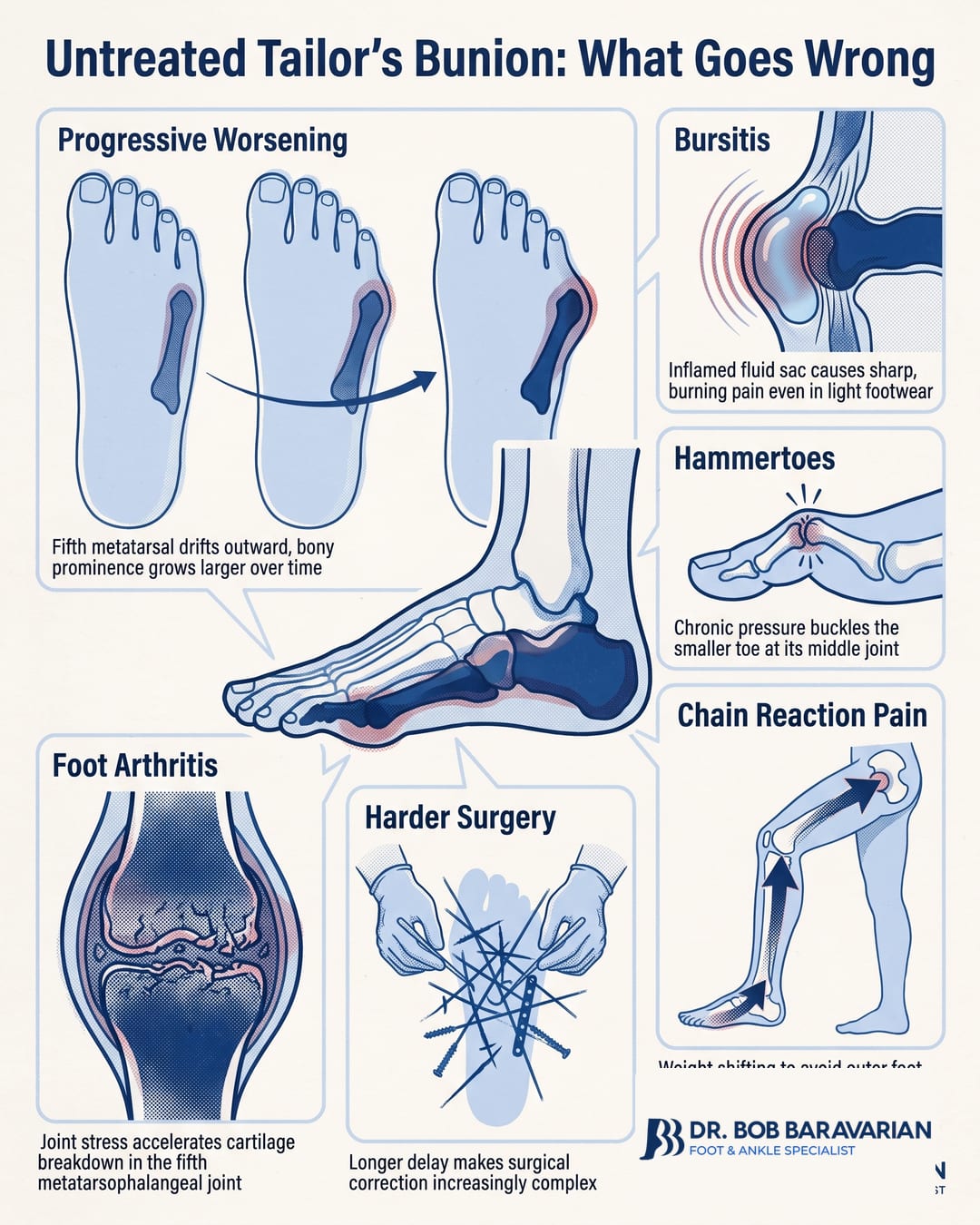
It is tempting to hope a bunionette will simply go away on its own, but without any management, the condition almost always worsens over time. The fifth metatarsal head continues to drift outward, the bony prominence grows larger, and the surrounding soft tissue becomes increasingly irritated. Leaving a tailor’s bunion untreated can lead to a cascade of secondary problems, including:
Bursitis: A fluid-filled sac called a bursa can develop over the fifth metatarsal head as the body tries to cushion the bone from friction. When this bursa becomes inflamed, it causes sharp, burning pain that makes even light footwear unbearable.
Hammertoes: Chronic pressure on the fifth toe can alter the mechanics of the smaller toes, contributing to hammertoe deformities in which the toe buckles at the middle joint.
Foot arthritis: Persistent joint stress and inflammation can accelerate cartilage breakdown in the fifth metatarsophalangeal joint, leading to degenerative arthritis that is much harder to treat than the original bunionette.
Worsening deformity: The lateral deviation of the fifth metatarsal tends to increase progressively, making surgical correction more complex the longer it is delayed.
Difficulty walking: As pain intensifies, patients unconsciously shift their weight to avoid pressure on the outer foot, which can create secondary problems in the ankle, knee, and hip.
The good news is that most of these complications are entirely preventable with timely, appropriate care. If you have noticed a bump forming on the outside of your foot, now is the right time to act.
Conservative Treatments for Tailor’s Bunion
The majority of patients with a tailor’s bunion find meaningful relief through non-surgical measures. It is important to be honest with you upfront: conservative treatments do not permanently correct the underlying bony deformity. They manage pain, reduce inflammation, and slow progression so many patients can live comfortably without ever needing surgery. Dr. Baravarian takes the time to work through every non-surgical option with you before discussing surgery.
Footwear Modifications
Switching to shoes with a wide toe box is often the single most effective first step. A wide toe box allows the forefoot to spread naturally without compressing the fifth metatarsal head against the shoe’s upper. Look for shoes with a rounded or square toe shape, adequate depth, and soft, flexible uppers. Avoid pointed-toe styles, high heels, and any shoe that creates pressure on the outer edge of the foot. Many patients notice a dramatic reduction in pain within days of making this change.
Padding and Cushioning
Applying a soft gel or foam pad directly over the bony prominence protects the fifth metatarsal head from friction and impact. Bunionette pads are widely available at pharmacies and can be worn inside most shoes. Moleskin cut to shape works equally well. The goal is to create a buffer between the prominent bone and the shoe’s interior so everyday walking doesn’t continuously aggravate the area.
Orthotics and Toe Spacers
Custom or over-the-counter orthotic insoles can redistribute pressure across the entire foot, reducing the load on the outer forefoot where the bunionette sits. A splint or toe spacer placed between the fourth and fifth toes can gently encourage better alignment and reduce the friction that drives inflammation. Dr. Baravarian may recommend a custom orthotic if your foot mechanics are contributing significantly to the deformity, as a well-fitted device addresses the root cause rather than just the symptom.
Icing and Anti-Inflammatory Medications
Applying an ice pack wrapped in a thin cloth to the affected area for 15 to 20 minutes several times a day helps reduce swelling and numb acute pain. Over-the-counter non-steroidal anti-inflammatory medications such as ibuprofen (Advil) or naproxen (Aleve) can further reduce both pain and inflammation. These are most useful during flare-ups and should be taken as directed on the label.
Corticosteroid Injections
When pain is severe, and other conservative measures have not provided sufficient relief, a precisely targeted corticosteroid injection into the area around the fifth metatarsal head can deliver a rapid, meaningful reduction in inflammation. Dr. Baravarian uses injections judiciously, as they are most effective as a short-term bridge while other conservative strategies take hold.
Foot Exercises and Physical Therapy
If injections have helped calm the inflammation around your tailor’s bunion, the next step is to keep that relief going with simple daily habits. Two of the most effective – and most overlooked – conservative tools are targeted foot exercises and custom or over-the-counter orthotics.
Foot exercises won’t straighten the bone, but they can strengthen the muscles that support your fifth metatarsal, reduce stiffness, and take pressure off the painful bump. A few worth trying every day:
Toe spreads: Sit with your foot flat on the floor, actively spread all five toes as wide as possible, hold for five seconds, then release. Repeat 10 times per foot.
Towel scrunches: Place a small towel on the floor and use your toes to scrunch it toward you to strengthen the intrinsic foot muscles.
Calf stretches: Tight calf muscles increase forefoot pressure during walking. Regularly stretching the gastrocnemius and soleus helps
reduce pressure onthe front of the foot.
Marble pickups: Use your toes to pick up marbles from the floor and drop them into a cup to improve dexterity and intrinsic muscle strength.
A physical therapist can design a program tailored to your foot mechanics and ensure you perform exercises correctly for maximum benefit.
How to Prevent a Tailor’s Bunion
While you cannot change your genetics, you can take practical steps to significantly reduce your risk of developing a bunionette or slow the progression of one that is already forming.
Choose shoes with a wide toe box: The single most important preventive measure is wearing footwear that does not compress the outer forefoot. Shop for shoes later in the day when your feet are at their largest, and always have both feet measured, since most people have one foot slightly wider than the other.
Limit high heels: High-heeled shoes shift body weight forward onto the forefoot and compress the toes. Limiting their use or choosing a lower, wider heel dramatically reduces pressure on the fifth metatarsal head.
Monitor your foot width over time: Feet naturally widen with age, pregnancy, and weight changes. Have your feet professionally measured every few years and update your shoe size accordingly, rather than assuming your size hasn’t changed.
Address foot mechanics early: If you have a family history of bunions or bunionettes, consider a preventive evaluation with a foot specialist. Custom orthotics fitted before a deformity becomes established can help maintain proper alignment.
Maintain a healthy weight: Excess body weight increases the load on every structure in the foot, including the fifth metatarsal head. Even modest weight reduction can meaningfully decrease forefoot pressure.
Strengthen your feet: Regular foot and toe exercises keep the intrinsic muscles strong, support proper alignment, and reduce the mechanical stress that drives bunionette formation.
Surgical Treatments for Tailor’s Bunion
When conservative measures don’t provide adequate relief, or when the deformity is severe enough to significantly limit daily activity, surgery offers a reliable path to lasting correction. The goal of tailor’s bunion surgery is to realign the fifth metatarsal, remove the bony prominence, and restore comfortable, pain-free function.
The most common surgical approach is an osteotomy, in which the fifth metatarsal bone is precisely cut and repositioned so that the metatarsal head no longer protrudes outward. The bone is then held in its corrected position while it heals. Depending on the severity of the deformity, Dr. Baravarian may perform a distal osteotomy – cutting near the head of the metatarsal – or a more proximal osteotomy closer to the base of the bone, which allows for greater angular correction in more advanced cases. In less severe cases, a simple shaving or reduction of the bony prominence may be sufficient to relieve pressure from footwear without requiring a full osteotomy.
Dr. Baravarian is a pioneer in minimally invasive and metal-free surgical techniques. His Ghost Surgery approach uses small, carefully placed incisions and specialized instruments to correct the deformity from within, with minimal disruption to the surrounding soft tissue. Because the incisions are so small, patients typically experience significantly less post-operative swelling and bruising than they would with traditional open surgery.
His metal-free fixation methods use bio-integrated hardware that becomes part of the bone over time – meaning there is no metal to ever remove and no long-term concerns associated with implanted screws or plates. This is a meaningful advantage for tailor’s bunion patients, who, with traditional techniques, might otherwise face a second procedure just to remove hardware once the bone has healed. Patients who might have been told they face a lengthy, difficult recovery are often pleasantly surprised by how quickly they return to their feet.
Many of Dr. Baravarian’s patients are walking in a stiff-soled protective shoe within days of surgery, with a tailored recovery plan designed to get them back to normal activity as quickly and safely as possible – a reflection of the personalized care that defines every treatment plan at DOCS Foot and Ankle.
What to Expect After Tailor’s Bunion Surgery
Immediately following surgery, patients are fitted with a stiff-soled shoe to protect the toes and prevent the foot from bending during the early healing phase. You may need crutches briefly, and a physical therapist is often consulted to help you adapt to weight-bearing as healing progresses.
You will typically wear a bandage or dressing for about a week after the procedure, and any removable stitches are removed in 10 to 14 days. If pins were inserted during surgery to hold the bone in its corrected position, they are typically removed at three to four weeks. Dr. Baravarian will take follow-up X-rays during your post-operative visits to evaluate how the fifth metatarsal is healing and to confirm that the alignment is being maintained. Most patients return to regular footwear within six to eight weeks, with full activity resuming shortly after.
Can tailor’s bunions be prevented?
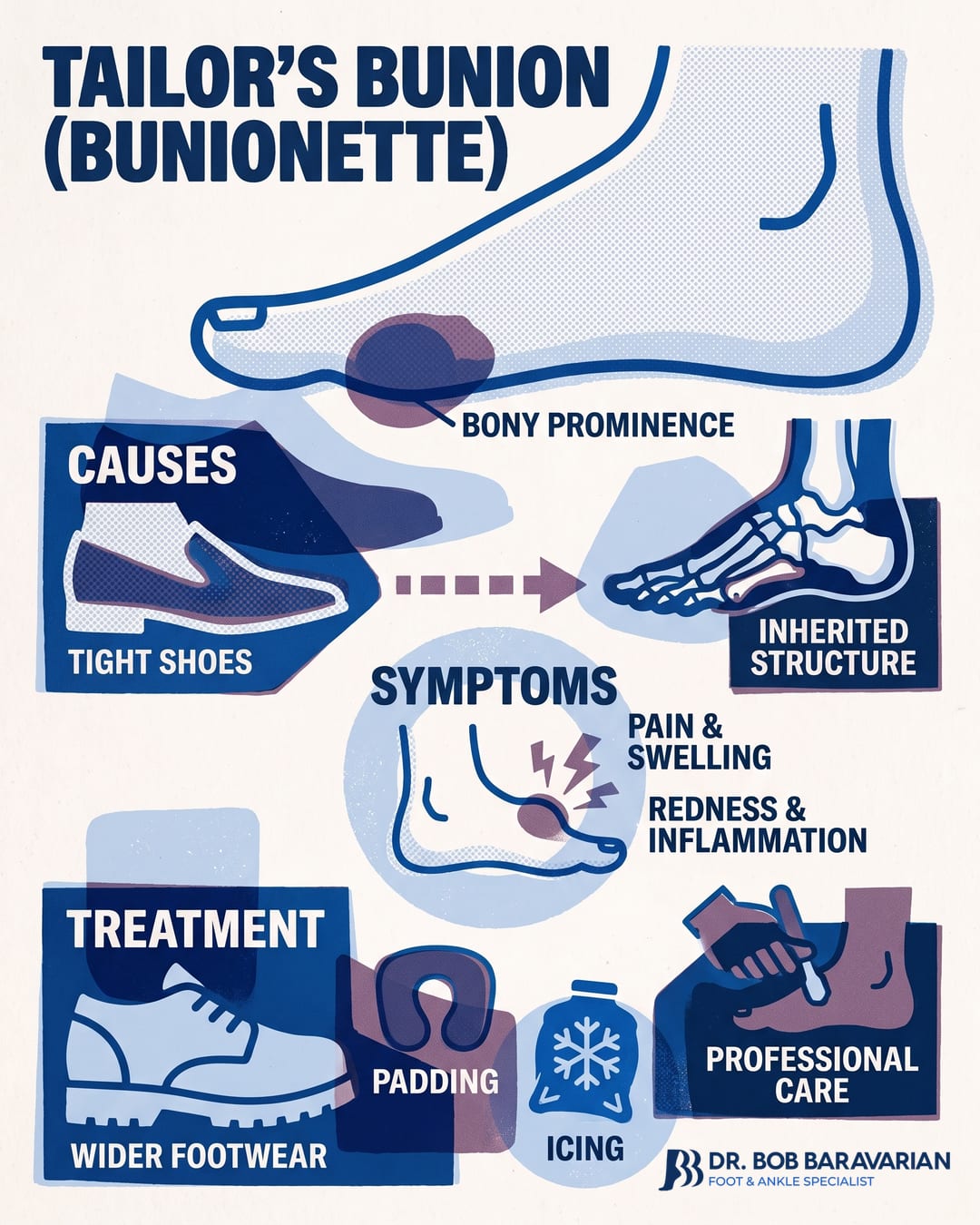
While you can’t always outsmart genetics, there’s quite a bit you can do to lower your risk of developing a tailor’s bunion – or slow one down if it’s already forming. The good news is that most prevention strategies are simple, everyday habits that don’t require any special equipment or medical intervention.
Choose footwear wisely. This is the single biggest factor you can control. Shoes with a wide, rounded toe box give your little toe the space it needs to sit naturally without being pushed inward. Avoid narrow, pointed styles and high heels that compress the forefoot and shift pressure onto the outer edge of your foot. If you’re not sure whether your feet are wide enough to warrant a wider shoe size, this guide on wide feet can help you figure that out.
Address foot mechanics early. Issues like overpronation can change how weight is distributed across your foot, placing extra stress on the fifth metatarsal. Custom orthotics or supportive insoles can help correct these imbalances before they lead to structural changes.
Stretch and strengthen regularly. Keeping the muscles and tendons around your foot flexible reduces abnormal pressure on the outer toe joint. Simple toe-spreading exercises and calf stretches go a long way toward maintaining healthy foot mechanics over time.
Act early if you notice changes. Catching a small bump early is far easier to manage than one that has progressed over the years. If your pinky toe area is starting to feel sore or look different, don’t wait – personalized care from a foot specialist can make a real difference in your long-term outcome.
Long-Term Outlook and Prognosis
The prognosis for a tailor’s bunion is genuinely encouraging. The vast majority of patients manage their condition successfully with conservative care alone and never require surgery. When patients adopt footwear modifications, orthotics, padding, and targeted exercises early, many experience a significant reduction in symptoms and a stable, comfortable foot for years.
For patients who do require surgery, outcomes are excellent. Studies consistently show high rates of patient satisfaction following osteotomy for bunionette correction, with most people returning to full activity and a wide range of footwear. Recurrence is uncommon when the underlying foot mechanics are properly addressed, particularly when custom orthotics are used post-operatively to maintain alignment.
The key message is this: a tailor’s bunion is manageable. With the right guidance and the right treatment plan, you can expect to walk comfortably, stay active, and enjoy the activities you love. Dr. Baravarian’s goal for every patient is not just pain relief today, but a healthy, functional foot for the long term.
Why Choose Dr. Bob Baravarian for Your Tailor’s Bunion Care?
When it comes to a condition as nuanced as a tailor’s bunion, your treating physician’s experience and philosophy matter enormously. Dr. Bob Baravarian is nationally recognized as a leader in foot and ankle care, and other doctors trust him with their toughest cases. His expertise spans the full spectrum of bunionette management, from the most conservative non-surgical strategies to the most advanced minimally invasive surgical corrections.

Dr. Bob takes the time to get to know every patient personally, tailoring each treatment plan as if he were caring for his own family. He will never recommend surgery unless it is truly the best option for you, and he will walk you through every alternative first. When surgery is the right choice, his pioneering non-metal, minimally invasive Ghost Surgery techniques deliver faster healing, less pain, and outstanding results that allow patients to return to the activities they love sooner than they thought possible.
Dr. Baravarian works directly with manufacturers to develop cutting-edge treatments and techniques, continuously refining his approach so that his patients benefit from the very latest advances in foot and ankle care. His practice is conveniently located throughout Southern California, making world-class bunionette care accessible wherever you are.
If you are ready to take the first step toward a pain-free foot, we would love to hear from you. Please call (855) 557-5400 or request a consultation online. You deserve expert care from a physician who genuinely cares about your outcome, and that is exactly what Dr. Bob Baravarian delivers every single day.
Frequently Asked Questions About Tailor's Bunion
Can a tailor's bunion go away on its own?

No. Because a bunionette involves a structural change in the position of the fifth metatarsal head, it will not resolve without some form of intervention. However, conservative measures can effectively control symptoms and prevent the deformity from worsening, so many patients live comfortably without ever needing surgery.
How do you shrink a tailor's bunion naturally?
You cannot reverse the bony prominence without surgery, but you can significantly reduce the inflammation and pain that make it problematic. Wide-toe-box shoes, bunionette pads, ice therapy, anti-inflammatory medications, toe spacers, and foot-strengthening exercises can help manage the condition naturally. Consistent use of these strategies can make the bump far less symptomatic.
Is a tailor's bunion the same as a bunion?
They are related but distinct conditions. A traditional bunion forms at the base of the big toe on the inner side of the foot, while a tailor’s bunion (bunionette) forms at the base of the fifth toe on the outer side. Both involve a bony deviation of a metatarsal bone, but they affect different parts of the forefoot and may require different treatment approaches.
When should I see a doctor about a tailor's bunion?
Seek an evaluation if the bump causes persistent pain, you have difficulty finding comfortable footwear, you notice redness or swelling that doesn’t settle with rest and ice, or the bump appears to be growing. Early evaluation gives you the most treatment options and the best chance of avoiding surgery.
How long does recovery from tailor's bunion surgery take?
Most patients are in a stiff-soled protective shoe for the first several weeks, with stitches removed at 10 to 14 days and any pins removed at three to four weeks. Most patients return to regular shoes within six to eight weeks. Dr. Baravarian’s minimally invasive techniques are specifically designed to shorten this timeline and minimize discomfort during recovery.