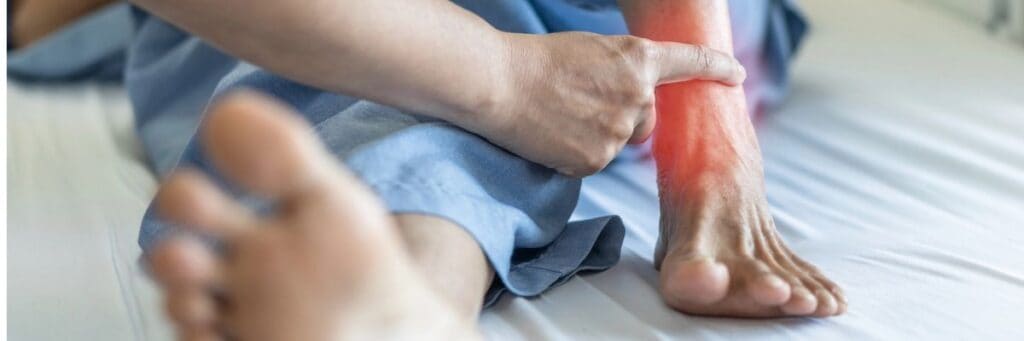
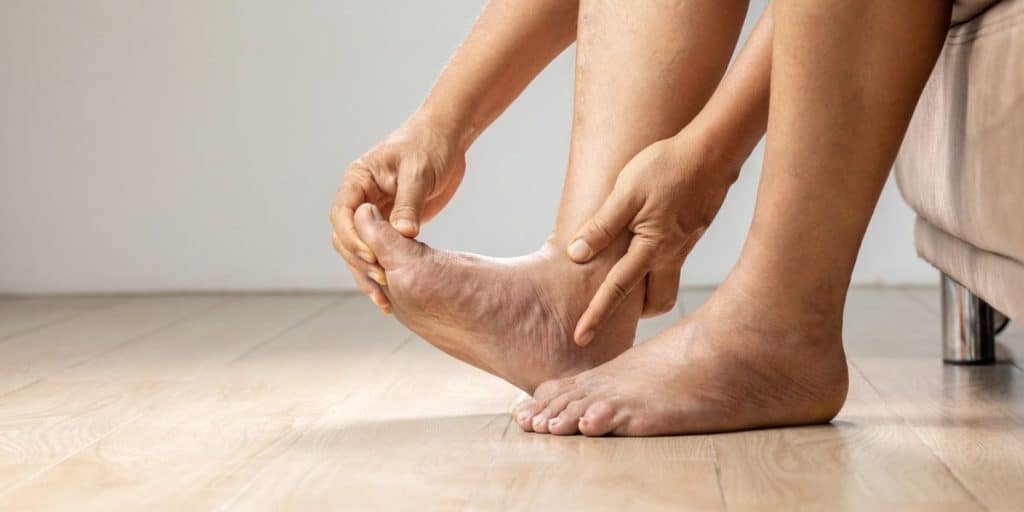
When the outer edge of your foot hurts enough to get your attention, it can often be difficult to identify the precise cause. While some of the following conditions can occur anywhere in or on your foot, they all belong on a checklist of potential sources of pain on the outside of your foot.
Stress Fractures in the Foot

Stress fractures are microscopic breaks in a bone. Stress fractures in the foot occur most frequently in the metatarsal bones (the long bones leading to your toes), the navicular bone (located in the midfoot), and the calcaneus bone (in the hindfoot). As you might have deduced from their name, stress fractures are caused by excessive repetitive stress. Over time, persistently applied excess pressure can cause tiny fissures to appear in even the healthiest bones. Just like the fractures themselves, the pain from stress fractures gradually increases in proportion to the amount of excess pressure being applied. As you might expect, foot stress fractures are most common among dedicated runners and other athletes whose sports regimens consistently apply significant pressure to their feet.
How to treat stress fractures
The triage treatment for stress fractures begins with the RICE protocol and anti-inflammatory medication. (Rice stands for rest, ice, compression, and elevation.) Your podiatrist may recommend using crutches to keep weight off your foot until the bones heal and the pain diminishes.
Recovery will include switching physical activities to those that place little or no weight-bearing stress on your feet, like swimming. In some cases, protective footwear or even a cast may be necessary to insulate the affected area from all stress. Most stress fractures are treated non-surgically, but in extreme cases, effective surgical remedies are available.
Ankle Sprain

An ankle sprain occurs when one edge of your foot rolls under while the other edge lifts up. The torque force produced by this leverage can fray or tear ligaments in your ankle (usually the anterior talofibular ligament). The consequences of an ankle sprain include immediate (and often long-lasting) pain, swelling, and bruising. When a sprain is not properly treated, the resulting chronic instability can last a lifetime.
Treatment for an ankle sprain
As with stress fractures, treatment for ankle sprains starts with the RICE regimen and anti-inflammatory medication. When dealing with an ankle sprain, the compression component of RICE should be gentle. Don’t impede your circulation by wrapping too tightly. If the sprain isn’t well on its way to complete recovery within a few days, see your podiatrist. The symptoms of the sprain may be masking an actual fracture. Some severe sprains may require surgical intervention to tighten the affected ligaments.
Cuboid Syndrome
It’s a good thing this cuboid syndrome is a rare condition, because it frequently goes undiagnosed, and the painful symptoms can linger for years. The cuboid bone is a small bone, more or less cube-shaped, on the outside of your midfoot, just behind the metatarsals. Sudden force, as from an ankle sprain, can dislodge this bone from its proper location. Or it can be displaced gradually, by stress over time, from causes like running or ballet dancing. When the cuboid bone gets out of place, the consequent pain can spread from your heel to your toes, making it difficult to locate the exact source of the pain. It takes a podiatrist or other healthcare professional to effectively diagnose and treat cuboid syndromes.
Treatment for cuboid syndrome
Initial treatment of cuboid syndrome involves getting the bone back where it belongs. Your podiatrist can choose between two manipulative maneuvers known as the “cuboid whip” and the “cuboid squeeze”. (Don’t try these at home.) Once the cuboid bone is back in place, a few weeks of rest should get you ready for renewed normal physical activity.
Peroneal Tendinosis
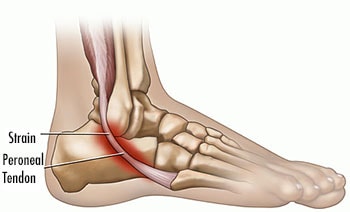
The peroneal tendons (longus and brevis) are paired cords that run down the outside of your foot, just behind the prominent ankle bone. Just as in the cuboid syndrome, either repetitive overuse, from activities like long-distance running or ballet dancing, or sudden force, like an ankle sprain incurred in a soccer match, can cause this condition. Whether the affected tendons are torn or merely strained, the symptoms can be both severe and long-lasting.
How to treat peroneal tendinosis
Because peroneal tendinosis is an overuse injury, it will usually heal with rest. So be patient and prop that foot up! Stubborn tendinosis may require the use of an ankle brace or a supportive boot for a few weeks. In extreme cases, where the tendons are torn or significantly stretched, surgical repair is usually simple and effective.
Corns and Calluses on the Foot
Calluses are areas of skin that have been thickened and toughened by repetitive friction between the skin of your foot and an exterior surface, like the inside of a badly fitting pair of shoes. They usually form in areas that take your weight when you are walking or running. Calluses are generally painless and relatively easy to eliminate.
Corns are a type of callus, also composed of dead skin. However, corns often grow on top of and between the toes, and they can intrude under the skin. Corns can be painful in and of themselves, and they can lead to infections or ulcerations of the skin.
Treatment of corns and calluses on the foot
Treatment of corns and calluses consists of removal, first of the cause, and then of the dead skin. Take steps (yeah, we know) to avoid the repetitive actions that caused the corns and calluses to develop. Properly fitting footwear and protective pads will usually eliminate or diminish the problem. If corns and calluses persist, your podiatrist can provide relief. A scalpel can be used during an in-office visit to pare down calluses and remove corns.
Your podiatrist can also instruct you on the use of patches containing salicylic acid. Orthotics are sometimes helpful in accommodating difficult corns and calluses. Don’t use any sharp instrument, like scissors, a nail clipper, or an X-Acto blade, to deal with your corns and calluses. It’s far too easy to cause an infection.
If you are experiencing problems with your feet or ankles, Dr. Bob Baravarian is here to help. As a nationally recognized podiatrist and foot and ankle specialist, he provides the most advanced care with some of the highest success rates in the nation and is a leader in the research and treatment of all foot and ankle conditions.
To schedule a consultation, please call (855) 557-5400 or make an appointment now.
Dr. Bob Baravarian is conveniently located in Los Angeles, near Cedars-Sinai Medical Center, providing expert foot and ankle care for patients throughout Southern California.