Hindfoot Instability and Flat-Foot Realignment System
Your feet are only as stable as the joint at their foundation. When the bones in the back of the foot, called the hindfoot, don’t stay where they belong, every step can strain your arch, heel, ankle, and even the joints above them.
The Phoenix Sinus Tarsi Stent (Phoenix STS) is a minimally invasive treatment that stabilizes the hindfoot from the inside. It’s often discussed as a flat-foot procedure, and it can be a great option for flat feet. But flat feet are just one sign of a bigger problem: hindfoot instability. Dr. Bob Baravarian and our team at DOCS Foot & Ankle look at the whole picture so we can treat the cause, not just the symptom.
What is hindfoot instability?
Your ankle bone (talus) sits on top of your heel bone (calcaneus). Together with the navicular bone in front, they form the talotarsal joint, the foundation that carries your body weight with every step.
In a stable foot, the talus stays balanced on the heel bone when you stand and walk. With hindfoot instability, the talus can slide forward, inward, and downward off the heel bone each time you put weight on your foot. The manufacturer of the Phoenix stent calls this recurrent talotarsal joint dislocation (RTTJD), and you’ll also hear it called talotarsal instability.
Why hindfoot instability is often missed
Hindfoot instability can be hard to see. Your foot may look perfectly normal when you’re sitting with your feet up and only shift out of alignment when you stand. That’s why a careful weight-bearing exam and standing X-rays matter.
What problems can hindfoot instability cause?
Because the hindfoot is the foundation of the foot, instability there can affect much more than your arch. It has been associated with:
- Flat feet and collapsing arches
- Overpronation (the foot rolling inward)
- Shin splints
- Foot fatigue
- Knee, hip, and lower back discomfort
These symptoms can have many causes, so having one of them doesn’t mean you have hindfoot instability. An exam with Dr. Bob is the only way to know what’s really behind your pain.
What is the Phoenix sinus tarsi stent?
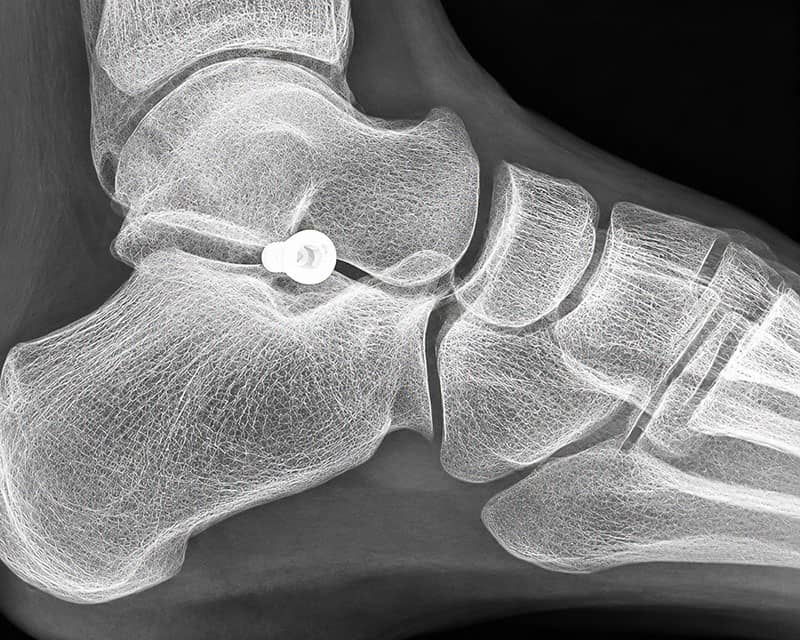
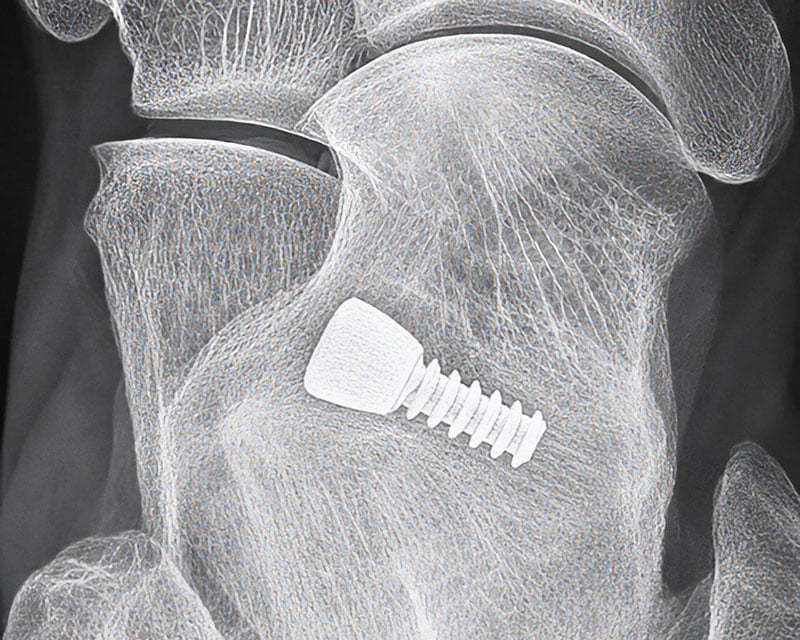
The Phoenix STS is a small titanium implant that’s placed in the sinus tarsi, a natural space between the ankle bone and the heel bone on the outer side of your foot. Astra OrthoMed designed and manufactured it, and it received FDA 510(k) clearance in August 2025.

The Phoenix stent belongs to a category of procedures called extra-osseous talotarsal stabilization (EOTTS). “Extra-osseous” means the implant sits in the space between the bones rather than being screwed into the bone itself. Learn more about the device and the condition it treats at ReAlignMyFeet.com.
How the Phoenix stent works
Think of the stent as a doorstop for your hindfoot. Once it’s in place, it keeps the talus from sliding too far forward, inward, or downward on the heel bone while still letting the joint move as it should.
That makes the Phoenix stent different from many traditional flat-foot surgeries. It:
- Doesn’t fuse any bones together
- Is placed without cutting or drilling bone
- Is designed to preserve natural joint motion
- Can be removed later if it’s ever medically necessary
Who is a good candidate for the Phoenix stent?
The Phoenix stent may be a good fit if your symptoms come from a flexible hindfoot that shifts out of place when you stand. You may be a candidate if you have:
- Flexible flat feet or overpronation
- Chronic foot fatigue
- Bunions that keep getting worse
- Posterior tibial tendon problems
- Recurrent ankle instability
- Heel or arch pain linked to poor foot alignment
The stent may be an option for both children and adults, depending on your exam and imaging. It’s usually not the right choice for a rigid flat foot or for advanced arthritis in the back of the foot. In those cases, Dr. Bob may recommend another approach, such as flatfoot reconstruction.
Do you need surgery right away?
Not necessarily. Many patients start with conservative care, such as custom orthotics, bracing, physical therapy, supportive shoes, and activity changes. If your pain keeps coming back or your symptoms get worse despite these treatments, the Phoenix stent may be the next step.
What to expect with the Phoenix sinus tarsi stent
With the Phoenix sinus tarsi stent, you can expect a guided journey from your first consultation through recovery. Our team will walk you through every step, ensuring you know what’s coming next, including detailed discussions about your symptoms, activity level, goals, and a tailored recovery plan.
Your consultation with Dr. Baravarian
Your visit with Dr. Bob starts with a conversation about your symptoms, activity level, and goals. He’ll examine your feet both sitting and standing, watch how you walk, and order weight-bearing X-rays to see how your hindfoot moves under load.
If the Phoenix stent is a good option for you, Dr. Bob will explain the benefits, risks, and alternatives so you can make an informed choice. If both feet are affected, he’ll also discuss whether to treat them at the same time or one at a time.
The Phoenix sinus tarsi stent procedure
The Phoenix stent is placed during a minimally invasive outpatient procedure, so you go home the same day. Depending on your needs, it may be done under local, regional, or general anesthesia.
Dr. Bob makes a small incision on the outer side of the foot over the sinus tarsi. He gently realigns the hindfoot and places the implant in the natural space between the bones. When the stent is done on its own, the procedure often takes only about 15-20 minutes.
The Phoenix stent can also be combined with other procedures, such as bunion or tendon repair, when that’s the best way to address your symptoms.
Recovery from Phoenix sinus tarsi stent surgery
Every patient heals differently, and Dr. Bob will give you a recovery plan tailored to you. In general, you can expect:
- Mild swelling and soreness for the first few days
- Partial weight-bearing within days for many patients
- A gradual return to normal activities over several weeks
It’s normal to notice the implant at first as your foot adapts to its new alignment. Most patients find this fades with time. Recovery may take longer if the stent is combined with other procedures.
What are the benefits of the Phoenix sinus tarsi stent?
For the right patient, the Phoenix stent offers several advantages over more invasive surgery:
- Minimally invasive: A small incision means less trauma to the foot.
- No fusion: Your joints keep their natural motion.
- No cutting or drilling bone: The implant sits in the space between the bones.
- Quick procedure: It often takes 15-20 minutes when done on its own.
- Outpatient: You go home the same day.
- Reversible: The implant can be removed if it’s ever medically necessary.
- Treats the foundation: Stabilizing the hindfoot addresses a root cause of many foot and ankle problems.
What are the risks of the Phoenix sinus tarsi stent?
Like any surgery, the Phoenix stent carries some risk. Possible complications include infection, nerve irritation or injury, implant irritation or displacement, continued pain, and the need for implant removal or further surgery. Dr. Bob will go over these with you in detail before you decide.
Why choose Dr. Bob Baravarian to solve your hindfoot instability?
Dr. Bob Baravarian, DPM, FACFAS, is a board-certified podiatric foot and ankle surgeon and Chief of Foot and Ankle Surgery at Providence St. John’s Health Center. He’s performed more than 25,000 surgeries and is known for choosing the least invasive treatment that will truly solve the problem.
Hindfoot instability often shows up alongside other issues, like bunions, tendon problems, or chronic ankle instability. Because Dr. Bob treats the full range of foot and ankle conditions, he can build a plan that addresses everything that’s causing your pain, not just one piece of it. Meet Dr. Bob to learn more about his background.
Find out if the Phoenix stent can stabilize your feet
If you’re living with flat feet, heel pain, foot fatigue, or ankles that never feel quite steady, the problem may start in your hindfoot. A simple, minimally invasive procedure could help put your foot on a stable foundation again.
Call (855) 557-5400 or request your consultation online to find out if the Phoenix sinus tarsi stent is right for you.
The Phoenix Sinus Tarsi Stent for Hindfoot Instability FAQs
Is the Phoenix stent only for flat feet?

No. Flat feet are one of the most common signs of hindfoot instability, but the Phoenix stent treats the instability itself. That’s why it may also help patients whose heel pain, bunions, tendon problems, or ankle instability stem from a hindfoot that won’t stay in place
Is the Phoenix stent a fusion?
No. The stent stabilizes the hindfoot without fusing any bones, so your joints can still move naturally
What is the Phoenix stent made of?
The implant is made of titanium. It’s intended to stay in your foot for the long term.
Will I feel the implant?
Some patients notice the implant for a while as their foot adjusts to its new position. For most people, this sensation fades over time.
Can the implant be removed?
Yes. Although the stent is meant to be permanent, it can be removed if it’s ever medically necessary.
Can both feet be treated?
Yes. If you have instability in both feet, Dr. Bob may treat them during the same procedure or one at a time, depending on what’s best for you.
Is the Phoenix stent the same as treatment for sinus tarsi syndrome?
They’re related but not the same. Sinus tarsi syndrome is pain and inflammation in the sinus tarsi, often after an ankle sprain. Hindfoot instability can cause that pain, and in those cases, stabilizing the hindfoot may help.
Will insurance cover the Phoenix stent?
Coverage depends on your insurance plan. Our team can help you understand your benefits and options before your procedure.
Is the Phoenix stent available outside the U.S.?
The Phoenix stent is FDA-cleared in the U.S., but availability varies by country. For example, it isn’t currently authorized for sale in Canada.