Dr. Bob discusses the advancements in ankle replacement surgery
Why Dr. Bob Baravarian’s Achilles repair technique sets him apart
Dr. Bob Baravarian, a nationally recognized Los Angeles foot and ankle surgeon, repairs Achilles tendon ruptures using a minimally invasive technique that requires only a 1-centimeter incision.
This advanced approach reduces scar tissue and minimizes healing complications while securely reattaching the healthy portion of the tendon to the heel bone. The result is faster recovery, less discomfort, and excellent long-term outcomes backed by Dr. Baravarian’s decades of surgical expertise.
If you’ve been told you might need ankle replacement surgery, you’re probably wondering whether there’s another way. The good news is that ankle replacement is rarely the first or only option. Most patients with ankle arthritis, cartilage damage, or chronic ankle pain have a full spectrum of alternatives to explore before anyone mentions an operating room. Dr. Bob Baravarian believes in exhausting every conservative and minimally invasive path first – because that’s exactly what he’d do if you were his own family member.
This guide walks through the full range of alternatives to ankle replacement surgery, from the most conservative non-surgical treatments to joint-preserving procedures, and clearly explains when replacement becomes the right call.
Non-surgical alternatives to ankle replacement surgery
If you’re researching ankle replacement surgery, chances are you’re hoping someone will tell you there’s another way – and honestly, that’s exactly the right instinct. Ankle replacement is a major procedure, and Dr. Bob Baravarian’s philosophy has always been to exhaust every reasonable non-surgical option before recommending surgery. Think of it as building a ladder: you only climb as high as you need to.
For many patients dealing with ankle arthritis or chronic ankle pain, the following non-surgical alternatives can provide meaningful – sometimes dramatic – relief:
Custom orthotics and bracing: Offloading pressure from a damaged joint can significantly reduce pain and slow arthritis progression. Ankle bracing adds stability for patients with ankle instability or ligament laxity, reducing pain with every step.
Activity modification and anti-inflammatory medication. Reducing high-impact activities and using NSAIDs or topical anti-inflammatories can control symptoms while other treatments take effect.
Corticosteroid and hyaluronic acid injections. Corticosteroid injections reduce inflammation quickly and can provide months of relief from ankle pain. Hyaluronic acid (viscosupplementation) lubricates the joint and is particularly useful in earlier-stage arthritis.
Platelet-rich plasma (PRP) therapy: Using your own blood platelets to stimulate healing, PRP is a regenerative option that can reduce pain and support tissue repair without surgery.
Stem cell therapy: Another regenerative approach, stem cell injections encourage the body’s natural healing response in damaged joint tissue. Learn more about how cartilage regeneration works here.
Amniotic fluid allograft and Softwave therapy: These minimally invasive, state-of-the-art regenerative treatments promote tissue healing and reduce inflammation with little to no downtime.
Weight management and physical therapy: Every pound of body weight places roughly four pounds of force on the ankle joint during walking. Even modest weight loss can dramatically reduce pain and slow arthritis progression. Targeted exercises strengthen the muscles and ligaments surrounding the ankle, improving stability and reducing the mechanical stress that accelerates cartilage damage. Therapy also addresses gait abnormalities that contribute to anterior ankle impingement and bone spur formation.
Dr. Bob takes the time to build a tailored treatment plan for every patient – exploring every non-surgical avenue with the same compassionate care he’d offer his own family before ever discussing surgery.
Biologic and regenerative alternatives
When standard non-surgical treatment stops providing adequate ankle pain relief, biologic treatments offer a powerful next step – one that competitors often cover but many ankle surgeons don’t offer in-house.
Platelet-rich plasma (PRP) is one of the most effective regenerative options for ankle arthritis. Dr. Baravarian draws a small blood sample, concentrates the growth factors, and injects them directly into the damaged joint. PRP stimulates the body’s own repair mechanisms, reducing inflammation and supporting cartilage healing without surgery. It is especially valuable for patients who are not yet candidates for replacement or who want to avoid it entirely.
Stem cell therapy and prolotherapy are additional biologic treatments that promote tissue repair in the ankle joint. Prolotherapy uses a dextrose solution to trigger a controlled healing response in weakened ligaments and tendons – useful for ankle instability that contributes to joint degeneration. These treatments reflect Dr. Baravarian’s commitment to pioneering non-metal, minimally invasive, regenerative techniques that deliver faster healing and less pain.
Platelet-rich plasma (PRP) for ankle arthritis: a regenerative alternative
If you’re looking for a non-surgical way to manage ankle arthritis before even considering a replacement, platelet-rich plasma (PRP) therapy is one of the most exciting options available today. It’s minimally invasive, uses your body’s own healing power, and – for the right patient – can deliver meaningful pain relief and improved function without a single incision.
Here’s how it works: we draw a small blood sample, then centrifuge it to concentrate the platelets. We then inject that platelet-rich solution directly into the arthritic ankle joint. Platelets contain growth factors that signal your body to reduce inflammation and begin repairing damaged tissue. It’s regenerative medicine at its most natural.
For patients with mild to moderate ankle arthritis, PRP can help calm the chronic inflammation that makes every step painful. Many patients notice a gradual improvement in stiffness and swelling over several weeks, with results that can last months. And because the treatment uses your own blood, the risk profile is remarkably low compared to surgery.
Dr. Bob Baravarian has offered PRP as part of a personalized treatment plan for ankle arthritis patients for years. He views it as one of several powerful tools – alongside stem cell therapy and amniotic fluid allograft therapy – that can help patients support cartilage health and delay or even avoid surgery altogether. If you’re not ready for ankle replacement surgery, PRP may be exactly the kind of compassionate, state-of-the-art care worth exploring first.
Minimally invasive surgical alternatives
When non-surgical and biologic treatments have been maximized but the ankle still limits your life, several surgical options preserve the joint without replacing it.
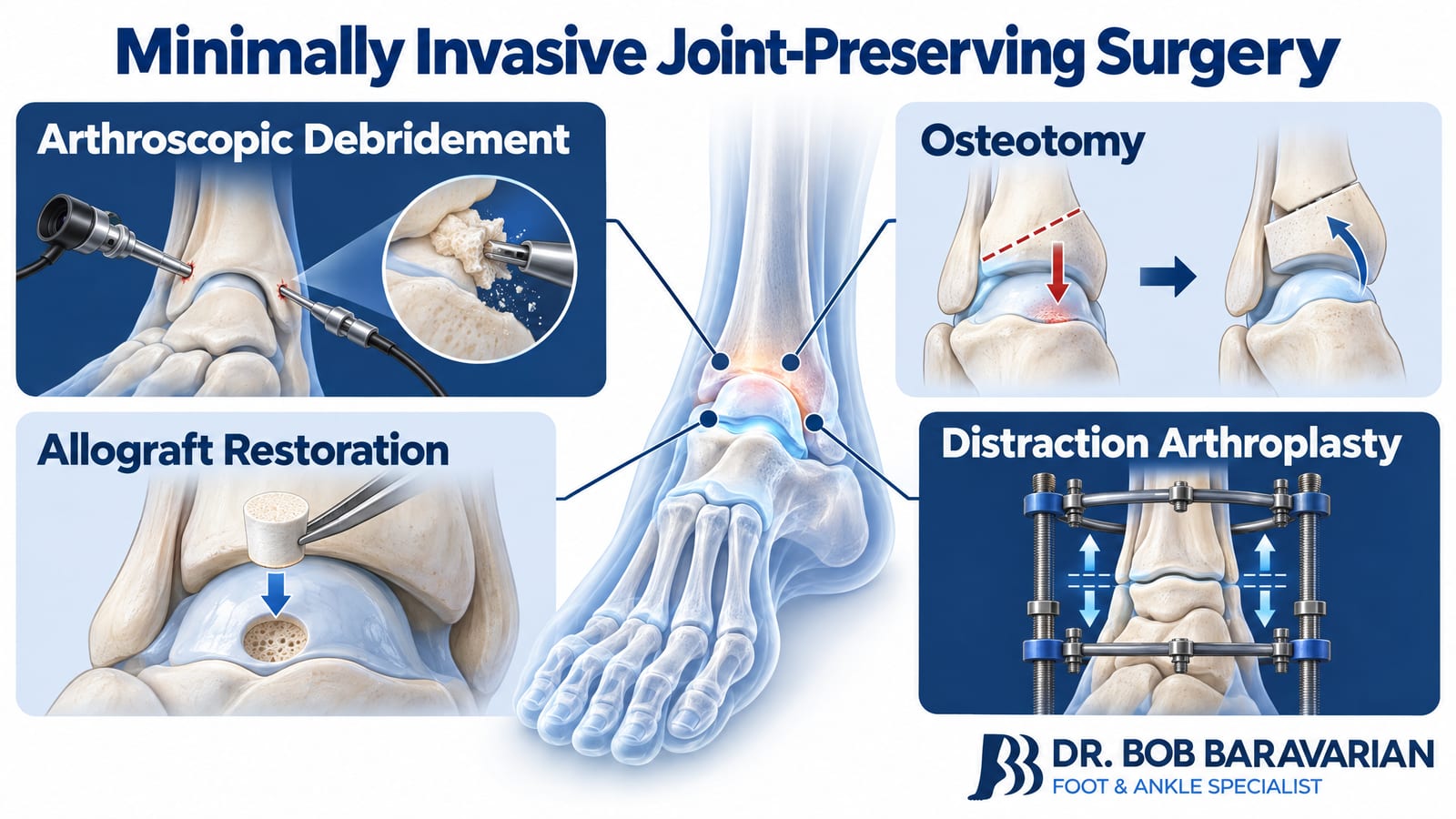
Arthroscopic debridement uses a small camera and instruments inserted through tiny incisions to remove bone spurs, inflamed tissue, and loose cartilage fragments. It is particularly effective for anterior ankle impingement and early-to-moderate arthritis where the joint surface is still largely intact.
Osteotomy realigns the bones around the ankle to shift weight-bearing away from the most damaged area of the joint – a useful option when arthritis is localized rather than affecting the entire joint surface.
Allograft cartilage restoration uses donor cartilage tissue to resurface focal areas of cartilage damage on the talus, restoring a smooth joint surface and relieving pain without removing the joint.
Ankle distraction arthroplasty: rather than replacing your damaged joint with an implant, this procedure uses an external frame to gently separate the ankle bones by just a few millimeters over several weeks. That small amount of space takes pressure off the worn cartilage and, remarkably, gives your body the chance to begin healing itself.
Research has shown that this off-loading effect can actually stimulate cartilage regeneration – something that was once considered impossible. For patients with moderate to severe ankle arthritis who aren’t quite ready for a full replacement, or who want to delay that decision as long as possible, distraction arthroplasty can provide meaningful pain relief and improved function while keeping your natural joint intact. If you’re curious about the science behind the body’s ability to regrow cartilage, this article on cartilage regeneration is a fascinating read.
The procedure is typically performed under general anesthesia, and you’ll wear the external fixator frame for around six to eight weeks. It’s not the most convenient recovery, but for the right patient it can be genuinely life-changing – preserving your own joint and potentially pushing back the need for replacement surgery by years, or even indefinitely.
Dr. Baravarian evaluates every patient individually to determine whether distraction arthroplasty, combined with regenerative therapies like PRP or stem cell treatment, could be the tailored treatment plan that keeps you out of the operating room for a major replacement procedure.
Ankle fusion as a surgical alternative to replacement
Ankle fusion (ankle arthrodesis) is the most established surgical alternative to total ankle replacement. The procedure uses pins, screws, plates, and sometimes bone grafts to permanently join the shinbone to the talus, eliminating the painful motion between arthritic surfaces.
Fusion reliably eliminates pain and has a long track record. The trade-off is permanent loss of ankle motion, which can over time increase stress on the knee and hip joints and alter gait. For younger, heavier, or highly active patients, fusion may be preferable to replacement because it carries no risk of implant failure. For older patients who prioritize natural movement and joint protection, replacement often wins. Dr. Baravarian evaluates both options carefully for every patient.
Dr. Bob explains how OSSIOfiber® fusions heal faster—with no metal left behind.
Who's a good candidate for ankle fusion surgery?
Generally, Dr. Bob reserves ankle fusions for patients who need significant strength and stability from their ankle without pain. Heavy, active, diabetic, and younger patients are the best candidates for this procedure. Unlike an artificial ankle, you don’t have to worry about wear and tear causing early breakdown, as replacements might not last more than 15 years.
Patients can still hike, walk, cycle, and stand for long periods without pain or worrying about damaging the joint.
Ankle fusions are also favored for patients with severe angular deformities of the ankle joint, which are usually not correctable with a TAA.
However, ankle fusion is not advised for patients with poor bone quality, limited blood flow in the ankle, or neuropathy (nerve damage) in the foot or ankle.
When is ankle replacement surgery unavoidable?
Ankle replacement becomes the right choice when all of the following are true: conservative non-surgical treatment has been tried for at least three to six months without adequate relief; biologic and minimally invasive options have been considered and either attempted or ruled out; imaging confirms end-stage arthritis with severe cartilage damage across the full joint surface; and the patient’s lifestyle, bone quality, and vascular health support a successful outcome.
Ankle replacement is not recommended for patients with uncontrolled diabetes, active bone infection, or peripheral arterial disease (PAD) affecting blood flow to the foot – conditions that significantly impair healing and raise the risk of serious complications.
Risks and failure rates of ankle replacement surgery
Understanding the risks of ankle replacement surgery is a big part of deciding whether it’s the right path for you – and it’s something Dr. Bob Baravarian believes every patient deserves to hear honestly before stepping into an operating room.
Total ankle replacement has come a long way, but it’s still not a perfect solution. Studies suggest that roughly 10 to 20 percent of ankle replacements require some form of revision surgery within 10 years. That’s a meaningful number, and it’s one reason why exploring every alternative first makes so much sense.
Common risks include implant loosening, where the artificial joint gradually loses its secure fit in the bone. Polyethylene wear – the breakdown of the plastic insert between the metal components – can also trigger inflammation and accelerate implant failure. Bone loss around the implant over time is another concern, which can make future ankle problems much harder to treat.
Revision surgery after a failed ankle replacement is considerably more complex than the original procedure. Surgeons often face compromised bone stock, scar tissue, and altered anatomy – all of which raise the stakes and extend recovery. In some cases, a failed replacement ultimately requires conversion to ankle fusion, which permanently limits motion.
Other risks include wound-healing complications, nerve damage, infection, and blood clots. Patients with diabetes, peripheral artery disease, or poor bone density face elevated risks across the board.
None of this is meant to frighten you – it’s meant to empower you. Dr. Bob’s philosophy is simple: surgery should only happen when it’s truly the best option. With his pioneering, state-of-the-art approach and tailored treatment plan for every patient, you can trust that he’ll thoroughly explore every alternative before recommending replacement.
Total ankle replacement vs. ankle fusion: which is better?
When surgery is necessary, the choice between replacement and fusion depends on your age, activity level, bone quality, and the pattern of joint damage. Replacement preserves natural ankle motion and protects the knee and hip from compensatory stress. Fusion eliminates pain reliably but permanently reduces motion. Dr. Baravarian evaluates both options using on-site X-ray and MRI imaging, so you never have to travel to multiple facilities for answers.
Why Dr. Baravarian is the right surgeon for this decision
The surgeon other doctors trust for their toughest cases, Dr. Baravarian holds dual training in orthopedic surgery and podiatry – a combination that gives him a uniquely complete understanding of how the foot, ankle, and lower limb work together. He takes the time to get to know every patient personally, tailoring each treatment plan as if he were caring for his own family.
His clinics offer on-site imaging, orthotic and brace manufacturing, and physical therapy – so your entire care journey, from first conservative treatment to post-surgical rehabilitation, happens in one place. Whether the answer is PRP, distraction arthroplasty, fusion, or replacement, you’ll know we’ve considered every option before you decide.
To schedule a consultation, call (855) 557-5400 or make an appointment online now. Dr. Bob Baravarian is conveniently located in Los Angeles, near Cedars-Sinai Medical Center, serving patients throughout Southern California.
Ankle replacement and ankle fusion FAQs
How long does an ankle replacement last?

The longevity of an ankle replacement, also known as total ankle arthroplasty, varies with several factors; however, these implants typically last about 15 years.
What kind of surgeon is best for ankle surgery?
A foot and ankle surgeon is usually the best physician to perform ankle replacement surgery because of their specialized training, expertise, and experience in managing the complexities of foot and ankle anatomy and related conditions. Here are the main reasons why:
- Specialized Training: Foot and ankle surgeons complete extensive medical training focused specifically on the foot and ankle. This includes finishing medical school, followed by a residency in orthopedic surgery or podiatry, and often an additional fellowship in foot and ankle surgery. This specialized training provides them with a thorough understanding of the wide range of issues that can affect the foot and ankle.
- Expertise in Foot and Ankle Anatomy: The foot and ankle are complex structures made up of many small bones, joints, ligaments, tendons, and muscles that work together to provide balance, stability, and mobility. Foot and ankle surgeons have a thorough understanding of this intricate anatomy, which is essential for successful ankle replacement surgery.
- Experience with a Range of Conditions: These surgeons treat many foot and ankle issues, from common injuries to complex deformities. This broad experience is crucial for ankle replacement surgery because the surgeon may need to manage other foot or ankle problems during the operation.
- Focused on Lower Extremity: Unlike general orthopedic surgeons, foot and ankle specialists focus solely on the lower extremity. This specialization helps them stay current with the latest techniques, treatments, and technologies, directly benefiting patients undergoing ankle replacement surgery.
- Ongoing Research and Advancements: Many foot and ankle surgeons conduct research and develop new surgical techniques and prosthetics, continually advancing ankle replacement surgery.
How do I find a reputable ankle replacement surgeon near me?
Finding a top ankle replacement surgeon near you involves several steps to ensure you receive the best care possible. Here’s a guide to assist you in your search.
- Start with Referrals: Ask your primary care doctor for a list of ankle replacement surgeons. You can also ask family, friends, and other healthcare professionals for recommendations.
- Research the Surgeon’s Credentials: Look for board certification, which is an important indicator of the surgeon’s skills, training, and experience. You can check websites like the American Board of Podiatric Medicine.
- Consider the Surgeon’s Experience: Experience matters a lot, especially for specialized procedures like ankle replacement surgery. Find out how many ankle replacement surgeries the surgeon has performed and inquire about complication rates.
- Evaluate Hospital Quality: Consider the quality of the hospital or clinic where the surgeon practices. Hospital quality matters because top-rated hospitals generally have fewer complications and better survival rates.
- Check Patient Reviews: Reading what other people have to say about a doctor can provide insight into how the doctor practices medicine, as well as how their medical practice is operated.
- Consult Your Insurance: To receive the most insurance benefits and pay the least out-of-pocket for your care, you may need to choose a surgeon who participates in your plan.
- Schedule a Consultation: Once you narrow down your list, schedule consultations to meet and interview the surgeons. Prepare a list of questions to ask, focusing on their experience with ankle replacements and your specific needs.
Your decision should depend on your specific condition, how comfortable you are with the surgeon, and the quality of care they can offer.