Diane discusses her revision surgery with Dr. Baravarian.
What is revision toe surgery?
Unfortunately, not all toe surgeries result in a painless, nicely aligned toe. There are several reasons why toe surgery may fail, including the development of new structural problems, joint stiffness, and persistent pain.
Repairing a bad surgery requires a great doctor-patient relationship and careful consideration to correct the procedure appropriately.
Fortunately, Dr. Bob Baravarian is one of the most technologically advanced providers of foot and ankle care in the country.
Dr. Bob Baravarian specializes in revision surgery, providing state-of-the-art care in a friendly, professional, and comfortable environment.
What causes failed bunion surgery and how is it revised?
Revision bunion surgery addresses cases where initial bunion surgery (hallux valgus) has failed, often due to new structural problems, patient factors, or poor surgical decisions/technique. A failed bunionectomy may be caused by malunion, nonunion, undercorrection, or overcorrection of the big toe joint. Dr. Baravarian specializes in performing bunion-revision surgery, with revisions accounting for almost one-third of his bunion surgeries. Choosing an experienced revision surgeon is essential to understand and address the shortcomings of the original surgery, with treatment options depending on the bunion's severity, your age, general health, activity level, and the condition of the bones and tissue.
A failed bunionectomy may be caused by:
- Malunion and nonunion. This refers to the bone healing improperly, leading to misalignment or deformity, causing foot pain and discomfort
- Undercorrection of the big toe joint. Surgeons decide on the best method based on clinical and imaging findings (x-rays). If they choose a technique that’s not strong enough, they might not completely resolve the issue, which could cause the bunion to recur.
- Overcorrection. The overcorrection of hallux valgus deformities occurs less frequently than undercorrection but typically leads to more severe symptoms and higher patient dissatisfaction. While undercorrection is often due to incorrect surgical planning, overcorrection is usually caused by technical mistakes made by the surgeon.
Dr. Baravarian specializes in performing bunion-revision surgery. Many of our patients come to us after previous bunion surgeries at other facilities have proved unsuccessful. Revisions account for almost one-third of our bunion surgeries.
It is essential to choose your revision surgeon wisely. Bunion revision surgery requires the necessary experience and skill to understand and address the shortcomings of the original surgery.
Failed hammertoe surgery can be revised, though it is one of the most challenging problems to treat, often due to insufficient bone or incorrect cuts. Corrections are performed using special pins and, if necessary, bone grafts to adjust the length and alignment of the toes. Dr. Bob Baravarian has conducted extensive research and refined many techniques for correcting hammertoe surgery failures, making him one of the very best hammertoe treatment specialists in California.
How is failed hammertoe surgery revised?
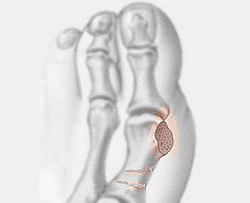
Regrettably, not all hammertoe surgeries result in a successful outcome with an aligned, pain-free toe.
Revision of hammertoe surgery is one of the most challenging problems to treat. Often, there has been so much bone removal that there is not enough left to correct the deformed toes. In some cases, there is enough bone, but the cut made is incorrect, resulting in poor toe alignment.
Fortunately, most cases of hammertoe deformity can be corrected with proper treatment. Corrections are performed using special pins and, if necessary, bone grafts to adjust the length and alignment of the toes.
Failed fusion surgery, though rare, can be caused by poor fixation, inadequate bone and cartilage removal, infection, or overall poor healing from the initial surgery. Our podiatrists have extensive knowledge of revision procedures for significant toe problems, including conservative orthotic and shoe modifications, revision osteotomy, fusion procedures, and implant replacement options.
What causes failed fusion surgery and how is it repaired?
Although it is rare for joint fusion surgery to need revision, there are several causes of fusion failure. These include poor fixation, lack of proper bone and cartilage removal from the joint, infection, and overall poor healing from the initial surgery.
Our podiatrists have extensive knowledge of revision procedures for significant toe problems, including conservative orthotic and shoe modifications, revision osteotomy, fusion procedures, and implant replacement options.
Why choose Dr. Baravarian for surgery revision?
Dr. Bob is one of the most technologically advanced podiatry clinics in the country.
He understands and treats foot and ankle conditions, utilizing all modern treatment modalities to their fullest advantage—these range from conservative techniques to foot surgery using state-of-the-art technologies. Bob Baravarian provides expert knowledge when evaluating and performing revisions to foot and ankle surgeries performed elsewhere.
Dr. Bob Baravarian is conveniently located in Los Angeles, near Cedars-Sinai Medical Center, providing expert foot and ankle care for patients throughout Southern California.
Sources
-
Shirzad K, Kiesau CD, DeOrio JK, et al. Lesser toe deformities. J Am Acad Orthop
Surg. 2011;19:505–14. -
Kelikian H. Deformities of the lesser toes. In: Hallux valgus, allied deformities of the
forefoot and metatarsalgia. Philadelphia: W.B. Saunders; 1965. p. 292–304. -
Arthroscopic-assisted correction of claw toe or overriding toe deformity: plantar plate
tenodesis. Arch Orthop Trauma Surg. 2007; 127: 823-826