 The Achilles is the strongest and thickest tendon in the human body, but it is the most commonly ruptured. Achilles ruptures occur most frequently in the third to fifth decades of life with a 70 percent higher predilection for males in comparison to females.
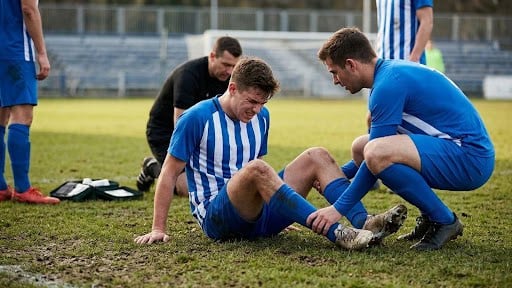
Achilles tendon tears are normally associated with traumatic sports injuries in non-athletes who overexert themselves during increased activity. We often refer to these individuals as weekend warriors. The most common cause of ruptures in these patients is the degenerative process. The otherwise sedentary lifestyle of these patients leads to poor vascularity in an area that already has a decreased blood supply. With the addition of activity and increased tension on the tendon, the Achilles ruptures.
Professional athletes are also susceptible to Achilles ruptures through indirect stress trauma. The associated mechanism of action can be a violent dorsiflexion against a plantarflexed ankle joint or a knee that forcefully extends while the foot is in a dorsiflexed position. It is rare for direct trauma, such as a laceration or direct pressure, to lead to an Achilles tendon injury. Other external factors that increase the risk of ruptures include fluoroquinolone therapy and steroid use, which weakens the collagen cross-linking of tendon fibers.
The Achilles tendon is approximately 15 cm long and begins near the middle portion of the calf. It is a connection between the two heads of the gastrocnemius muscle and soleus muscle, forming the triceps surae. A few centimeters prior to its insertion, the tendon fibers twist approximately 90 degrees in a counterclockwise rotation.1 The tendon then inserts to the middle third portion of the posterior calcaneus. Blood supply to the Achilles tendon is mainly from the musculotendinous junction of the triceps surae and the paratenon surrounding the tendon.4 Therefore, it is important to try to salvage the paratenon during repair.
The Achilles tendon has an area that is 2 cm to 6 cm proximal to its insertion with decreased vascularity, referred to as the “watershed area.” It is innervated by the sural nerve, which courses along the lateral aspect of tendon. This nerve is susceptible to damage during initial injury as well as surgical management. The medial aspect of the Achilles tendon has the plantaris tendon running along it in certain cases. The plantaris tendon is absent about 7 percent of the time or damaged during a rupture. However, when it is present, one also can use the plantaris tendon for augmentation.
What To Look For In The Clinical Exam And Diagnostic Imaging
Patients will describe an auditory pop and snap feeling during the time of injury. Many times, they feel someone has hit or kicked them in the calf. Patients often present with an apropulsive gait to the affected extremity with the inability to rise on their toes, a phenomenon often referred to as Jack’s test.
Clinically, patients have increased edema and ecchymosis to the injured area. A gap or defect referred to as a “palpable dell” is present at the location of the rupture. Interestingly, patients complain of pain initially but after a day or two, pain decreases significantly.
Clinical tests include the Thompson-Doherty test. When performing this test, one squeezes the calf while the patient lies in a prone position. If this does not elicit a significant passive plantarflexion, the clinician should suspect a rupture. Be mindful that this test could serve as a false negative due to the long flexor tendons firing if one squeezes more than the calf complex. For this reason, the clinician should always do a comparison to the contralateral limb.
Another test that one can perform is O’Brien’s test, in which one places needles along the Achilles tendon. When one squeezes the proximal tendon, the distal needles should not move, which represents a rupture.
One can diagnose the majority of Achilles tendon ruptures clinically. However, if the clinical exam is not obvious or if there has been a period of time between injury and presentation, diagnostic imaging may be necessary. Take an X-ray to rule out any osseous pathology such as an avulsion fracture of the posterior calcaneus. One can also assess the disruption of Kager’s triangle through radiograph views.
Ultrasound is an efficient in-office evaluation that can help confirm a rupture. With this modality, the clinician can perform dynamic testing. If limited gapping is present and tendon ends are well opposed, there is potential for treating the patient conservatively with the foot cast in a plantarflexed position. If there are any questions regarding whether the patient has a partial or complete rupture, the level of rupture or the amount of defect, magnetic resonance imaging (MRI) may be helpful mainly for surgical planning.
Is Conservative Treatment Worthwhile?
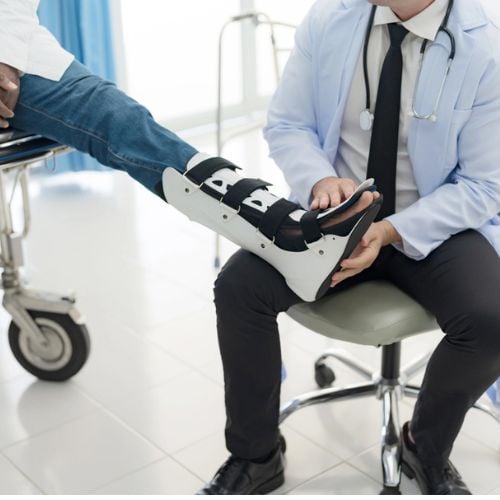
The conservative treatment option for an Achilles tendon rupture is suitable for certain patients. This includes immobilization in a cast or a controlled ankle motion (CAM) boot. However, patients who receive conservative treatment are immobile for a longer duration of time in comparison to those who have surgery. The amount of time for immobilization varies but is generally up to eight to 12 weeks. During this time, the tendon may heal in an elongated position and anatomic tension does not occur as with surgical intervention. This leads to increased weakness and a prolonged duration of rehabilitation.
Research has also shown an increased incidence of re-ruptures in up to 15 percent of patients treated with immobilization. Therefore, one should reserve conservative treatment for elderly and non-surgical candidates.
A Closer Look At Percutaneous Achilles Repair
Surgical intervention is the preferred treatment for Achilles tendon ruptures. The ideal time for surgery is within the first seven to 14 days of injury because there is increased vascularity to the area. Also, surgical repair can be difficult during the first seven days due to the amount of fraying at the rupture site. Waiting until the 14-day mark allows the tendon ends to remodel, thus making the repair a little less challenging.
Currently, there are multiple open repair procedures. The three most successful procedures that allow for a stronger construct are the Bunnell, Kessler and Krackow suture techniques. The concept of all these repairs involves end-to-end apposition of the ruptured tendon. The drawback of open techniques is that the surgeon needs to visualize healthy tendon proximal and distal to the rupture site, and this requires a larger incision of at least 6 cm. This leads to more dissection and increased adhesions to the Achilles tendon.8 With a larger incision, one has to also be wary of wound healing issues and infection.
Due to these complications, a newly available option is the Percutaneous Achilles Repair System (Arthrex). The traditional incision with this system is generally a 2 cm transverse incision slightly proximal to the rupture site. However, the senior author generally makes a 2 cm longitudinal incision for better visualization and exposure. This gives the surgeon the option to convert the surgery into an open repair if necessary by extending the incision.
Proceed to identify the paratenon. Limited dissection preserves vascularity. Use an Allis clamp to pull down a healthy portion of the proximal end of the tendon. Then place the product’s Achilles Jig System inside the paratenon. It is important that the jig device is within the paratenon so the sutures also remain within the paratenon once one removes the jig system. This decreases the risk of sural nerve damage. Initially narrow the inner arms of the jig system to accommodate for the tendon and then widen the arms to allow for easy proximal advancement.
Pass guide pins with nitinol loops through the numbered holes with associated colored sutures. Most surgeons will generally use holes one through five. One pearl is to apply manual tension on the tendon in order to facilitate central placement of the guide pins within the tendon. We also leave the first guide pin in hole one while passing a second guide pin and sutures through holes two to five. This prevents the tendon from retracting and holds the jig system in place. After passing all the sutures through the proximal tendon end, place the jig system into the distal portion of the tendon and repeat all the steps.
Then organize sutures in the order you placed them in. Use the blue FiberWire (Arthrex) to place a locking stitch on the medial and lateral aspect of both ends of the ruptured tendon. This results in a stronger repair. Before tying the FiberWires, maximally plantarflex the foot at about 20 to 30 degrees. Remember that over time, the tendon will stretch. Tie the FiberWires that are farthest away from the rupture site first. This will pull the healthier tendons closer together. For increased stability, tie the blue locking stitch next and follow this with the white FiberWire. This suture technique reduces bulbous Achilles tendon formation because it eliminates the need to place FiberWire across the rupture site. The surgeon can actually debride some of the devitalized tissue. We tend to leave some tissue so there is no void between the tendon ends. Lastly, reapproximate the paratenon and skin.
A Guide To Postoperative Management
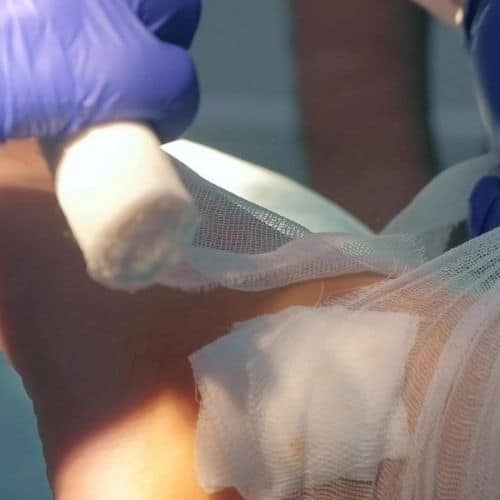
Place the patient into an equinus cast at about 20 to 30 degrees of plantarflexion depending on the amount of correction. Five days postoperatively, remove the cast and evaluate the incision site to make sure no dehiscence or infection has occurred. Then place the patient into a second cast at about 10 to 15 degrees of plantarflexion.
At the two-week post-op visit, remove the sutures and place the patient into a neutral cast. At the four-week post-op visit, obtain an ultrasound to make sure the tendon ends are well opposed with no gapping. Then place the patient into a controlled ankle motion (CAM) walker with heel lifts. The patient can bear minimal weight, about 20 percent of normal, and slowly transition into walking. Physical therapy generally starts at four weeks as well. Remove the CAM walker at six to eight weeks. The patient can return to activity at about 12 weeks. Full recovery often occurs in six months.
In Conclusion
Achilles tendon ruptures are becoming a more common pathology in the population today. Surgical management of ruptures has consistently proven to be the best treatment option in comparison to conservative care. Studies have shown that patients treated with an open repair procedure have a lower incidence of re-rupture rates, increased tendon strength and earlier mobilization. However, the traditional open repair techniques can be complicated with increased adhesions, wound healing issues and infection.
The Percutaneous Achilles Repair System offers a great solution to such complications. It provides a stronger repair with surgeons able to place locking stitches through healthy, non-injured tendon, all within a 2 cm incision. This minimal incision decreases wound complications and infections while preserving the vascularity of the tendon. New advancements in surgical techniques also include the Achilles Midsubstance SpeedBridge (Arthrex). It utilizes the Percutaneous Achilles Repair System technique for the proximal end of the rupture with two SwiveLocks into the calcaneus for the distal portion. This procedure utilizes a knotless technique that results in an even stronger repair. Both the Percutaneous Achilles Repair System and Achilles Midsubstance SpeedBridge are great options for percutaneous repair of Achilles tendon ruptures.
Dr. Baravarian is an Assistant Clinical Professor at the UCLA School of Medicine. He is the Chief of Podiatric Foot and Ankle Surgery at the Santa Monica UCLA Medical Center and Orthopedic Hospital, and is the Director of the University Foot and Ankle Institute in Los Angeles.
Dr. Redkar is a Fellow at University Foot and Ankle Institute in Los Angeles.