 Plantar fasciitis is a well-known pathology to most foot and ankle specialists. A systematic review performed by Landorf and Menz found that heel pain affects 7 percent of people over 65, makes up one-quarter of all foot injuries in runners, and accounts for 1 million physician visits per year.
A second prevalent chief complaint in many offices is ankle sprains and/or ankle instability. In the United States, there are an estimated 23,000 ankle sprains per day and 5,000 in the United Kingdom.2 Up to 55 percent of these patients go untreated by medical professionals. Approximately 20 percent of conservatively treated patients go on to experience chronic problems related to lateral ankle instability.
Static stability of an ankle results from osseous and ligamentous structures, but muscle activation controls dynamic support. The peroneal tendons, specifically, play an important role in preventing excess supination of the foot on uneven terrain and therefore protect against lateral ankle injuries.
A study in the Journal of Athletic Training looked at muscle activation in patients with or without chronic ankle instability.4 Researchers used surface electromyography to study how many neurons are activated during muscle contraction to determine the amount of muscle fibers that were contracting in patients with and without chronic ankle instability. The study found that the peroneus longus was firing earlier in the gait cycle and 13 percent longer than those with healthy ankles. The authors believed that because the tendon was firing earlier, there was less protection against pathological inversion motion at the point of heel strike and the tendon would become more easily fatigued.
We believe that to compensate for an unstable ankle, the increased activation of the peroneal tendons places a pronatory effect on the foot, causing increased strain on the plantar fascia and resulting in plantar fasciitis symptoms.
A Guide To The Diagnostic Workup And Conservative Treatment
When a patient presents to our institution with plantar heel pain, we perform a relatively common evaluation including testing the location of pain. As one would test for a positive Tinel’s sign to rule out tarsal tunnel or pain with lateral heel compression to rule out a stress fracture, we also include anterior drawer testing for excessive ankle inversion.
If the ankle is unstable, we have the patient stand to evaluate proprioception and balancing. We often find ankle instability and plantar fasciitis coexist quite frequently. If the patient’s ankle is unstable yet asymptomatic, treatment usually requires a change in shoe gear, supportive inserts, home stretching, ice, massage and physical therapy. Physical therapy for this patient would not only be geared toward addressing the tight posterior musculature and thickened plantar fascia, but ankle instability as well.
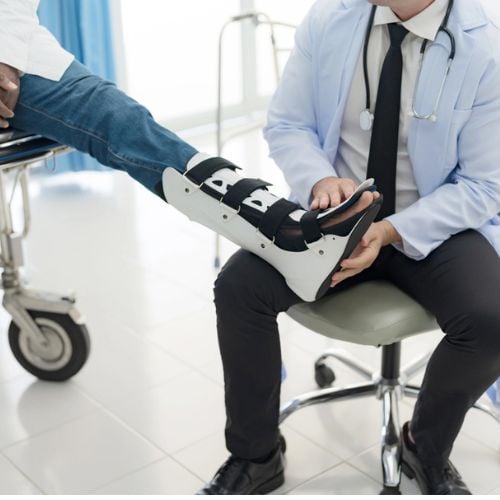
In a patient with plantar fascia pain whose ankle is also symptomatic, grossly unstable or fails first-line treatment, we will then provide an ankle brace. Our theory is that with additional ankle support, the peroneal tendons do not have to activate earlier and fire longer. This would then halt extra pronatory movement and decrease strain to the medial plantar fascia. With the use of the ankle brace in conjunction with the other plantar fascia treatment modalities noted above, we have seen improvement in our patients’ symptoms.
Key Pearls On Effective Surgical Treatment
For those patients with ankle instability, peroneal spasm and chronic plantar fasciitis who fail conservative treatment, we recommend not only addressing the chronic plantar fascia pain but the ankle instability as well. Preoperatively, obtain magnetic resonance imaging (MRI) to evaluate the plantar fascia tissue as well as the ankle ligaments, peroneal tendons and talar dome. Tendon and ankle pathology often occur with patients who have chronic ankle instability along with multiple inversion injuries. Therefore, it is important to address those associated pathologies at the time of surgery. In surgery, we first perform the lateral ankle stabilization followed by the plantar fascia treatment.
In the absence of tendon pathology, we perform a slightly curved incision around the anterior aspect of the fibula. Dissection protects the sural nerve inferiorly. Once the retinaculum is visible, transect it along the anterior fibula. This allows visualization of the anterior talofibular and calcaneofibular ligaments, and protection of the peroneal tendons inferiorly. Then incise the ligaments at the fibular attachment and resect the excessive, diseased ligament tissue. Drill two 2.4 mm anchors into the fibula at the insertion of the anterior talofibular and calcaneofibular ligaments. We then perform a pants-over-vest suturing technique using the attached 2-0 FiberWire (Arthrex) to reapproximate the ligament to the fibula all while maintaining the foot in a dorsiflexed position. Then repair the retinaculum using another 2-0 FiberWire in a pants-over-vest technique. Approximate the skin and direct attention to the plantar fascia.
In a patient who has mild scarring of the fascia and short-term symptoms, we would perform a Topaz (Smith and Nephew) microplantar fasciotomy along with ankle stabilization. Then after a sterile prep, draw a 20- to 24-hole grid over the area of maximal pain at the medial origin of the plantar fascia. The holes are approximately 5 mm apart. We then puncture the skin with a 0.062-inch Kirschner wire so the Topaz wand can gain access to the fascia. Then introduce the wand to the level of fascia and activate the wand, extending it through the fascia. Do this at each hole in the grid.
For patients who have experienced long-term symptoms and severe thickening of the fascia visible on MRI, we recommend a medial band release. Our preferred method is to perform an endoscopic plantar fasciotomy. We make a small 1 cm incision to the medial aspect of the heel at the insertion of the plantar fascia and then bluntly dissect to the fascia itself. We then insert the Centerline (Arthrex) arthroscope and blade to allow for direct visualization, and subsequently transect the medial half of the plantar fascia.
What An Appropriate Postoperative Protocol Entails
Postoperatively, place the patient in a cast and emphasize strict non-weightbearing to protect the ankle repair for three weeks. Gradually transition the patient to a weightbearing cast or boot to complete a five- to six-week total healing period. Physical therapy usually begins at weeks three to five. After six to eight weeks, the patient will continue with physical therapy and will transition to a supportive shoe with full-time use of an ankle brace. At 10 to 12 weeks, patients will gradually return to normal activities and continue use of the ankle brace during exercise or increased activity for six months to a year.
In Conclusion
We believe plantar fasciitis can be caused or aggravated by the pronatory forces of the peroneal tendon that attempt to stabilize an unstable ankle. Evaluating a patient with plantar fasciitis for ankle instability takes very little time and can answer many questions regarding the cause of pain and lack of improvement with initial conservative care. Furthermore, improvement in pain while using an ankle brace is a good indication that the patient will do well with lateral ankle stabilization.
In addition to addressing the cause of the pathology (lateral ankle instability) to prevent recurrence, one also needs to treat the chronic thickening and scarring of the plantar fascia by stimulating healing with a micro-fasciotomy or complete medial band fascia release.
Dr. Baravarian is an Assistant Clinical Professor at the UCLA School of Medicine. He is the Chief of Podiatric Foot and Ankle Surgery at the Santa Monica UCLA Medical Center and Orthopedic Hospital, and is the Director of the University Foot and Ankle Institute in Los Angeles.
Dr. Bohman is a Fellow at University Foot and Ankle Institute in Los Angeles.
References
- Landorf KB, Menz HB. Plantar heel pain and fasciitis. Clin Evid. 2008; 2(1):1-16.
- Hertel J. Functional anatomy, pathomechanics, and pathophysiology of lateral ankle instability. J Athl Train. 2002; 37(4):364.
- Miller A, Raikin SM. Lateral ankle instability. Oper Tech Sports Med. 2014; 22(4):282-289.
- Feger MA, Donovan L, Hart JL, Hertel J. Lower extremity muscle activation in patients with or without chronic ankle instability during walking. J Athl Train. 2015; 50(4):350-357.